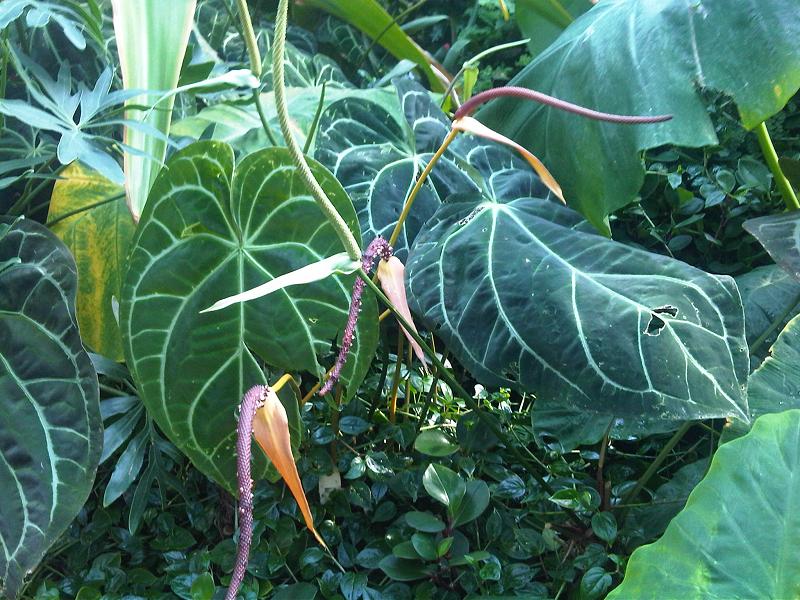
Photo: Emőke Dénes, CC BY-SA 4.0 · source

Houseplant · Araceae
Crystal anthurium
Anthurium crystallinum
In other languages: Anthurium (Nederlands) · Anthurium (Français)
Anthurium crystallinum is a foliage plant from the tropical rainforests of Central America and north-western South America, including Panama and Colombia. It is grown not for its flower but for its large, heart-shaped leaves: velvety dark green with striking silvery-white veins, as if inlaid with crystal. New leaves unfurl bronze to pinkish purple and only turn dark green after a few weeks. It is related to the familiar flamingo flower with its red spathes, but its own inflorescence is an inconspicuous green spike. It needs warmth, high humidity and an open compost, and rewards you with some of the most beautiful leaves you can grow indoors.
Caution: All parts of the plant contain calcium oxalate crystals. If chewed or swallowed, they cause a burning sensation, swelling of the mouth and throat, and drooling. Keep the plant out of reach of children, cats and dogs, and wash your hands after contact with the sap.
Light
Partial shade
no harsh midday sun
Moisture
Normal
no wet feet
Legal basis
Potting soil
Hardiness
Houseplant
min. 15 °C
Size
0.6 m
tall, 0.6 m wide
| Height | 0.6 m |
|---|---|
| Poisonous to people and pets | Yes, take care with children and pets |
Identify
Crystal anthurium: how do you recognise it?
- Habit
- Compact, upright plant up to 60 cm high and wide, with a short stem and leaves on long stalks.
- Leaves
- Heart-shaped, 20–40 cm long, velvety dark green with silvery-white veins; the underside is paler.
- New leaves
- They unfurl bronze to pinkish purple and turn dark green within a few weeks.
- Flower
- A narrow, greenish spathe with a slender spike: inconspicuous and fairly rare indoors.
- Roots
- Thick, fleshy roots and aerial roots on the stem, which need air: in dense, wet compost they rot.
Plants: March–May
In your garden
Why grow it?
- Spectacular leaves: velvety dark green with silvery-white veins.
- Every new leaf is a small event: it unfurls bronze to pinkish purple and slowly changes colour.
- Evergreen and decorative all year round.
- Ideal for a warm bathroom or a bright spot out of strong sun.
- A showpiece in any collection of foliage plants.
Crystal anthurium: where does it grow best?
- Plenty of light but no direct sun: 1–2 m from an east- or west-facing window, or behind a net curtain at a south-facing window.
- An open, chunky mix of orchid bark, potting compost, perlite and a little sphagnum moss, slightly acid to neutral.
- Evenly and slightly moist: never soggy and never bone dry.
- Warm: 18–27 °C, never below 15 °C and free from draughts.
- High humidity, at least 60 %: a bathroom with daylight, a tray of wet clay pebbles or a humidifier helps.
- Light
- Bright, out of direct sun
- Potting soil
- Airy, humus-rich compost
- Acidity
- Acid or neutral
- Watering
- Moderately
- Size
- 0.6 m tall, 0.6 m wide
- Temperature
- Minimum 15 °C
Goes well with
- Calathea: Another foliage plant that loves warmth, shade and humid air.
- Philodendron: Green, glossy leaves that make the silvery foliage stand out.
- Ferns: Fine, fresh greenery that needs the same humid air.
- Nerve plant: A low foliage plant with coloured veins, for the same bathroom.
Maintenance
Crystal anthurium: when and how to plant it?
Plant in March–May.
- Repot in March–May, every two years or when roots grow out of the pot.
- Choose a pot with drainage holes, only slightly larger than the previous one; an orchid pot or a pot with extra holes lets air reach the roots.
- Make an open mix of orchid bark, potting compost, perlite and a little sphagnum moss.
- Ease the plant out of its pot, remove old compost and rotten roots, and set it at the same depth as before.
- Fill in without pressing the compost down hard and water with lukewarm, soft water.
- After repotting, keep it somewhere warm and out of the sun for a few weeks.
Care
- Watering
- Water when the top 2–3 cm feel dry, using lukewarm rainwater or soft water. Do not leave water in the saucer.
- Humidity
- Keep it high: stand the pot on a tray of wet clay pebbles, group plants together or use a humidifier. Dry air causes brown edges.
- Feeding
- From March to September, a low dose of liquid feed for foliage plants every four weeks.
- Leaves
- Dust the velvety leaves with a soft brush; wiping or leaf shine damages them.
- Repotting
- Every two years in spring, in a fresh, open mix.
Tip: Keep it in a warm bathroom with daylight or on a tray of wet clay pebbles, and use an open, chunky mix of bark and potting compost. That way it gets the warmth and humid air it needs.
Crystal anthurium: when to prune it?
When: It is not pruned. Simply cut off old, yellow or damaged leaves, at any time of year.
How:
- Cut an old or yellow leaf off at the base of its stalk with sharp, clean scissors.
- Remove a flower spike if you want the plant to put its energy into new leaves.
- Wear gloves: the sap can irritate the skin.
Caution: The sap contains calcium oxalate crystals that irritate skin and mucous membranes. Wash your hands after pruning.
Propagation
- Dividing offsets
- When repotting in spring, carefully separate side shoots that have their own roots and pot them up individually in an open mix.
- Stem cuttings
- A piece of stem with a few aerial roots and at least one leaf will root in moist sphagnum moss, somewhere warm under plastic.
Crystal anthurium: how does it get through the winter?
- A houseplant that stays indoors all year, never below 15 °C.
- It grows more slowly in winter: water a little less and do not feed.
- Central heating dries the air: pay extra attention to humidity and do not put it above a radiator.
- Move it slightly closer to the window for more light, but not against cold glass.
Diseases and pests
- Brown leaf edges: Air too dry or irregular watering. Raise the humidity and water evenly.
- Yellow leaves: Too much water or compost that is too dense, sometimes with root rot. Let the compost dry out a little more and repot in a more open mix.
- Torn new leaves: In dry air, new leaves sometimes stick together and tear as they unfurl. Keep the humidity high.
- Red spider mite and thrips: Fine pale speckles and webbing, or silvery flecks on the leaves. Spray the leaves with lukewarm water and keep the air humid.
- Scale and mealybugs: Brown scales or white woolly tufts on stalks and leaves. Remove them gently with a cotton bud.
Through the year
- January: Rest. Less water, no feed. Watch out for dry air.
- March: Repot or divide offsets. Start feeding.
- April: Repot. New leaves unfurl.
- May: Last month for repotting. Water evenly.
- June: Growth. Feed every four weeks.
- July: Growth. Protect from direct sun. Dust the leaves.
- September: Last feed.
- October: Less water. Raise humidity once the heating goes on.
- December: Rest. Keep away from cold glass and radiators.
Use
Edible and useful
Not edible. All parts of these houseplants of the arum family are poisonous: the sap is full of needle-shaped crystals (calcium oxalate) which, when chewed, at once cause burning pain and swelling of the lips, mouth and throat, with drooling and sometimes vomiting. Most at risk are cats, which like to chew trailing stems and leaves, dogs, and young children playing on the floor. Hang climbers and trailing plants out of their reach, clear up cut stems and cuttings straight away, and do not put a glass of cuttings in water where a cat drinks from it. Wear gloves when pruning and repotting, do not rub your eyes, and wash your hands afterwards. If your cat or dog drools or its mouth swells, call your vet. If any is swallowed, call a poison centre (in Belgium 070 245 245) or your doctor at once.
You and this species
Did you know?
- The name Anthurium comes from the Greek anthos (flower) and oura (tail), after the tail-like flower spike.
- The species name crystallinum refers to the shiny, silvery veins: the leaf looks as if it were inlaid with crystal.
- It is related to the flamingo flower sold by florists, but that one is grown for its red spathe and this one for its leaves.