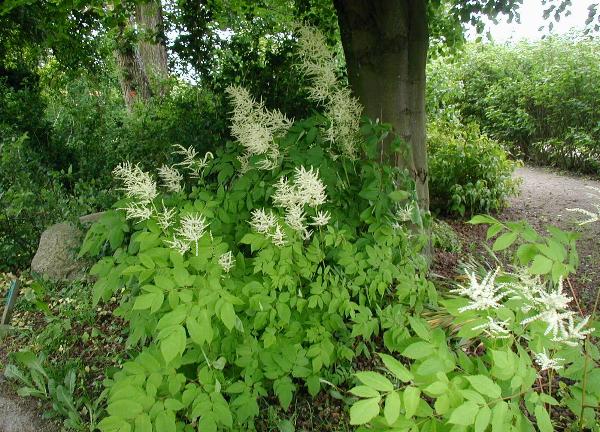
Photo: Sten Porse, CC BY-SA 3.0 · source

Perennial · Rosaceae
Goat’s beard
Aruncus dioicus
In other languages: Geitenbaard (Nederlands) · Barbe de bouc (Français)
Goat’s beard is a large perennial from damp mountain woods in Europe, Asia and North America. It forms a big clump of finely divided, fern-like leaves, topped in June and July by plumes of hundreds of tiny, creamy white flowers, up to 1.5–2 m tall. It looks like a giant astilbe, but belongs to the rose family. Gardeners value it as a stately focal point for partial and full shade, where few other plants flower so tall and so freely. The cultivar ‘Kneiffii’ stays much shorter and has finely cut leaves.
Light
Partial shade or shade
tolerates little sun
Moisture
Normal to wet
must not dry out
Legal basis
Loam or clay
any pH
Hardiness
Fully hardy
down to -35 °C
Size
1.8 m
tall, 1.2 m wide
Flowering
June–July
| Pruning months | March and July |
|---|---|
| Height | 1.8 m |
| Native to Belgium | No, planted |
| Good for bees, butterflies and birds | Yes, for bees |
| Poisonous to people and pets | Not known to be poisonous |
| Flowering | June–July |
Identify
Goat’s beard: how do you recognise it?
- Habit
- Large, upright clump 1.5–2 m tall and 1–1.2 m wide.
- Leaves
- Large, two or three times pinnate with toothed leaflets; fresh green, yellow in autumn.
- Flower
- Plumes 30–50 cm long with hundreds of tiny flowers, in June–July. Male and female flowers are on separate plants.
- Colour
- Creamy white; male plumes are fuller and whiter, female ones greener and more drooping.
- Fruit
- Only female plants form small seed capsules, which turn brown in autumn.
- Roots
- A woody, deep rootstock that becomes large and tough over the years.
Flowering: June–July · Plants: March–April and October · Pruning: March and July
In your garden
Why grow it?
- A stately focal point of 1.5–2 m for partial and full shade.
- Large, creamy white plumes in June–July, especially full and airy on male plants.
- Bees and other insects visit the flowers.
- Attractive, fern-like leaves that often turn yellow in autumn.
- Fully hardy and very long-lived: it only gets better with the years.
Goat’s beard: where does it grow best?
- Partial or light shade; in full sun only if the soil always stays moist.
- Humus-rich, fertile loam or clay, from slightly acid to chalky.
- Normally moist to wet: it does well beside a pond or stream.
- Allow 1–1.2 m per plant; it takes a few years to reach full size.
- Light
- Partial shade and shade
- Soil type
- Loam or clay
- Acidity
- Not fussy
- Moisture
- Normal or wet
- Size
- 1.8 m tall, 1.2 m wide
- Hardiness
- Hardy (to -35 °C)
Goes well with
Maintenance
Goat’s beard: when and how to plant it?
Plant in March–April and October.
- Plant in March–April or in October.
- Dig a generous hole, twice as wide as the pot, and mix in a few spadefuls of compost or leaf mould.
- Set the plant at the same depth as it was in the pot and firm the soil well.
- Keep 1–1.2 m away from other plants: moving it later is difficult.
- Water in thoroughly straight away and keep the soil moist during the first year.
- Spread a thick layer of leaf mould around the base.
Care
- Water
- Never let it dry out. Water thoroughly in dry spells, especially in the first years.
- Feeding
- A layer of compost or well-rotted manure in spring.
- Mulching
- A layer of leaf mould in spring keeps the soil cool and moist.
- Spent plumes
- Cut them off after flowering, especially on female plants, which otherwise self-seed. Or leave them if you like the brown plumes.
- Support
- Not needed: the stems are sturdy enough.
Tip: Place it in front of a dark background, such as a hedge or an evergreen shrub: the creamy plumes will then light up the shade.
Goat’s beard: when to prune it?
Pruning months: March and July.
When: After flowering, in July, cut off the plumes. Remove the old stems and dead leaves in March.
How:
- Cut the spent plumes off just above the leaves.
- Leave the leaves until they turn yellow and die back in autumn.
- In March, cut the old stems off just above the ground, before the new shoots appear.
Caution: If you do not want seedlings, cut the plumes off female plants before the seed ripens.
Propagation
- Division
- In March or October: cut or saw a piece with buds off the woody rootstock and replant it straight away. On old plants this is hard work; young clumps divide more easily.
- Seed
- Sow the fine seed from female plants in a pot in autumn or spring and barely cover it. Seedlings turn out male or female.
Goat’s beard: how does it get through the winter?
Hardy to −35 °C.
- Fully hardy, to about −35 °C: in Belgium no protection is needed.
- The top growth dies back and the plant sprouts again in spring.
- Leave the stems until March: they mark the spot and protect the rootstock.
Diseases and pests
- Sawflies: Larvae that strip the leaves in no time, often in May–June. Pick them off by hand; the plant usually regrows.
- Scorched leaves: Brown, dried leaf edges in sun and drought. Water, mulch the soil and choose a shadier spot when planting.
- Slugs: They eat the young shoots in spring. Pick them off in the evening.
- Seedlings: Female plants self-seed. Cut the plumes off in time or weed out the seedlings while small.
Through the year
- March: Cut down old stems. Give compost. Plant.
- April: Plant. New shoots appear; watch for slugs.
- May: Apply mulch. Watch for sawflies.
- June: Flowering begins. Water in dry spells.
- July: Flowering. Cut off spent plumes.
- August: Water in dry spells.
- October: Plant or divide. Yellow autumn colour.
- November: The leaves die back; leave the stems standing.
Use
Good for wildlife
- Bees
- Nectar and pollen for honeybees and wild bees.
You and this species
Did you know?
- The species name dioicus means ‘dioecious’: male and female flowers grow on separate plants.
- It looks very much like a giant astilbe, but it is related to the rose, not to astilbe.
- The name goat’s beard refers to the long, beard-like plumes.