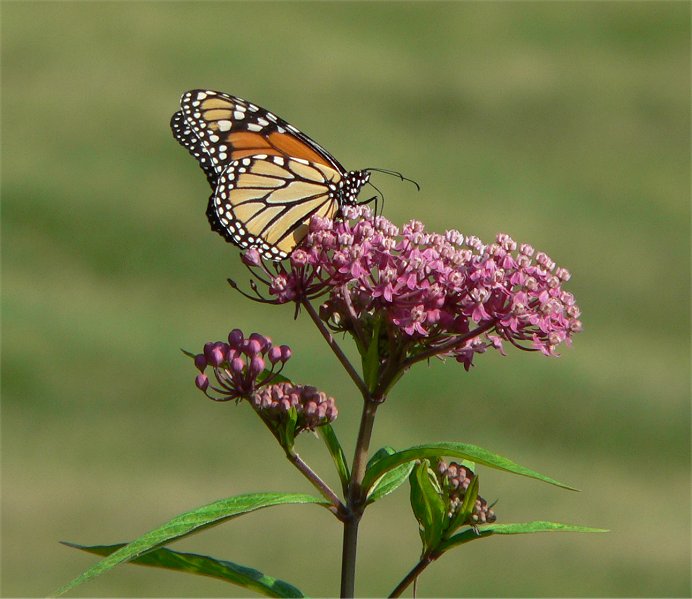
Photo: The original uploader was Teune at English Wikipedia., CC BY-SA 3.0 · source

Perennial · Apocynaceae
Swamp milkweed
Asclepias incarnata
In other languages: Rode zijdeplant (Nederlands) · Asclépiade incarnate (Français)
Swamp milkweed comes from eastern and central North America, where it grows in wet meadows, marshes and along streams. It is an upright, clump-forming perennial of 1–1.2 m with narrow, lance-shaped leaves. From July to September, the tops of the stems carry flat clusters of small pink to mauve flowers with a lovely vanilla scent. Butterflies, bumblebees and bees flock to them. They are followed by narrow, upright seed pods filled with silky down. Well-known cultivars are the white ‘Ice Ballet’ and the pink ‘Cinderella’.
Caution: All parts are poisonous if eaten, and the milky sap can irritate the skin and eyes. Dangerous for children, cats, dogs and grazing animals such as horses, sheep and cattle. Wear gloves when pruning and do not plant it in a field where animals graze.
Light
Full sun
warm and bright
Moisture
Normal to wet
must not dry out
Legal basis
Loam, clay or peat
acid to neutral
Hardiness
Fully hardy
down to -35 °C
Size
1.2 m
tall, 0.6 m wide
Flowering
July–September
| Pruning months | March and August |
|---|---|
| Height | 1.2 m |
| Native to Belgium | No, planted |
| Good for bees, butterflies and birds | Yes, for bees and butterflies |
| Poisonous to people and pets | Yes, take care with children and pets |
| Flowering | July–September |
Identify
Swamp milkweed: how do you recognise it?
- Habit
- Upright clump 1–1.2 m tall and 60 cm wide, with sturdy stems that branch near the top.
- Leaves
- Narrow and lance-shaped, 7–15 cm long, opposite; smooth, fresh green.
- Flowers
- Small, star-shaped flowers in flat clusters 5–8 cm across at the stem tips; pink to mauve, from July to September.
- Scent
- Sweet, of vanilla, especially in warm weather.
- Fruit
- Narrow, upright pods 5–10 cm long that split in autumn and release flat seeds with white, silky down.
- Sap
- Stems and leaves contain some milky sap, which is poisonous and can irritate the skin.
Flowering: July–September · Sowing: March–April · Plants: May–June · Pruning: March and August
In your garden
Why grow it?
- One of the best nectar plants for butterflies, bumblebees and bees in late summer.
- The pink flower clusters smell sweetly of vanilla, especially on warm days.
- Also grows in wet soil at the edge of a pond or in a rain garden, where few other flowering plants cope.
- A long flowering season from July to September, followed by decorative pods with silky down.
- Does not run: it forms a clump, unlike common milkweed.
Swamp milkweed: where does it grow best?
- Full sun: in shade it flowers poorly and the stems flop.
- Humus-rich loam, clay or peaty soil, acid to neutral.
- Moist to wet: at the edge of a pond, in a ditch or in a border that does not dry out. Ordinary garden soil also works if you water in dry spells.
- Space plants 50–60 cm apart; the clump widens over the years.
- Mark the spot, because it only appears late in spring.
- Light
- Sun
- Soil type
- Loam, clay or peat
- Acidity
- Acid or neutral
- Moisture
- Normal or wet
- Size
- 1.2 m tall, 0.6 m wide
- Hardiness
- Hardy (to -35 °C)
Goes well with
- Purple loosestrife: Purple spikes for the same wet, sunny spot.
- Joe Pye weed: Tall pink flower heads in late summer, also a butterfly magnet.
- Meadowsweet: Creamy plumes for a wet border.
- Coneflower: Flowers at the same time and attracts the same insects.
- Siberian iris: Narrow, upright leaves and blue flowers in June, for the same wet, sunny spot.
Maintenance
Swamp milkweed: when and how to plant it?
Plant in May–June.
- Plant in May–June, once the soil has warmed up.
- Dig a hole twice as wide as the pot and mix in compost or leaf mould.
- Set the plant at the same depth as it was in the pot and firm the soil well.
- Keep 50–60 cm between plants.
- Water generously straight away and keep the soil moist for the first few months.
- A mulch of compost or shredded leaves keeps the soil cool and moist.
Care
- Water
- The soil must never dry out. In an ordinary border, water generously every week in dry summers.
- Feeding
- A layer of compost in May; nothing more is needed.
- Deadheading
- Remove spent flower clusters for a longer display, or leave a few for the decorative pods.
- Support
- Usually not needed in sun; in a windy spot a plant support helps.
- Patience
- It only starts growing in May or even June. Do not dig or plant in that spot while nothing is visible.
Tip: Push a cane into the ground beside the plant in autumn: it only appears in May or June, and this way you will not dig it up by mistake in spring.
Swamp milkweed: when to prune it?
Pruning months: March and August.
When: In August, remove spent flower clusters if you do not want seed pods. Cut back the dead stems in March.
How:
- Cut spent clusters back to the next leaf; side shoots will then keep flowering.
- If you let pods ripen, cut them off before they split if you do not want seedlings.
- In March, cut the old stems down to 5–10 cm above the ground; that way you can see at once where the plant is.
Caution: Wear gloves when pruning: the milky sap can irritate the skin and eyes.
Propagation
- Seed
- Keep the seed moist in the fridge for 3–4 weeks, then sow it indoors at room temperature in March–April. Plant out in May–June; seedlings often flower only in their second year.
- Division
- In spring, as the shoots appear, carefully divide an older clump with a sharp spade. It dislikes being moved, so keep large pieces with plenty of roots.
- Cuttings
- In June, take 10 cm cuttings from young, non-flowering shoots and insert them in moist cutting compost.
Swamp milkweed: how does it get through the winter?
Hardy to −35 °C.
- Very hardy, to about −35 °C: no protection needed in Belgium.
- It dies back completely in autumn and overwinters below ground.
- Leave the stems until March: they mark the spot and give shelter to insects.
Diseases and pests
- Aphids: Bright yellow aphids in dense colonies on the stem tips and pods. Spray off with water; ladybirds and parasitic wasps clear them up.
- Slugs and snails: They eat the young shoots in May–June. Pick them off in the evening and protect the shoots.
- Red spider mite: Fine yellow speckles on the leaves in hot, dry weather. Water and mist the foliage.
- Not coming up: It starts late; wait until June before deciding it has died. Real losses are mostly caused by summer drought.
Through the year
- March: Cut down old stems. Chill the seed and sow indoors.
- April: Sow indoors. Keep the plant’s spot clear.
- May: The first shoots appear. Plant. Add compost.
- June: Plant. Watch for slugs. Water in dry spells.
- July: Flowering begins. Vanilla scent and plenty of butterflies.
- August: Full flower. Remove spent clusters. Water in dry spells.
- September: Last flowers. Seed pods ripen.
- October: Collect seed before the pods split. Leave the stems standing.
Use
Edible and useful
Not edible. All parts of milkweed are poisonous: the white milky sap contains cardiac glycosides, compounds that, like those of foxglove, act on the heart; monarch butterfly caterpillars store them and become poisonous themselves. Swallowing any causes vomiting, stomach ache and diarrhoea, and in larger amounts an irregular heartbeat. Grazing animals, especially sheep but also horses and cattle, can become seriously ill from it, even from dried plants in hay: do not plant it in or beside a field. The sap irritates the skin and eyes: wear gloves, do not rub your eyes and wash your hands after cutting back. If any is swallowed, call a poison centre (in Belgium 070 245 245) or your doctor at once.
Good for wildlife
- Bees
- Nectar and pollen for honeybees and wild bees.
- Butterflies
- Nectar for butterflies.
You and this species
Did you know?
- In North America it is a food plant of the monarch butterfly: the caterpillars eat the leaves and store the toxins, which makes them poisonous to birds in turn.
- The pollen is packed in tiny sacs that catch on insects’ legs and so travel to the next flower.
- Its relative, common milkweed (Asclepias syriaca), is on the European list of invasive alien species; swamp milkweed forms a clump and does not spread.