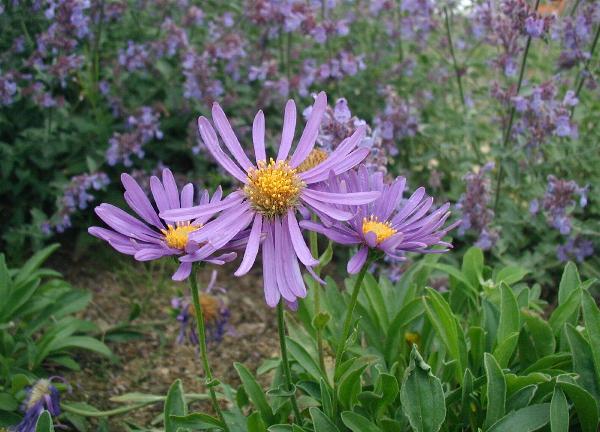
Photo: Wikimedia Commons, CC BY-SA 3.0 · source

Perennial · Asteraceae
Alpine aster
Aster alpinus
In other languages: Alpenaster (Nederlands) · Aster des Alpes (Français)
Alpine aster is a low perennial from the daisy family, native to the mountains of Europe and Asia, from the Alps and the Pyrenees to Siberia. It forms a rosette of spoon-shaped, hairy, grey-green leaves, from which sturdy little stems of 15–25 cm rise from May to July. Each stem carries a single large, daisy-like flower 3–5 cm across, with violet-blue ray petals around a golden yellow centre. That makes it flower months earlier than the familiar autumn asters. There are cultivars in several colours, such as the dark purple ‘Dunkle Schöne’, the pink ‘Happy End’ and the white ‘Albus’.
Light
Full sun
warm and bright
Moisture
Dry to normal
no wet feet
Legal basis
Sand or loam
neutral to chalky
Hardiness
Fully hardy
down to -35 °C
Size
0.25 m
tall, 0.4 m wide
Flowering
May–July
| Pruning months | July |
|---|---|
| Height | 0.25 m |
| Native to Belgium | No, planted |
| Good for bees, butterflies and birds | Yes, for bees and butterflies |
| Poisonous to people and pets | Not known to be poisonous |
| Flowering | May–July |
Identify
Alpine aster: how do you recognise it?
- Habit
- Low clump 15–25 cm tall and about 30–40 cm wide.
- Leaves
- Spoon-shaped to lance-shaped, hairy and grey-green, mainly in a basal rosette.
- Flower
- Usually one flower head 3–5 cm across per stem, violet-blue, pink or white with a golden yellow centre, from May to July.
- Fruit
- Small seeds with a tuft of hairs, spread by the wind.
- Roots
- A compact, branching rootstock that spreads slowly.
Flowering: May–July · Sowing: March–April · Plants: March–April and September–October · Pruning: July
In your garden
Why grow it?
- An aster that already flowers in late spring, from May to July.
- Large, colourful flowers on a small plant: ideal for the rock garden and the front of the border.
- Bees and butterflies are drawn to the open flowers with their yellow centre.
- Fully hardy, even in severe winters.
- Lovely in a pot or trough on the patio, as long as the compost drains well.
Alpine aster: where does it grow best?
- Full sun; in shade it flowers poorly.
- Sandy or loamy soil, neutral to chalky, that drains well.
- Dry to moderately moist; it dislikes wet winters.
- Ideal in a rock garden, on a wall, in a gravel bed or at the front of the border.
- Plant 25–30 cm apart, in groups for the best effect.
- Light
- Sun
- Soil type
- Sand or loam
- Acidity
- Neutral or chalky
- Moisture
- Dry or normal
- Size
- 0.25 m tall, 0.4 m wide
- Hardiness
- Hardy (to -35 °C)
Goes well with
- Pinks: Low, scented cushions on the same dry, chalky soil.
- Carpathian bellflower: Blue or white bells that carry on flowering after the aster.
- Thyme: A fragrant carpet between the clumps, also loved by bees.
- Houseleek: Neat rosettes as a contrast in the rock garden.
Maintenance
Alpine aster: when and how to plant it?
Plant in March–April and September–October.
- Plant in March–April or in September–October, when the soil is not too wet.
- On heavier soil, work coarse sand or fine gravel into the planting spot.
- Dig a hole slightly larger than the pot.
- Set the plant at the same depth as it was in the pot: the rosette should sit on the soil, not in it.
- Firm in and water. In the first year, water now and then in dry weather.
- Mulch with fine gravel; it keeps the rosette dry and clean.
Care
- Watering
- Once established, only during long droughts.
- Feeding
- A thin layer of compost in March is enough; too much fertiliser gives floppy plants.
- Faded flowers
- Remove them regularly: it keeps the plant tidy and can extend flowering a little.
- Rejuvenating
- Divide the clump every three years, otherwise the centre goes bare and it flowers less.
- In a pot
- Use potting compost with one third coarse sand and keep the pot dry in winter.
Tip: Divide the clump every three years in March or September and replant only the young outer pieces: it then stays compact and flowers freely.
Alpine aster: when to prune it?
Pruning months: July.
When: After flowering, in July, cut the flower stems back to the rosette.
How:
- During flowering, regularly remove faded flowers, stem and all.
- After flowering, cut all the flower stems back to the leaf rosette.
- Leave the rosette in place over winter; in March, just remove dead leaves.
Propagation
- Division
- Every three years, in March–April or in September, lift the clump, split it into pieces with their own roots and replant the young outer pieces.
- Seed
- In March–April, sow indoors on sandy seed compost, cover lightly and keep cool and light. Plant out once the seedlings are sturdy. Cultivars do not always come true from seed.
Alpine aster: how does it get through the winter?
Hardy to −35 °C.
- Fully hardy, to about −35 °C: no protection is needed in Belgium.
- Wet soil is the biggest danger: make sure drainage is good.
- Remove fallen leaves from the rosette, so it does not rot.
- In a pot or trough: stand it under a roof overhang, so the compost does not get waterlogged.
Diseases and pests
- Powdery mildew: White powder on the leaves, especially in dry summers. It is less prone than autumn asters; leave space around it and cut off affected leaves.
- Slugs: They eat young rosettes and flower buds. Pick them off in the evening; a gravel mulch helps.
- Rot: Brown, rotting rosettes in wet winters. Plant in free-draining soil with gravel.
- Bare centre: After a few years the middle of the clump dies. Divide it every three years.
Through the year
- March: Sow indoors. Plant or divide. Remove dead leaves.
- April: Sow indoors. Planting. Watch out for slugs.
- May: Flowering begins.
- June: In flower. Remove faded flowers.
- July: End of flowering. Cut back the flower stems.
- August: Water during long dry spells.
- September: Plant or divide.
- October: Planting. Top up the gravel mulch.
- November: Remove fallen leaves from the rosettes.
Use
Good for wildlife
- Bees
- Nectar and pollen for honeybees and wild bees.
- Butterflies
- Nectar for butterflies.
You and this species
Did you know?
- When the asters were reclassified, many North American species, such as the autumn asters, were given a new genus name (Symphyotrichum). The alpine aster was allowed to keep the name Aster.
- Unlike most asters, it usually carries just one flower per stem.
- In the mountains it grows on chalky grassland and rocky slopes, up to above the tree line.