Photo: Cliff from I now live in Arlington, VA (Outside Washington DC), USA, CC BY 2.0 · source

Houseplant · Begoniaceae
Polka dot begonia
Begonia maculata
In other languages: Begonia (Nederlands) · Bégonia tacheté (Français)
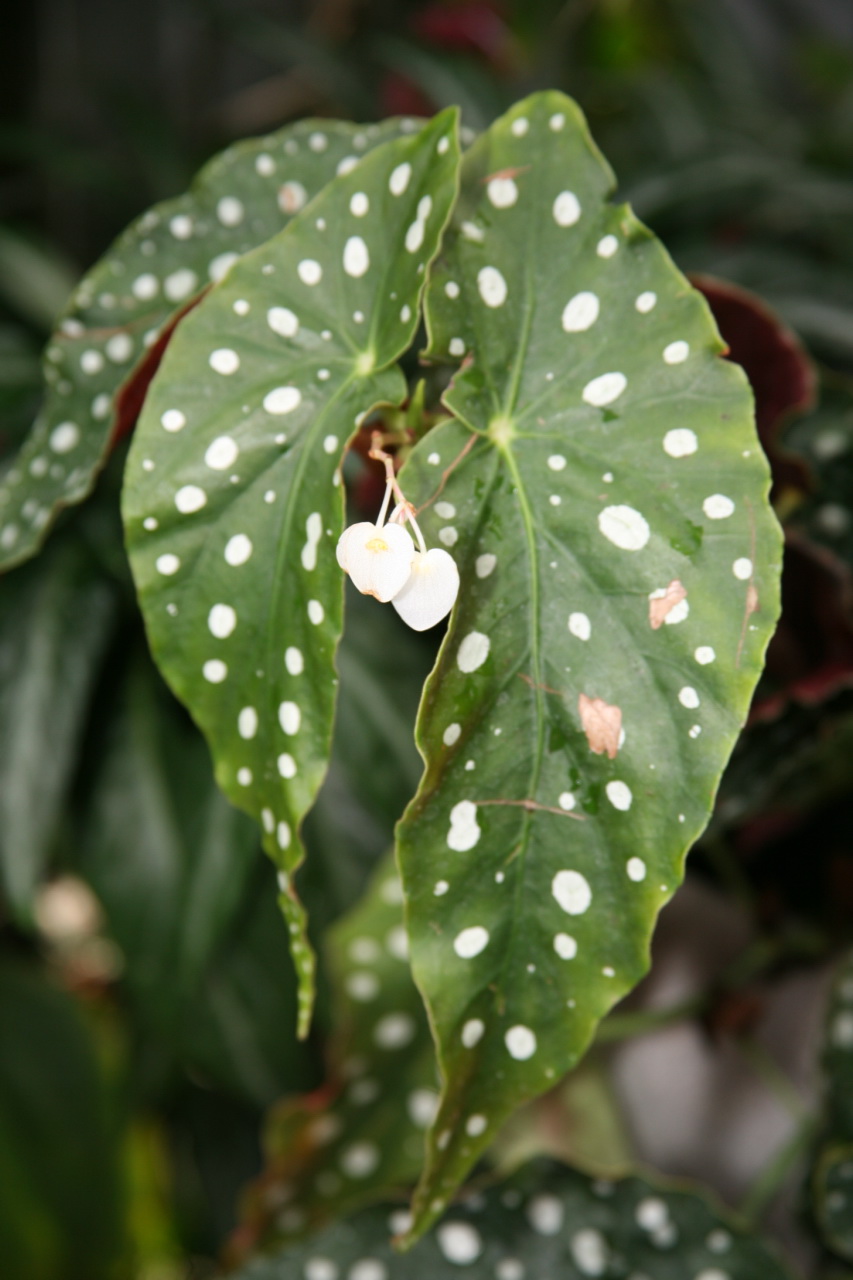
The polka dot begonia, Begonia maculata, comes from the Atlantic rainforest of south-eastern Brazil. It is a cane begonia with upright, jointed stems reminiscent of bamboo, up to about 1 m tall. The long, lopsided leaves are olive green with silvery-white spots on top and deep red underneath. From May to September small clusters of white to pale pink flowers hang from the stems. The best-known cultivar is ‘Wightii’, with plenty of spots and white flowers. Enthusiasts love its graphic leaves, which stand out in any interior.
Caution: Begonias are toxic to cats and dogs, and to children who chew them: they contain oxalates, especially in the roots. Chewing causes irritation of the mouth and throat, drooling and vomiting. Keep it out of reach of children and pets.
Light
Partial shade
no harsh midday sun
Moisture
Normal
no wet feet
Legal basis
Potting soil
Hardiness
Houseplant
min. 13 °C
Size
1 m
tall, 0.5 m wide
Flowering
May–September
| Pruning months | March |
|---|---|
| Height | 1 m |
| Poisonous to people and pets | Yes, take care with children and pets |
| Flowering | May–September |
Identify
Polka dot begonia: how do you recognise it?
- Habit
- Upright cane begonia with jointed, bamboo-like stems, up to about 1 m tall and 50 cm wide.
- Leaves
- Long and lopsided, 10–20 cm, with a slightly wavy edge; olive green with silvery-white spots, the underside deep red.
- Flower
- Hanging clusters of small white to pale pink flowers with yellow stamens, from May to September.
- Stems
- Succulent and somewhat brittle; over time they become top-heavy and need support.
- Roots
- Fine and fairly shallow: it likes a pot that is not too large.
Flowering: May–September · Plants: March–April · Pruning: March
In your garden
Why grow it?
- Striking leaves: silver spots on olive green, with a deep red underside.
- Flowers from May to September with hanging clusters of white to pale pink flowers.
- Grows quickly into a slender, upright plant that takes up little floor space.
- Very easy to propagate from cuttings, even in a glass of water.
- Stays green all year in a bright spot without harsh sun.
Polka dot begonia: where does it grow best?
- Bright, but no direct midday sun: an east- or west-facing window, or some distance from a south-facing one. Strong sun scorches the leaves and fades the spots.
- Too dark a spot makes it leggy and floppy, with fewer spots and flowers.
- Room temperature of 18–24 °C, never below 13 °C, without cold draughts.
- An open, humus-rich potting mix that drains well, slightly acid to neutral.
- It likes humid air but not wet leaves: stand it on a tray of wet gravel or near other plants.
- Light
- Bright, out of direct sun
- Potting soil
- Multi-purpose compost or airy, humus-rich compost
- Acidity
- Acid or neutral
- Watering
- Moderately
- Size
- 1 m tall, 0.5 m wide
- Temperature
- Minimum 13 °C
Goes well with
- Chinese money plant: Round leaves contrasting with the long, spotted leaves, for the same bright spot.
- Peperomia: Small and compact, with the same need: let it dry out between waterings.
- Prayer plant: Patterned leaves with red veins that go well with the red leaf undersides.
- Boston fern: Fresh, fine foliage that keeps the air around the plant more humid.
Maintenance
Polka dot begonia: when and how to plant it?
Plant in March–April.
- Repot in March–April, when the roots fill the pot.
- Choose a pot with a drainage hole, only one size larger: in a pot that is too big the compost stays wet for too long.
- Use potting compost mixed with some perlite or fine bark, so that it stays open.
- Set the plant at the same depth as before and firm lightly.
- Put a cane in the pot straight away to tie the stems to.
- Water and let the excess drain away.
Care
- Watering
- Let the top 2–3 cm dry out before watering again, then water thoroughly onto the compost, not over the leaves. Empty the saucer.
- Humidity
- Humid air is good, but do not mist the leaves: that leads to powdery mildew. A tray of wet gravel helps.
- Feeding
- From April to September, every two to three weeks, a feed for flowering houseplants at half strength.
- Support
- Tie the stems loosely to a cane, as they become top-heavy.
- Spent flowers
- Cut off faded clusters; this keeps the plant tidy.
- Repotting
- Every 1–2 years in spring.
Tip: Every spring, root a few tips and plant them back beside the mother plant in the pot: this keeps it full at the base, even when the old stems become bare.
Polka dot begonia: when to prune it?
Pruning months: March.
When: Prune in March, before new growth starts. During the growing season you can pinch out a tip now and then.
How:
- Cut back stems that are too long or bare to just above a node; new shoots will grow from below.
- In summer, pinch out a tip now and then for a fuller, bushier plant.
- Remove weak, dead or rotten stems right at the base.
- Use the trimmed tips as cuttings.
Caution: Do not cut all the stems very short at once: always leave a few with leaves.
Propagation
- Cuttings in water
- From April to August, cut a 10–15 cm length of stem with two or three nodes, remove the lower leaves and stand it in a glass of water in a bright spot. Roots appear after 2–4 weeks; pot it up once they are a few centimetres long.
- Cuttings in compost
- Insert the same kind of cutting in moist cutting compost, cover with a clear bag and keep it warm (20–22 °C). It roots within a few weeks.
Polka dot begonia: how does it get through the winter?
- Not hardy: it stays indoors all year and should not stand colder than 13 °C.
- Water less in winter: let the compost dry out a little more and do not feed.
- Give it the brightest spot, but not against a cold window or above a hot radiator: dry air causes brown leaf edges.
- Some leaf drop after a move or a sudden change in temperature is normal; it reshoots in spring.
Diseases and pests
- Powdery mildew: A white, powdery coating on the leaves, especially when they are wet and the air is still. Cut off affected leaves, do not mist and make sure the air can circulate.
- Stem and root rot: Black, soft stem bases and limp leaves caused by soggy compost. Let the compost dry out, repot in fresh compost and take cuttings of healthy tips as a back-up.
- Brown leaf edges: Caused by dry air or compost left dry for too long. Water more regularly and move it away from the radiator.
- Leaf drop: Caused by cold draughts, a big change in temperature or too little light. Give it a fixed, bright and warm spot.
- Mealybug and spider mite: White fluffy tufts in the leaf axils or fine webbing under the leaves. Wipe off mealybugs with a cotton bud and clean the leaf undersides with a damp cloth.
Through the year
- January: Little water, no feeding. Brightest spot, away from draughts.
- February: Watch for spider mite and dry leaf edges caused by the heating.
- March: Prune: cut back long or bare stems to above a node. Repot.
- April: Repot if not yet done. Start feeding again. Take cuttings.
- May: Flowering begins. Tie the stems to a cane.
- June: Flowering. Feed every two to three weeks. Take cuttings.
- July: Flowering. Water when the top layer is dry; no harsh sun.
- August: Flowering. Cut off faded clusters.
- September: Last flowers. Last feed.
- October: Water less. Choose the brightest spot.
- December: Rest. Away from cold windows and a hot radiator.
Use
Edible and useful
Not edible. All begonias are poisonous, especially the tubers and roots: they contain oxalates which, when chewed, cause a burning feeling and irritation of the mouth and throat, with drooling and vomiting, in children as well as in cats and dogs; grazing animals and rabbits can fall ill from them too. Tuberous begonias overwinter dry in a box or pot: store the tubers out of reach of children and pets, and not with the potatoes. Indoor begonias often stand on the windowsill, at a child’s height and within a cat’s reach: put them higher up or in another room. The flowers of tuberous begonia sometimes appear on lists of edible flowers, but because of the oxalates they are best not eaten, especially if you have kidney stones. If any is swallowed, call a poison centre (in Belgium 070 245 245) or your doctor at once.
You and this species
Did you know?
- The genus Begonia is named after Michel Bégon, a 17th-century French administrator and plant enthusiast.
- With some 2000 species, Begonia is one of the largest plant genera.
- The name maculata means ‘spotted’, after the silvery-white spots on the leaves.