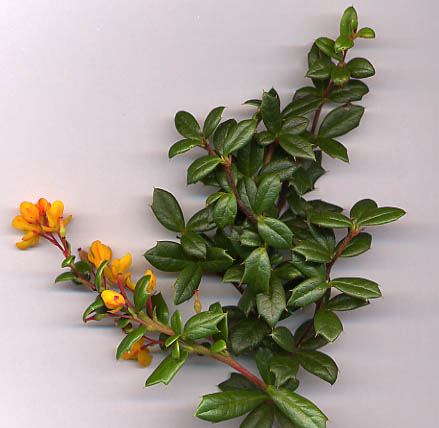
Photo: Wikimedia Commons, CC BY-SA 3.0 · source

Shrub · Berberidaceae
Darwin’s barberry
Berberis darwinii
In other languages: Berberis (Nederlands) · Épine-vinette de Darwin (Français)
Darwin’s barberry is a prickly evergreen shrub from southern Chile and Argentina. It forms a dense, rounded bush 2–3 m tall and wide, with small, glossy dark green leaves that look like miniature holly. In April and May it is smothered in hanging clusters of deep orange flowers, followed in summer by blue-black berries with a bluish bloom. Gardeners love it because it stays green all year, needs little attention and makes an impenetrable hedge that keeps unwanted visitors out. Bees visit the flowers and birds feast on the berries.
Caution: The leaves and spines are prickly: wear gloves and do not plant it along a narrow path or near a children’s play area.
Light
Sun or partial shade
preferably some sun
Moisture
Dry to normal
no wet feet
Legal basis
Sand, loam or clay
any pH
Hardiness
down to -15 °C
protect young plants
Size
2.5 m
tall, 2.5 m wide
Flowering
April–May
| Pruning months | May–June |
|---|---|
| Height | 2.5 m |
| Native to Belgium | No, planted |
| Good for bees, butterflies and birds | Yes, for bees and birds |
| Poisonous to people and pets | Not known to be poisonous |
| Flowering | April–May |
Identify
Darwin’s barberry: how do you recognise it?
- Habit
- Dense, rounded, upright shrub 2–3 m tall and wide. Moderately fast-growing.
- Leaves
- Small (1–3 cm), leathery and glossy dark green, with spiny teeth like holly. They stay on all winter.
- Stems
- Brown twigs with branched spines of three to five points.
- Flowers
- Hanging clusters of small, rounded flowers, deep orange with a red tinge, in April–May.
- Fruit
- Round blue-black berries with a bluish bloom, ripe in summer. Birds love them.
Flowering: April–May · Plants: April–May and September–October · Pruning: May–June
In your garden
Why grow it?
- One of the earliest flowering shrubs: in April and May a sea of orange flower clusters.
- Evergreen, so it gives a dense, glossy backdrop or hedge in winter too.
- Bees and bumblebees find nectar and pollen in spring; birds eat the berries and nest safely among the spines.
- The prickly branches make it a natural, intruder-proof hedge.
- Tough and undemanding: after the first year it tolerates drought and rarely needs feeding.
Darwin’s barberry: where does it grow best?
- Sun or partial shade; it flowers most freely in full sun.
- Any well-drained soil: sand, loam or clay, acid to chalky. It does not tolerate waterlogging.
- Fairly dry to moist soil; once established it copes with a dry summer.
- A spot sheltered from bitter east winds prevents scorched brown leaves in hard winters.
- Allow 2–2.5 m for a single shrub; for a hedge, plant 2–3 plants per metre.
- Light
- Sun and partial shade
- Soil type
- Sand, loam or clay
- Acidity
- Not fussy
- Moisture
- Dry or normal
- Size
- 2.5 m tall, 2.5 m wide
- Hardiness
- Hardy (to -15 °C)
Goes well with
- Californian lilac: Blue flowers in May next to the orange: a classic contrast.
- Forget-me-not: A blue underplanting that flowers at the same time.
- Grape hyacinth: Flowers in April at its feet, in the same vivid blue.
- Daffodil: Yellow spring flowers that go well with the orange clusters.
- Ornamental grasses: Soft, swaying shapes against the dark, stiff leaves.
Maintenance
Darwin’s barberry: when and how to plant it?
Plant in April–May and September–October.
- Plant in April–May or September–October, when the soil is neither frozen nor waterlogged.
- Soak a dry rootball in a bucket of water for a quarter of an hour first.
- Dig a hole twice as wide as the rootball, loosen the bottom and mix in some compost.
- Set the plant at the same depth as in the pot, backfill and firm well. For a hedge, use a string line and space plants 35–50 cm apart.
- Water in thoroughly straight away and repeat during dry spells in the first year.
- Spread a mulch of wood chips or leaf mould around the base: less weeding among the spines.
Care
- Watering
- Weekly in dry weather in the first year. After that only in long dry spells, especially for a young hedge.
- Feeding
- Rarely needed. On poor sandy soil, scatter a handful of compost or organic fertiliser around the base in March.
- Mulching
- A layer of wood chips or leaf mould keeps the soil moist and weeds down; weeding between prickly stems is no fun.
- Young hedge
- For the first two years, cut a young hedge back by a third after flowering so it branches densely from the base.
- Gloves
- Wear thick, long gloves for every job on this shrub: leaves and spines go straight through thin fabric.
Tip: Prune every year straight after flowering, wearing thick gloves: the shrub stays dense and flowers generously again the following spring.
Darwin’s barberry: when to prune it?
Pruning months: May–June.
When: Straight after flowering, from late May to mid-June. That gives the shrub the rest of the year to make new shoots that will flower next spring.
How:
- Cut flowered shoots back to just above a young side shoot or a leaf.
- Remove dead, weak and crossing stems at the base.
- Trim a hedge once a year, after flowering. Keep it slightly wider at the bottom than at the top so light reaches the base.
- Renovate an overgrown or bare shrub over two or three years: each year remove a third of the oldest stems at ground level.
Caution: It flowers on last year’s wood: pruning in autumn or winter removes the flowers. Check for nesting birds before you prune.
Propagation
- Semi-ripe cuttings
- In July–August: 10 cm cuttings of this year’s growth, lower leaves removed, in sandy cutting compost under plastic in a shady spot. Plant them out the following spring.
- Seedlings
- Birds often sow the berries elsewhere in the garden. In spring, lift young seedlings with a little soil and move them to their final spot.
- Layering
- In spring, peg a low branch into the soil and cover it with earth. Sever it after a year and replant it.
Darwin’s barberry: how does it get through the winter?
Hardy to −15 °C: protect young plants.
- Hardy to about −15 °C: no problem in most Belgian winters.
- In hard winters, bitter east winds can turn the leaves brown. Wait until May before cutting out dead tips; the rest usually regrows.
- Protect young plants with horticultural fleece during severe frost in their first winter.
- In a pot the roots freeze more easily: stand the pot against a wall and wrap it in hessian.
Diseases and pests
- Root rot: On wet, poorly drained soil the leaves discolour and branches die back. Choose a drier spot or improve the soil with coarse grit.
- Brown leaves after winter: Wind or frost damage. Wait until May and only cut out what is really dead.
- Bare base: A shrub that is never pruned becomes bare at the bottom. Remove a few old stems at the base every year.
- Berberis sawfly: The larvae sometimes strip the leaves in summer, although they prefer deciduous barberries. Pick them off wearing gloves.
Through the year
- January: Resting. Birds shelter among the prickly branches.
- February: Cover young plants with fleece in severe frost and bitter wind.
- March: Scatter compost around the base on poor soil. Top up the mulch.
- April: Planting. The first orange flower clusters open.
- May: Full flower. Planting is still possible. Prune in late May once flowering is over.
- June: Prune the shrub and trim the hedge, by mid-June at the latest. Check for nests first.
- July: Take semi-ripe cuttings. The berries turn blue. Water young plants in dry weather.
- August: Berries for the birds. Cuttings can still be taken.
- September: Planting. Look out for seedlings sown by birds.
- October: Planting.
Use
Good for wildlife
- Bees
- Nectar and pollen for honeybees and wild bees.
- Birds
- Berries, seeds or insects as food, or a place to nest.
You and this species
Did you know?
- Charles Darwin found this shrub in Chile in 1835, during his voyage on the Beagle. The plant is named after him.
- It was not until 1849 that plant collector William Lobb introduced it to Europe, where it quickly became a popular garden plant.
- Cut through a barberry branch and you will see bright yellow wood: the colour comes from a yellow pigment called berberine.