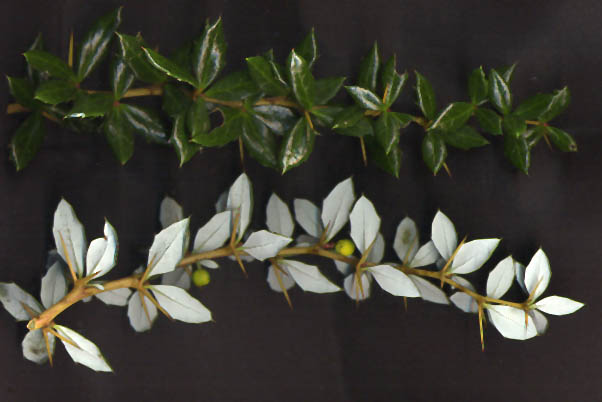
Photo: MPF, CC BY-SA 3.0 · source

Shrub · Berberidaceae
Warty barberry
Berberis verruculosa
In other languages: Berberis (Nederlands) · Berbéris (Français)
Berberis verruculosa is a compact, evergreen barberry from the mountains of western China. It slowly forms a dense, rounded shrub about 1 m high and 1.5 m wide, with small glossy dark green leaves that are white underneath. In May–June it bears golden-yellow flowers, singly or in pairs, followed by blue-black, bloomy berries. The young shoots are covered in tiny warts, which give the plant its name. Gardeners use it for low, prickly hedges, as an edging along a path or as an evergreen shrub at the front of a border.
Caution: The shoots carry sharp spines and the leaf margins prick: wear sturdy gloves when pruning and do not plant it right beside a path or a play area.
Light
Sun or partial shade
preferably some sun
Moisture
Dry to normal
no wet feet
Legal basis
Sand, loam or clay
any pH
Hardiness
Fully hardy
down to -20 °C
Size
1 m
tall, 1.5 m wide
Flowering
May–June
| Pruning months | June–July |
|---|---|
| Height | 1 m |
| Native to Belgium | No, planted |
| Good for bees, butterflies and birds | Yes, for bees |
| Poisonous to people and pets | Not known to be poisonous |
| Flowering | May–June |
Identify
Warty barberry: how do you recognise it?
- Habit
- Dense, rounded shrub about 1 m high and 1.5 m wide, with arching shoots. Slow growing.
- Leaves
- Elliptic, 1.5–2.5 cm, stiff and glossy dark green with a few spiny teeth; white underneath. Evergreen; a few leaves turn red in autumn.
- Flowers
- Golden-yellow, cup-shaped flowers 1.5 cm across, singly or in pairs, in May–June.
- Fruit
- Oval blue-black berries with a blue-grey bloom, in autumn.
- Shoots
- Brown young twigs covered in small warts, with three sharp spines at each node.
Flowering: May–June · Plants: April–May and September–October · Pruning: June–July
In your garden
Why grow it?
- Green and glossy all year, with a white flash from the leaf undersides.
- Golden-yellow flowers in May–June that attract bees and bumblebees.
- Ideal for a low, dense hedge that needs little clipping.
- In autumn and winter a few older leaves turn red among the green.
- Very hardy and happy in dry to moderately moist soil.
- The spines keep cats and unwanted visitors at bay.
Warty barberry: where does it grow best?
- Sun or partial shade; in sun it is densest and flowers best.
- Any free-draining soil: sand, loam or clay, acid to chalky.
- Dry to moderately moist; avoid standing water in winter.
- As a single shrub allow 1–1.5 m; for a low hedge, 40–50 cm between plants.
- Light
- Sun and partial shade
- Soil type
- Sand, loam or clay
- Acidity
- Not fussy
- Moisture
- Dry or normal
- Size
- 1 m tall, 1.5 m wide
- Hardiness
- Hardy (to -20 °C)
Goes well with
- Cranesbill: Airy pink and blue flowers in front of the dark hedge.
- Lady’s mantle: A soft yellow edging at the foot of the shrub.
- Ice plant: Flat flower heads in late summer, when the barberry stays quietly green.
- Tulip: Colourful spring flowers in front, before the barberry blooms.
Maintenance
Warty barberry: when and how to plant it?
Plant in April–May and September–October.
- Plant in April–May or September–October, when the soil is neither frozen nor waterlogged.
- Dig a hole twice as wide as the root ball, or a 40 cm wide trench for a hedge, and mix in some compost.
- Set the plant at the same depth as in the pot and firm the soil well.
- Water thoroughly straight away.
- Mulch around the base with wood chips or leaf mould.
Care
- Water
- In dry spells during the first year; after that only in prolonged drought.
- Feeding
- Some compost or organic shrub fertiliser in March.
- Mulching
- A layer of wood chips keeps weeds down between young hedging plants.
- Hedge
- Clipping once a year after flowering is enough to keep it neat.
- Gloves
- Wear sturdy gloves: the spines and leaf teeth are prickly.
Tip: Clip a hedge of this barberry only once a year, straight after flowering: it stays dense and flowers freely again the following year.
Warty barberry: when to prune it?
Pruning months: June–July.
When: After flowering, in late June or July. A free-standing shrub needs little pruning.
How:
- Clip a hedge to shape after flowering, keeping the base slightly wider than the top.
- On a free-standing shrub, just shorten shoots that stick out.
- Remove dead or damaged twigs back to healthy wood.
- Rejuvenate an old, bare shrub by removing a few old stems at the base.
Caution: Do not prune in autumn or winter: you would remove the flower buds for the following spring.
Propagation
- Semi-ripe cuttings
- In August–September, 8–10 cm cuttings with a heel, in a sandy cutting mix in a cold frame. They root slowly; plant them out the following spring.
- Seed
- In autumn, sow seed from ripe berries in a tray outdoors: cold is needed for germination. Seedlings may differ from the parent.
Warty barberry: how does it get through the winter?
Hardy to −20 °C.
- Very hardy, to about −20 °C: no protection is needed in Belgium.
- A cold, dry easterly wind can brown a few leaves; it simply reshoots in spring.
- In a pot or trough it can stay outdoors, provided water drains away freely.
Diseases and pests
- Berberis sawfly: Greyish-white larvae with black spots strip the leaves in summer. Pick them off, wearing gloves, as soon as you see them.
- Root rot: Yellow leaves and dying shoots on wet, heavy soil. Move it to a free-draining spot.
- Bare base: A hedge that is wider at the top than at the bottom becomes bare below. Clip it to a slightly tapered shape.
- Weeds in the hedge: Grass and weeds among the prickly shoots are awkward to remove. Plant in weed-free soil and mulch.
Through the year
- March: Add compost or organic fertiliser. Weed.
- April: Plant. Apply mulch.
- May: In flower. Bees and bumblebees.
- June: End of flowering. Clip the hedge.
- July: Last clipping. Watch for berberis sawfly.
- August: Take semi-ripe cuttings.
- September: Plant. Blue-black berries.
- October: Plant. Sow seed outdoors in a tray.
- November: A few leaves turn red.
Use
Good for wildlife
- Bees
- Nectar and pollen for honeybees and wild bees.
You and this species
Did you know?
- The species name verruculosa means ‘covered in small warts’ and refers to the warty young shoots.
- Barberry wood and roots are bright yellow; they were once used to dye wool and leather yellow.
- When an insect touches the stamens, they snap inwards and dust it with pollen.