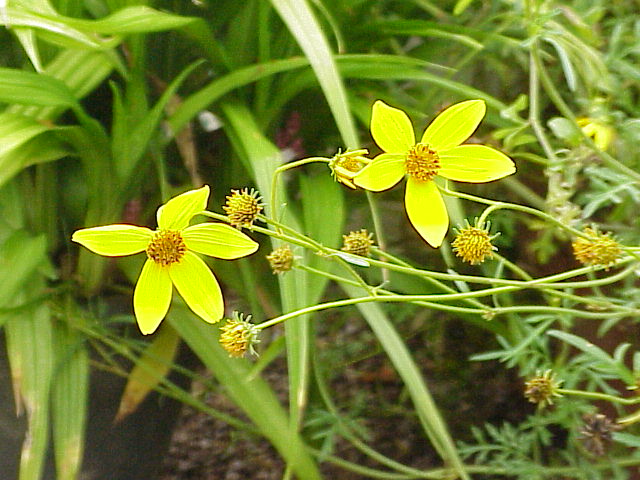
Photo: Kurt Stüber [1], CC BY-SA 3.0 · source

Annual · Asteraceae
Apache beggarticks
Bidens ferulifolia
In other languages: Bidens (Nederlands) · Bidens (Français)
Bidens ferulifolia comes from Mexico and the southern United States, where it is a short-lived perennial. Here it is grown as an annual in troughs, pots and hanging baskets. It forms a loose, spreading plant with finely cut, fern-like leaves and thin stems that trail up to half a metre over the edge. From May to October it is covered in small, star-shaped, golden-yellow flowers of 2–3 cm. It grows fast, is undemanding and attracts bees and butterflies; besides the classic yellow, there are varieties with orange, red or yellow-and-white flowers.
Light
Full sun
warm and bright
Moisture
Normal
no wet feet
Legal basis
Sand, loam or clay
acid to neutral
Hardiness
down to 0 °C
protect in harsh winters
Size
0.3 m
tall, 0.5 m wide
Flowering
May–October
| Pruning months | July |
|---|---|
| Height | 0.3 m |
| Native to Belgium | No, planted |
| Good for bees, butterflies and birds | Yes, for bees and butterflies |
| Poisonous to people and pets | Not known to be poisonous |
| Flowering | May–October |
Identify
Apache beggarticks: how do you recognise it?
- Habit
- Spreading to trailing, about 30 cm tall and 50 cm wide; the stems trail up to 50 cm over the edge.
- Leaves
- Finely cut and fern-like, fresh green; they look a little like fennel leaves.
- Flower
- Open, star-shaped flower heads of 2–3 cm, usually with five broad ray florets, from May to October.
- Colour
- Golden yellow; there are also varieties in orange, red or yellow with white.
- Fruit
- Narrow, dark seeds with barbed hooks at the tip that cling to clothing and animal fur.
Flowering: May–October · Sowing: February–March · Plants: May–June · Pruning: July
In your garden
Why grow it?
- Flowers non-stop from May to October with little effort.
- One of the strongest trailing plants: the stems fill a hanging basket or trough within a few weeks.
- Bees and butterflies visit the open, golden-yellow flowers.
- Copes well with sun, wind and heat, even on a sunny balcony.
- The warm yellow goes beautifully with blue, purple and white.
Apache beggarticks: where does it grow best?
- Full sun: in shade it flowers poorly and the stems become long and floppy.
- Good potting compost or, in the garden, free-draining sandy, loamy or clay soil, acid to neutral.
- Moderately moist: it needs plenty of water but does not tolerate standing water.
- Allow 30–40 cm per plant; place it at the edge of a trough or basket so the stems can trail.
- Light
- Sun
- Soil type
- Sand, loam or clay
- Acidity
- Acid or neutral
- Moisture
- Normal
- Size
- 0.3 m tall, 0.5 m wide
- Hardiness
- Frost tender: plant out after the last frost (mid-May)
Goes well with
Maintenance
Apache beggarticks: when and how to plant it?
Plant in May–June.
- Sow indoors in February–March at 18–20 °C, barely covering the seed. Many varieties are sold as young plants raised from cuttings.
- In May, harden off home-raised plants for a week by putting them outside during the day.
- Plant out after mid-May, when night frosts are over, or in June.
- Choose a pot or trough with a drainage hole and good potting compost; in the garden, work in some compost.
- Set the plant at the same depth as in its pot, 30–40 cm apart.
- Water in well and let excess water drain away.
Care
- Water
- It is thirsty: in summer, water troughs and baskets daily, sometimes twice in hot weather. In the garden, only in dry spells.
- Feeding
- Liquid feed for balcony plants every week, from June to September: it is a vigorous grower.
- Deadheading
- Not essential, but a plant that sets less seed flowers more freely.
- Neighbours
- It can smother weaker neighbours in a trough; trim its stems back a little if it does.
Tip: Choose a roomy basket or trough and keep it evenly moist: bidens is a heavy drinker and feeder. Trim long stems back a little in July and it will stay compact and flower until the frost.
Apache beggarticks: when to prune it?
Pruning months: July.
When: In July, when the stems get long or the plant becomes bare in the middle. Otherwise no pruning is needed.
How:
- Shorten long stems by a third to a half, just above a leaf.
- Do not cut everything at once: work in two rounds a week apart so there are always some flowers.
- Water and feed after trimming; after a few weeks it is in full flower again.
Propagation
- Seed
- Indoors in February–March at 18–20 °C, barely covering the seed. It usually germinates within one to two weeks. Not all varieties come true from seed.
- Cuttings
- In August–September, take tip cuttings of 5–8 cm from non-flowering shoots and put them in moist cutting compost. They root quickly and overwinter indoors in a bright, cool place.
Apache beggarticks: how does it get through the winter?
Hardy to 0 °C: protect in harsh winters.
- Not hardy: frost kills it. It is usually grown as an annual and cleared away after the first frost.
- It can be overwintered in a bright, frost-free, cool place at 5–10 °C with little water, but overwintering cuttings is easier.
- Only put overwintered plants and cuttings back outside after mid-May.
Diseases and pests
- Aphids: On young shoots in spring and summer. Spray off with water; ladybirds and hoverflies will deal with the rest.
- Wilting: The stems hang limp in dry weather. Water generously at once; a larger basket or trough dries out less quickly.
- Grey mould: Brown, mouldy leaves and flowers in a cool, wet summer. Remove affected parts and keep the plant open and airy.
- Bare, untidy plant: Too little sun or feed, or stems that are too long. Move it to a sunnier spot, trim the stems and feed.
Through the year
- February: Sow indoors at 18–20 °C.
- March: Sow more. Prick out seedlings into small pots.
- April: Buy young plants and keep them in good light, frost-free.
- May: After mid-May, plant out in troughs and baskets. First flowers.
- June: Still time to plant. Feed every week.
- July: In full flower. Shorten long stems. Water daily in warm weather.
- August: In flower. Take cuttings for overwintering.
- September: In flower. Take more cuttings.
- October: Last flowers. Clear away after the first frost.
- November: Keep cuttings cool and bright, with little water.
Use
Good for wildlife
- Bees
- Nectar and pollen for honeybees and wild bees.
- Butterflies
- Nectar for butterflies.
You and this species
Did you know?
- The name Bidens means ‘two teeth’ and refers to the barbed hooks on the seeds of many species, which cling to clothing and animal fur. The English name beggarticks comes from this too.
- The species name ferulifolia means ‘with leaves like Ferula’, the giant fennel: the finely cut foliage resembles it.
- Belgium has native relatives, such as trifid bur-marigold and nodding bur-marigold, which grow along ditches and pond edges.