Photo: Shu Suehiro, CC BY 3.0 · source

Houseplant · Bromeliaceae
Queen’s tears
Billbergia nutans
In other languages: Billbergia (Nederlands) · Billbergia (Français)
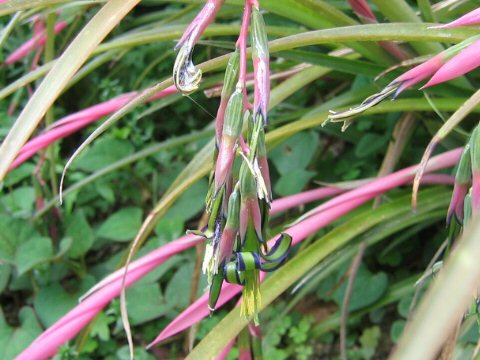
Billbergia nutans is a bromeliad from South America, from southern Brazil to Paraguay, Uruguay and northern Argentina. It forms dense clumps of narrow, grass-like, grey-green leaves with finely toothed edges. In late winter and spring, arching flower spikes appear with bright pink bracts and flowers in green, violet-blue and yellow. Its common name, queen’s tears, refers to the drops of nectar that can fall from the flowers. It is one of the easiest bromeliads: it tolerates cool conditions, grows quickly and lives on after flowering through its many offsets.
Light
Partial shade
no harsh midday sun
Moisture
Normal
no wet feet
Legal basis
Potting soil
Hardiness
Houseplant
min. 5 °C
Size
0.4 m
tall, 0.5 m wide
Flowering
January–April
| Pruning months | April–May |
|---|---|
| Height | 0.4 m |
| Poisonous to people and pets | Not known to be poisonous |
| Flowering | January–April |
Identify
Queen’s tears: how do you recognise it?
- Habit
- Dense clump of narrow, upright to arching rosettes, 30–40 cm tall and up to 50 cm wide.
- Leaves
- Narrow and strap-like, 30–40 cm long, grey-green, with tiny teeth along the edge; sometimes reddish in good light.
- Flower
- Nodding spikes with bright pink bracts; the tubular flowers are green edged with violet-blue, with yellow stamens.
- Flowering time
- From January to April; each rosette flowers once.
- Roots
- Small and mainly for anchorage; a small pot is enough.
Flowering: January–April · Plants: April–May · Pruning: April–May
In your garden
Why grow it?
- Exotic, nodding flowers in late winter and spring, when little else flowers indoors.
- Very tough and tolerant: it copes with cool rooms and a little neglect.
- Quickly fills a pot with many rosettes, which flower again every year.
- The flower spikes also look lovely in a small vase.
- Easy to divide and share with friends.
Queen’s tears: where does it grow best?
- Bright light to light shade: an east or west window is ideal. Morning sun is fine, strong midday sun is not.
- Normal room temperature, but it also tolerates cool conditions down to 5 °C; a slightly cooler winter spot at 10–15 °C suits it well.
- Open, humus-rich compost: potting compost mixed with some fine bark, or bromeliad compost.
- In summer it can go outside in a sheltered spot in light shade.
- Light
- Bright, out of direct sun
- Potting soil
- Multi-purpose compost or airy, humus-rich compost
- Acidity
- Acid or neutral
- Watering
- Moderately
- Size
- 0.4 m tall, 0.5 m wide
- Temperature
- Minimum 5 °C
Goes well with
- Spider plant: Just as tough and tolerant, with similar narrow leaves.
- Clivia: Also likes a cool winter and flowers in spring.
- Air plant: A related bromeliad that you can simply lay down or hang up.
- Cast-iron plant: Large, dark leaves that also tolerate a cool spot.
Maintenance
Queen’s tears: when and how to plant it?
Plant in April–May.
- Repot or divide in April or May, after flowering.
- Choose a wide, fairly shallow pot with a drainage hole; it has few roots.
- Use an open mix of potting compost and fine bark, or bromeliad compost.
- Set the rosettes at the same depth as before and firm them in well; support them temporarily with a small cane if needed.
- Water in moderately, preferably with rainwater, then let the compost dry slightly.
Care
- Water
- From spring to autumn keep the compost lightly moist, preferably with rainwater; let the surface dry between waterings. Water more sparingly in winter.
- Feeding
- From April to September, liquid feed at half strength or bromeliad feed every three to four weeks.
- Spent rosettes
- A rosette that has flowered slowly dies back. Cut it off at the base as soon as it yellows, so the young offsets get room.
- Repotting
- Only when the pot is overcrowded, every two or three years: it flowers well when pot-bound.
- Humidity
- Ordinary room air is fine; it is far less demanding than other bromeliads.
Tip: Let it fill its pot: a dense clump flowers most freely. Only divide it in spring after flowering, when the pot is really overcrowded.
Queen’s tears: when to prune it?
Pruning months: April–May.
When: After flowering, in April–May, remove spent flower spikes and rosettes.
How:
- Cut withered flower spikes off at their base.
- Cut rosettes that have flowered and are turning yellow off at the base.
- Leave the young offsets: they will flower in a year or two.
Propagation
- Division
- After flowering, in April–May, divide a full clump into pieces of three to five rosettes and pot each piece separately.
- Offsets
- Cut off an offset at least a third the size of the parent with a sharp knife and plant it in open compost.
Queen’s tears: how does it get through the winter?
- House plant: it cannot take frost, but tolerates cool conditions down to about 5 °C.
- A bright, slightly cooler spot at 10–15 °C is ideal; there it flowers in late winter.
- Water sparingly in winter and do not feed.
- A bright, frost-free conservatory or porch also suits it.
Diseases and pests
- Scale insects: Brown bumps under the leaves. Wipe off with a cloth or cotton bud dipped in methylated spirit.
- Mealybug: White fluffy tufts between the leaf bases. Remove with a cotton bud dipped in methylated spirit.
- Rot: Brown, soft leaf bases caused by overly wet compost. Water less, remove rotten parts and replant in open compost.
- No flowers: A clump that is too young, a spot that is too dark or a winter that is too warm. Give it more light and a cooler winter, and do not divide it too often.
Through the year
- January: Start of flowering. Bright, cool spot.
- February: Flowering. Water sparingly.
- March: Flowering. Cut a spike for a small vase if you like.
- April: End of flowering. Remove spent rosettes, divide or repot. Start feeding again.
- May: Divide or repot. In late May possibly outside in light shade.
- June: Water, preferably with rainwater. Feed every three to four weeks.
- July: Water and feed. Keep out of strong midday sun.
- August: Water and feed.
- September: Bring it back in before cold nights. Last feed.
- October: Water less. Stop feeding.
- November: Keep it cool and bright, around 10–15 °C.
- December: Water sparingly. Leave it bright and cool.
You and this species
Did you know?
- The name queen’s tears refers to the drops of nectar that fall from the flowers when you move the plant.
- The genus is named after the Swedish botanist Gustaf Johan Billberg.
- It belongs to the same family as the pineapple.