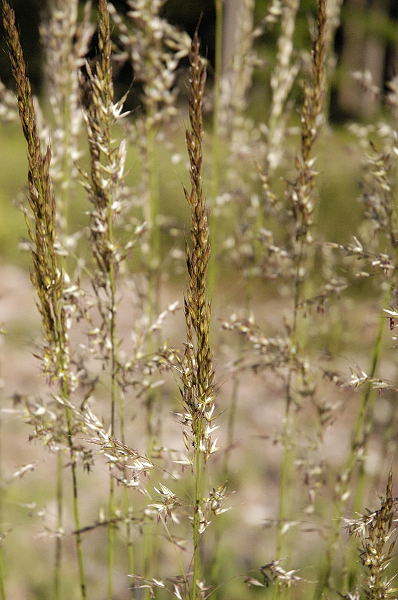
Photo: James K. Lindsey, CC BY-SA 3.0 · source

Ornamental grass · Poaceae
Korean feather reed grass
Calamagrostis brachytricha
In other languages: Diamantgras (Nederlands) · Calamagrostis brachytricha (Français)
Korean feather reed grass (Calamagrostis brachytricha) comes from East Asia, from China and Korea to Japan, where it grows in open woodland and along forest edges. It forms an upright, non-spreading clump of broad, fresh green leaves, about 1 m tall in flower. From August to October it produces thick, fluffy plumes, soft pink to silvery purple at first and later beige; backlit or covered in dew they sparkle like diamonds, which is why it is also called diamond grass. Unlike most ornamental grasses it also tolerates light shade. The plumes stay upright well into winter and are only cut back in March.
Light
Sun or partial shade
preferably some sun
Moisture
Normal
no wet feet
Legal basis
Sand, loam or clay
any pH
Hardiness
Fully hardy
down to -25 °C
Size
1 m
tall, 0.6 m wide
Flowering
August–October
| Pruning months | March |
|---|---|
| Height | 1 m |
| Native to Belgium | No, planted |
| Poisonous to people and pets | Not known to be poisonous |
| Flowering | August–October |
Identify
Korean feather reed grass: how do you recognise it?
- Habit
- Upright, compact clump about 60 cm wide; about 1 m tall with the plumes.
- Leaves
- Broad and strap-shaped, fresh green and slightly arching; yellow to beige in autumn.
- Flowers
- Thick, fluffy, slightly slanting plumes from August to October; soft pink to silvery purple, later beige.
- Seed
- The plumes stay on all winter; it sometimes self-seeds a little.
- Roots
- A dense clump without long runners.
Flowering: August–October · Plants: March–May · Pruning: March
In your garden
Why grow it?
- One of the finest grasses for late summer and autumn, when the border starts to look tired.
- The pink, fluffy plumes sparkle when backlit, with morning dew and frost.
- Also tolerates light shade, where most ornamental grasses fail.
- It does not spread: a neat clump that stays in its place.
- Strong winter structure: the plumes stay upright until March.
- Little work: cut back once a year.
Korean feather reed grass: where does it grow best?
- Sun or partial shade; in light shade it still flowers well, in deep shade the stems flop.
- Ordinary garden soil: sand, loam or clay, acid to chalky.
- Normally moist: it dislikes drying out in summer and wet feet in winter.
- Plant it so that the low autumn sun shines through the plumes from behind.
- Allow 50–60 cm between plants.
- Light
- Sun and partial shade
- Soil type
- Sand, loam or clay
- Acidity
- Not fussy
- Moisture
- Normal
- Size
- 1 m tall, 0.6 m wide
- Hardiness
- Hardy (to -25 °C)
Goes well with
- Japanese anemone: Pink and white flowers in the same late summer, also in partial shade.
- Michaelmas daisy: Purple and blue flowers beside the pink plumes.
- Bugbane: White flower spikes in autumn, in the same partial shade.
- Ice plant: Pink flower heads that bloom at the same time.
- Black-eyed Susan: Yellow flowers with a dark centre as a warm contrast.
Maintenance
Korean feather reed grass: when and how to plant it?
Plant in March–May.
- Plant in March, April or May, as the soil warms up.
- Dig a hole twice as wide as the root ball and mix in some compost.
- Set the plant at the same depth as it was in the pot and firm the soil well.
- Leave 50–60 cm between plants; it looks best in a group of three or five.
- Water generously straight away, then weekly in dry spells during the first summer.
Care
- Watering
- In dry spells during the first year; after that only in long dry periods, especially on sandy soil.
- Feeding
- A little compost in April is enough; too much fertiliser makes the stems floppy.
- Cutting back
- In March, cut the whole clump back to 10–15 cm above the ground.
- Rejuvenating
- Divide every four or five years, when the clump goes bare in the middle.
- Seedlings
- Weed out unwanted seedlings while they are small.
Tip: Plant it where the low autumn sun shines through the plumes from behind, for example to the west or south of a seating area: then they really sparkle like diamonds.
Korean feather reed grass: when to prune it?
Pruning months: March.
When: Cut back in March, before the new leaves appear; leave the plumes standing all winter.
How:
- Tie the clump together with string and cut it off in one go with shears or secateurs, 10–15 cm above the ground.
- Do not leave it too late: if the new shoots are already tall, you will cut off their tips.
- Chop up the cut stems before adding them to the compost heap.
Caution: Do not cut back in autumn: the old clump protects the heart of the plant and gives insects shelter in winter.
Propagation
- Division
- In April, as new growth begins, lift a clump and cut it into pieces with a sharp spade; replant straight away and water.
- Seed
- Sow ripe seed in spring in pots, barely covering it; seedlings flower after one or two years.
Korean feather reed grass: how does it get through the winter?
Hardy to −25 °C.
- Fully hardy, to about −25 °C: no protection needed.
- Leave the plumes standing: they stay upright and look superb with frost or snow.
- In a large pot it can stay outside; raise the pot on feet so that water can drain away.
Diseases and pests
- Flopping stems: Too much shade or fertiliser makes the clump floppy. Give it a lighter spot and feed less.
- Bare centre: Old clumps die out in the middle. Divide them in spring and replant the outer parts.
- Seedlings: It sometimes self-seeds in the border. Weed out the seedlings while young.
- Brown leaf tips: In drought the leaf tips wither. Water during long dry spells.
Through the year
- January: Leave the plumes standing. Lovely with frost.
- February: Leave standing.
- March: Cut back to 10–15 cm. Add compost.
- April: Plant or divide.
- May: Plant. Water after planting.
- July: Water in dry spells.
- August: First pink plumes.
- September: Full flower: backlit plumes.
- October: Flowering. The plumes turn beige.
- November: Leave the plumes for winter.
- December: Winter structure.
You and this species
Did you know?
- The name Calamagrostis comes from the Greek kalamos (reed) and agrostis (a kind of grass).
- It is sometimes confused with feather reed grass ‘Karl Foerster’ (Calamagrostis × acutiflora), but that flowers as early as June and does not set viable seed.
- The name Korean feather reed grass refers to its origin and its feathery plumes.