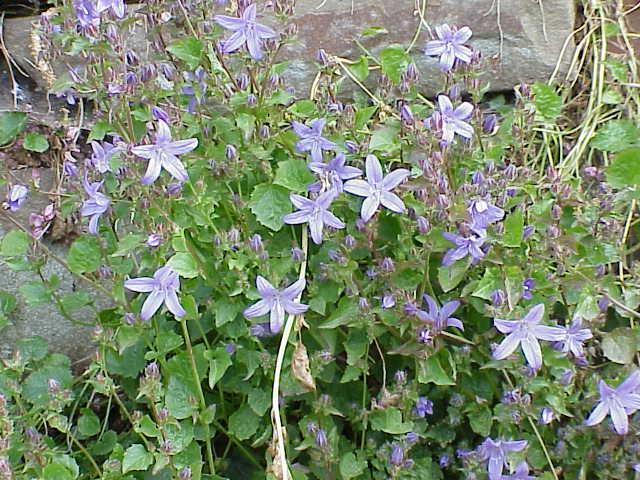
Photo: Kurt Stüber [1], CC BY-SA 3.0 · source

Perennial · Campanulaceae
Trailing bellflower
Campanula poscharskyana
In other languages: Kruipklokje (Nederlands) · Campanule de Poscharsky (Français)
Trailing bellflower comes from the mountains along the Adriatic coast, from Croatia to Montenegro, where it grows in rock crevices and on old walls. It is a low, creeping perennial, 15–20 cm tall, that quickly forms a wide carpet by means of runners. From June into September it is covered in small, star-shaped, lavender-blue flowers with a white centre. Gardeners love it because it will grow almost anywhere: on low walls, between stones, at the front of a border and under shrubs. Well-known cultivars are ‘Stella’ (deep violet-blue) and ‘E.H. Frost’ (milky white with a pale blue eye).
Light
Sun or partial shade
preferably some sun
Moisture
Dry to normal
no wet feet
Legal basis
Sand, loam or clay
any pH
Hardiness
Fully hardy
down to -30 °C
Size
0.15 m
tall, 0.6 m wide
Flowering
June–September
| Pruning months | March and July |
|---|---|
| Height | 0.15 m |
| Native to Belgium | No, planted |
| Good for bees, butterflies and birds | Yes, for bees |
| Poisonous to people and pets | Not known to be poisonous |
| Flowering | June–September |
Identify
Trailing bellflower: how do you recognise it?
- Habit
- Low and creeping, 15–20 cm tall and 50–60 cm or more across; spreads by runners.
- Leaves
- Small, heart-shaped to rounded, with toothed edges; fresh green, partly evergreen in mild winters.
- Flower
- Open, star-shaped bells of 2–2.5 cm with five deeply cut lobes, in loose sprays.
- Colour
- Lavender blue with a white centre; there are also white and violet cultivars.
- Roots
- Shallow and branching, with runners that quickly form new plants.
Flowering: June–September · Plants: March–May and September–October · Pruning: March and July
In your garden
Why grow it?
- Long flowering: from June into September, with the biggest flush in early summer.
- A fast ground cover that clothes bare patches, walls and edges in a single season.
- Bees and bumblebees busily visit the open flowers.
- Tough and fully hardy, even in poor, dry soil.
- Lovely tumbling over a wall, in a rock garden or in a trough.
Trailing bellflower: where does it grow best?
- Sun to partial shade: it flowers most freely in sun and stays fresher for longer in partial shade.
- Any well-drained soil: sand, loam or clay, acid to chalky.
- Dry to moist; it copes well with drought, less well with wet feet in winter.
- Plant 30–40 cm apart; the plants knit together after a year.
- Keep it away from small, slow alpines: it will smother them.
- Light
- Sun and partial shade
- Soil type
- Sand, loam or clay
- Acidity
- Not fussy
- Moisture
- Dry or normal
- Size
- 0.15 m tall, 0.6 m wide
- Hardiness
- Hardy (to -30 °C)
Goes well with
- Lady’s mantle: Soft green leaves and yellow sprays next to the blue stars.
- Hardy geranium: Just as easy and long-flowering, for a relaxed border.
- Roses: A blue underplanting at the foot of shrub and climbing roses.
- Lavender: The same sunny, dry spot; together a blue and purple picture.
- Stonecrop: On walls and between stones, with fleshy leaves and later flowers.
Maintenance
Trailing bellflower: when and how to plant it?
Plant in March–May and September–October.
- Plant from March to May or in September–October.
- Dig a hole a little larger than the pot; in heavy clay, mix in some grit or gravel.
- Set the plant at the same depth as it was in the pot and firm the soil well.
- Space plants 30–40 cm apart; on a wall, tuck small pieces with a little soil into the joints.
- Water well and keep the soil slightly moist for the first few weeks.
Care
- Watering
- Rarely needed once established. Only water during long dry spells and in pots and troughs.
- Feeding
- Not needed in ordinary garden soil. Too much fertiliser gives lots of leaves and fewer flowers.
- Deadheading
- Shear the plant lightly after the first flush in July; it will flower again until September.
- Keeping it in check
- Every spring, cut away with a spade the edges that spread too far, especially next to smaller plants.
- Rejuvenating
- Divide every 3–4 years when the centre becomes bare.
Tip: Dress a stone wall or steps by tucking small pieces with a little soil into the joints: within a year a blue curtain will hang over the edge.
Trailing bellflower: when to prune it?
Pruning months: March and July.
When: Remove the dead stems in March and shear lightly in July, after the first flush of flowers.
How:
- In March, cut away all dead and withered stems, just above the new leaves.
- In July, shear the faded flowering stems back to the foliage with grass shears or hedge shears.
- Water afterwards: new flowers follow within a few weeks.
Propagation
- Division
- In March–April or September: lift pieces with roots and runners and replant them straight away.
- Cuttings
- In spring, root 5 cm cuttings of young, non-flowering shoots in moist cutting compost; they root quickly.
Trailing bellflower: how does it get through the winter?
Hardy to −30 °C.
- Fully hardy, down to about −30 °C: no protection is needed in Belgium.
- In mild winters part of the foliage stays green; clear away dead leaves in March.
- In pots and troughs: make sure excess water can drain away, as wet roots are a bigger danger in winter than frost.
Diseases and pests
- Spreading: It smothers small neighbours. Cut back the edges every spring and do not plant it among slow alpines.
- Slugs: They eat the young leaves in spring. Pick them off in the evening and keep the surroundings open and dry.
- Rust: Orange pustules under the leaves. Cut out affected stems and give the plant more air.
- Bare centre: Old clumps go bare in the middle. Divide them and replant the young outer pieces.
Through the year
- March: Cut away dead stems. Plant or divide.
- April: Plant. Cut back edges that have spread too far.
- May: Plant. Watch out for slugs.
- June: Flowering begins.
- July: Full flower. Shear lightly after the first flush.
- August: New flowers. Water during long dry spells.
- September: Last flowers. Plant or divide.
- October: Plant. Move rooted runners.
Use
Good for wildlife
- Bees
- Nectar and pollen for honeybees and wild bees.
You and this species
Did you know?
- Campanula means ‘little bell’: it comes from the Latin campana, bell.
- It looks very like its relative Campanula portenschlagiana, but that species has true tubular bells, while trailing bellflower has open, starry flowers.
- In the wild it often grows in cracks in limestone rock with very little soil, which is why it is so at home in a wall.