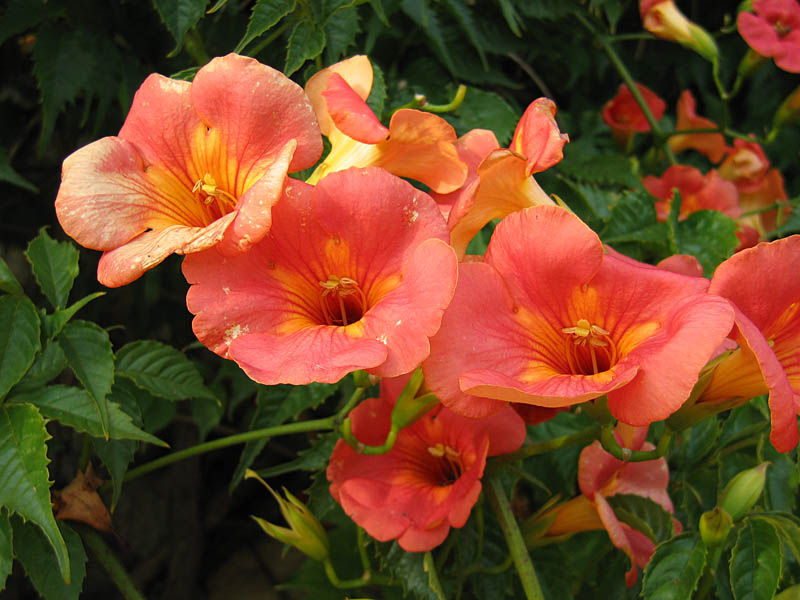
Photo: Wikimedia Commons, CC BY-SA 2.0 · source

Climber · Bignoniaceae
Chinese trumpet vine
Campsis grandiflora
In other languages: Chinese trompetbloem (Nederlands) · Bignone de Chine (Français)
Chinese trumpet vine comes from eastern China. It is a deciduous woody climber of 5–7 m with pinnate leaves and, from July to September, clusters of large, wide-open trumpet flowers in warm orange. Compared with the common trumpet vine (Campsis radicans) the flowers are larger and more open, but the plant is less hardy and makes hardly any aerial roots. Against a warm, sunny wall it flowers generously in late summer, when many other climbers have finished. Bees readily visit the flowers.
Light
Full sun
warm and bright
Moisture
Normal
no wet feet
Legal basis
Sand, loam or clay
any pH
Hardiness
down to -15 °C
protect young plants
Size
8 m
tall, 4 m wide
Flowering
July–September
| Pruning months | March |
|---|---|
| Height | 8 m |
| Native to Belgium | No, planted |
| Good for bees, butterflies and birds | Yes, for bees |
| Poisonous to people and pets | Not known to be poisonous |
| Flowering | July–September |
Identify
Chinese trumpet vine: how do you recognise it?
- Habit
- Deciduous woody climber, 5–7 m tall and 3–4 m wide, with few or no aerial roots: it needs tying in.
- Leaf
- Pinnate, with 7–9 oval, toothed leaflets of 3–6 cm; fresh green and smooth underneath.
- Flower
- Wide-open trumpets 6–8 cm across with a short tube, in loose clusters at the tips of new shoots, from July to September.
- Colour
- Warm orange to orange-red, the throat more yellow with red veins.
- Roots
- Strong and deep; once established it copes with a dry spell.
Flowering: July–September · Plants: April–May · Pruning: March
In your garden
Why grow it?
- Large, exotic-looking trumpet flowers from July to September.
- Flowers in late summer, when most climbers are over.
- Flowers on new wood: even after a hard winter or a heavy prune.
- Bees seek out the flowers.
- A southern touch on a warm wall or pergola.
Chinese trumpet vine: where does it grow best?
- Full sun is needed for good flowering: a south- or west-facing wall is ideal.
- Any well-drained soil: sand, loam or clay, acid to chalky.
- Moderately moist: do not let it dry out in summer, but avoid wet feet in winter.
- Warm and sheltered: it is hardy to about −15 °C.
- Plant 30–40 cm from the wall and allow 3–4 m of width.
- Light
- Sun
- Soil type
- Sand, loam or clay
- Acidity
- Not fussy
- Moisture
- Normal
- Size
- 8 m tall, 4 m wide
- Hardiness
- Hardy (to -15 °C)
Goes well with
- Italian clematis: Purple flowers beside the orange, at the same time.
- Lavender: A fragrant, drought-loving edging at the foot of the warm wall.
- Catmint: Blue flowers at the base that contrast beautifully with the orange.
- African lily: Blue flower heads in a pot on the warm terrace next to it.
Maintenance
Chinese trumpet vine: when and how to plant it?
Plant in April–May.
- Plant in April–May, once the soil has warmed up, so it roots well before winter.
- Fix sturdy wires or a trellis to the wall first, as it barely clings by itself.
- Dig a generous hole 30–40 cm from the wall and mix in compost.
- Set the plant at the same depth as in its pot, leaning towards the wall, and tie the shoots in loosely.
- Water in well and mulch around the base.
Care
- Water
- Regularly in dry spells for the first two summers. Later too in hot, dry summers, or it drops its buds.
- Feeding
- A little compost or organic fertiliser in April. Too much nitrogen gives lots of leaves and few flowers.
- Tying in
- Tie in new shoots regularly during the growing season; they do not cling by themselves.
- Mulching
- A layer of compost in spring and a thick layer of straw or leaves around the base in winter.
- Patience
- Young plants take a few years to flower; that is normal.
Tip: Put it against the warmest wall in the garden and be patient: the more sun it gets, the earlier and more freely it flowers.
Chinese trumpet vine: when to prune it?
Pruning months: March.
When: In March, before growth starts. It flowers on new wood, so a firm spring prune costs no flowers.
How:
- Cut last year’s side shoots back to two or three buds from the permanent framework.
- In the first years, build a framework of a few strong main stems and tie them in a fan against the wall.
- Remove dead and frost-damaged wood back to healthy growth.
- Renew an old, bare plant by cutting a few old main stems back close to the ground.
Caution: Do not prune in summer: the flowers form at the tips of the new shoots.
Propagation
- Semi-ripe cuttings
- In July–August, take 10–15 cm cuttings and root them in moist cutting compost under plastic, in a warm, bright spot.
- Layering
- In spring, peg a low stem into the soil; sever and replant it after a year.
Chinese trumpet vine: how does it get through the winter?
Hardy to −15 °C: protect young plants.
- Moderately hardy, to about −15 °C: against a warm wall it survives most Belgian winters.
- Protect the base of young plants in winter with a thick layer of straw, leaves or wood chips.
- If it is frosted in a hard winter, it usually reshoots from the base and flowers on the new wood.
- In a cold, exposed spot the common trumpet vine is a safer choice.
Diseases and pests
- No flowers: A young plant, too much shade or summer pruning. Give it sun and patience, and prune only in March.
- Frosted stems: Brown, dried-out stems after a hard winter. Cut them back to live wood in March.
- Aphids: On young shoots in May–June. Hose them off with water; ladybirds do the rest.
- Bud drop: Buds fall in dry weather. Water and mulch the base.
Through the year
- March: Prune: side shoots back to two or three buds. Remove dead wood.
- April: Planting. Add compost.
- May: Planting. Tie in new shoots.
- June: Tying in. Watch for aphids.
- July: Flowering begins. Water in dry spells. Take cuttings.
- August: Full flower. Water in dry spells.
- September: Flowering. Tie in new shoots.
- November: Cover the base of young plants with straw or leaves.
Use
Good for wildlife
- Bees
- Nectar and pollen for honeybees and wild bees.
You and this species
Did you know?
- Campsis × tagliabuana is a cross between this species and the common trumpet vine; the best known is ‘Madame Galen’.
- The name Campsis comes from the Greek kampsis, ‘bending’, after the curved stamens.
- Unlike the common trumpet vine, this species makes few or no aerial roots, so it really needs support.