Photo: Kristian Peters -- Fabelfroh 12:34, 3 October 2005 (UTC), CC BY-SA 3.0 · source

Perennial · Lamiaceae
Catmint
Nepeta racemosa
In other languages: Kattenkruid (Nederlands) · Népéta (Français)
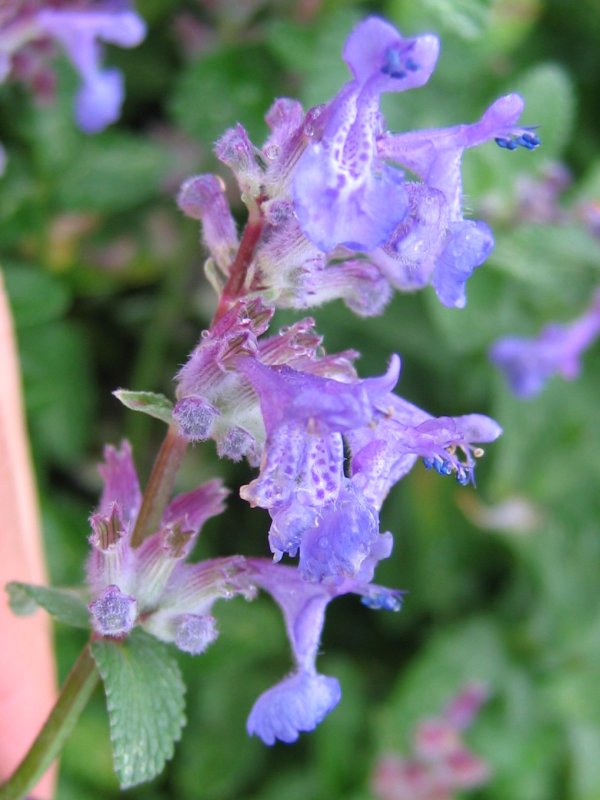
Catmint is an aromatic perennial from the Caucasus, Turkey and Iran, in the same family as lavender and mint. It forms loose, broad mounds of small, grey-green leaves topped from May to September by spikes of lavender-blue lipped flowers. The leaves smell spicy, a little like mint, and many cats adore them. Gardeners choose it as an easy, drought-tolerant edging plant for sunny borders and as one of the very best plants for bees. Well-known varieties include ‘Walker’s Low’, with long spikes, and the white ‘Snowflake’.
Light
Full sun
warm and bright
Moisture
Dry to normal
no wet feet
Legal basis
Sand, loam or clay
any pH
Hardiness
Fully hardy
down to -30 °C
Size
0.4 m
tall, 0.6 m wide
Flowering
May–September
| Pruning months | March and July |
|---|---|
| Height | 0.4 m |
| Native to Belgium | No, planted |
| Good for bees, butterflies and birds | Yes, for bees and butterflies |
| Poisonous to people and pets | Not known to be poisonous |
| Flowering | May–September |
Identify
Catmint: how do you recognise it?
- Habit
- Loose, broad mound about 40 cm tall and 60 cm wide, with square stems.
- Leaves
- Small, heart-shaped, toothed and grey-green, softly hairy.
- Flowers
- Loose spikes of small lipped flowers in lavender-blue, sometimes white or pink; May to September.
- Scent
- The leaves smell spicy, a little like mint, when crushed.
- Roots
- Fibrous roots in a compact clump that slowly widens.
Flowering: May–September · Plants: March–May and September–October · Pruning: March and July
In your garden
Why grow it?
- Flowers for almost five months, from May to September, especially if you cut it back after the first flush.
- A favourite with bees, bumblebees and butterflies: the flowers hum all summer.
- Drought-tolerant: after the first year it rarely needs extra water.
- The grey-green leaves smell fresh and spicy as you brush past.
- Ideal as a soft, loose edging along paths, patios and rose beds.
Catmint: where does it grow best?
- Full sun: in shade it flops and flowers poorly.
- Well-drained soil: sand, loam, or clay lightened with grit; neutral to chalky is fine.
- Dry to moist soil; it dislikes wet ground in winter.
- Space 40–50 cm apart; as an edging a little closer, at 35 cm.
- Light
- Sun
- Soil type
- Sand, loam or clay
- Acidity
- Not fussy
- Moisture
- Dry or normal
- Size
- 0.4 m tall, 0.6 m wide
- Hardiness
- Hardy (to -30 °C)
Goes well with
- Roses: A classic pairing: the blue softens the rose colours and hides the bare base.
- Lavender: The same sun and dry soil, and together a feast for bees.
- Ornamental onion: Purple globes rising above the blue mounds in May–June.
- Cranesbill: Flowers in June; then the catmint carries on the blue.
- Balkan clary: Upright purple spikes beside the loose mounds.
Maintenance
Catmint: when and how to plant it?
Plant in March–May and September–October.
- Plant in March–May or September–October.
- On heavy clay, dig a generous hole and mix in coarse sand or fine gravel for better drainage.
- Set the plant at the same depth as in the pot, no deeper.
- Space plants 40–50 cm apart.
- Water in straight away, then weekly in dry spells until the plant has rooted.
- Do not pile compost against the stems; a layer of gravel keeps the crown dry.
Care
- Watering
- In dry spells during the first year. After that rarely needed, except in pots.
- Feeding
- Little or none. On rich soil it goes soft and flops.
- Cutting back
- After the first flush in July, cut everything back by half for a second flowering (see pruning).
- Cats
- Protect young plants from rolling cats with a few twigs or a wire cage until they are established.
- Support
- Usually not needed; cutting back keeps the plant compact.
Tip: After the first flush in July, cut everything back by half, even if some flowers remain: two weeks later it flowers again into September.
Catmint: when to prune it?
Pruning months: March and July.
When: After the first flush in July, cut everything back by half. In March, cut off the old stems.
How:
- In July, cut all the stems back by half, even if some flowers remain.
- Water afterwards in dry spells: about two weeks later it flowers again.
- In autumn, leave the old stems standing: they protect the clump in winter.
- Cut those old stems off in March, just above the new leaves at the base.
Caution: In March, do not cut into the young leaves at the base: that is where the new growth comes from.
Propagation
- Division
- In March–April: cut the clump into pieces, each with roots and young shoots, and replant them straight away.
- Cuttings
- In April–May: 5–8 cm cuttings from young, non-flowering shoots in a mix of sand and compost. Roots form within a few weeks.
- Seed
- The species can be sown in spring; named varieties do not come true from seed.
Catmint: how does it get through the winter?
Hardy to −30 °C.
- Very hardy, to about −30 °C: no protection is needed in Belgium.
- Leave the old stems in winter to protect the clump.
- Wet winter soil is more dangerous than frost: make sure drainage is good.
- In a pot: stand it against a wall, under an overhang, so the compost does not get waterlogged.
Diseases and pests
- Powdery mildew: White powder on the leaves, mainly in dry late summers. Cutting back and watering a little helps; the new leaves are usually healthy.
- Flattened plants: Cats love to roll in it. A wire cage or a few twigs protect young plants.
- Flopping: Too much shade or too rich a soil. Cut back in July and do not feed.
- Winter rot: Wet, heavy soil makes the clump rot. Plant on a slightly raised spot or mix grit into the soil.
Through the year
- March: Cut off the old stems, just above the new leaves.
- April: Plant, divide or take cuttings.
- May: Flowering begins. Protect young plants from cats.
- June: Full bloom. Plenty of bees and butterflies.
- July: After the first flush, cut everything back by half.
- August: Second flush. Water in severe drought.
- September: Late flowers. Planting is possible again.
- October: Plant. Leave the old stems standing.
- November: Rest. The stems protect the clump.
Use
Good for wildlife
- Bees
- Nectar and pollen for honeybees and wild bees.
- Butterflies
- Nectar for butterflies.
You and this species
Did you know?
- The compound nepetalactone in the leaves makes many cats playful or excited. Not every cat reacts to it.
- As in lavender, mint and sage, the stems are square: a hallmark of the mint family.
- The name of the variety ‘Walker’s Low’ refers to a garden, not to its height: it grows to about 60 cm.