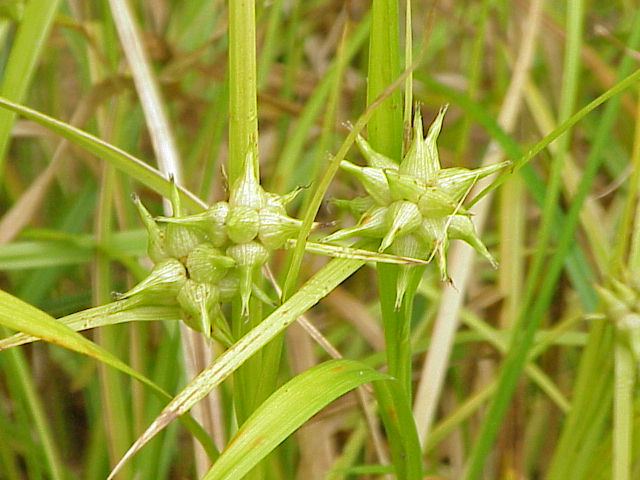
Photo: Kurt Stüber [1], CC BY-SA 3.0 · source

Ornamental grass · Cyperaceae
Gray's sedge
Carex grayi
In other languages: Carex grayi (Nederlands) · Carex grayi (Français)
Carex grayi, known as Gray’s sedge, is a sedge from eastern North America, where it grows in wet meadows, swampy woods and along rivers. It forms a sturdy clump 60–90 cm tall with fresh green, fairly broad leaves. Its special feature is the fruit: from summer on, spiky green balls about 3 cm across appear on the stems, looking like a medieval mace or morning star. They turn brown later and are excellent in dried arrangements and as cut flowers. The plant is fully hardy and happiest on a moist to wet spot, for example at the edge of a pond.
Light
Sun or partial shade
preferably some sun
Moisture
Normal to wet
must not dry out
Legal basis
Loam, clay or peat
any pH
Hardiness
Fully hardy
down to -30 °C
Size
0.7 m
tall, 0.5 m wide
Flowering
June–August
| Pruning months | March |
|---|---|
| Height | 0.7 m |
| Native to Belgium | No, planted |
| Poisonous to people and pets | Not known to be poisonous |
| Flowering | June–August |
Identify
Gray's sedge: how do you recognise it?
- Habit
- Sturdy, upright clump 60–90 cm tall and 40–50 cm wide.
- Leaves
- Narrow ribbon-like, up to about 1 cm wide, fresh green, yellow-brown in autumn.
- Flower
- Inconspicuous spikes in June–July on upright stems; the female flowers sit in a rounded spike.
- Fruit
- Green balls about 3 cm across full of spiny fruits, turning brown later; the main ornamental feature.
- Stem
- Fairly stout and triangular, as in many sedges.
Flowering: June–August · Plants: March–May and September–October · Pruning: March
In your garden
Why grow it?
- Striking, spiky fruiting balls that no other sedge has.
- Lovely as a cut flower and dried in everlasting bouquets, lasting a long time.
- Fully hardy and low maintenance: one cut a year.
- Great for wet, awkward spots, pond edges and banks.
- Fresh green foliage that contrasts well with flowering moisture lovers.
Gray's sedge: where does it grow best?
- Sun or half shade; in sun the soil should preferably stay moist.
- Moist to wet, fertile soil: loam, clay or peat, acid to chalky.
- Even tolerates wet feet for a while or shallow water at the pond edge.
- Shelter it from strong wind. Allow 40–50 cm between plants.
- Light
- Sun and partial shade
- Soil type
- Loam, clay or peat
- Acidity
- Not fussy
- Moisture
- Normal or wet
- Size
- 0.7 m tall, 0.5 m wide
- Hardiness
- Hardy (to -30 °C)
Goes well with
- Yellow flag iris: Sturdy marginal plant with yellow flowers in spring.
- Meadowsweet: Creamy-white plumes on the same moist soil.
- Rodgersia: Large, decorative leaves in moist half shade.
- Marsh marigold: Yellow flowers in early spring at wet edges.
Maintenance
Gray's sedge: when and how to plant it?
Plant in March–May and September–October.
- Plant in March–May or in September–October, when the soil is not frozen.
- Dig a hole twice as wide as the root ball and mix in a few spades of compost.
- Set the plant at the same depth as in its pot and firm the soil well.
- Plant in groups of 3–5, 40–50 cm apart.
- Water thoroughly straight away, even if it rains.
- Spread a layer of leaf-mould mulch around the clump to hold the moisture.
Care
- Water
- Keep the soil moist at all times; in dry summers water generously and regularly.
- Feeding
- A spade of compost in spring; no more is needed.
- Mulching
- A layer of leaf mould in spring keeps the soil wet and cool.
- Fruit heads
- Cut them when the balls are fully grown but still green, for a fresh or dried arrangement.
- Dividing
- If the heart of the clump is bare, divide it in spring after 3–4 years.
Tip: Cut the balls while they are still green and firm and hang them upside down to dry: they keep their shape into winter.
Gray's sedge: when to prune it?
Pruning months: March.
When: From late February to March, before the new shoots start to grow.
How:
- Cut the old brown leaves and stems back to about 5–10 cm above the ground.
- Use sharp secateurs or shears and wear gloves.
- Pull dead leaves from between the new shoots with your fingers.
- In summer you can cut fruit heads for a bouquet.
Caution: Do not cut into the new shoots, only the old foliage.
Propagation
- Division
- In March–April lift the clump and divide it with a sharp spade into pieces with roots and shoots; replant straight away and water.
- Seed
- Sow in spring on moist soil, or collect the ripe fruits; the seed germinates slowly and unevenly.
Gray's sedge: how does it get through the winter?
Hardy to −30 °C.
- Fully hardy, to about −30 °C: no protection needed.
- The foliage changes colour in autumn and dies back in winter; the clump shoots again in spring.
- In a pot: keep the compost moist, place the pot against a wall and protect it with hessian in severe frost.
Diseases and pests
- Brown leaf tips: The soil is too dry. Water generously, mulch and preferably choose a damper spot.
- Floppy, flattened stems: Too much shade or after heavy rain. Move the plant to a lighter spot and plant in groups so the clumps support one another.
- Bare heart: After a few years. Divide the clump in spring and replant the young pieces.
- Self-sown seedlings: In wet soil young plants may establish. Weed them out or move them in spring.
Through the year
- March: Cut back old foliage. Divide and plant. Add compost.
- April: Plant. Mulch.
- May: Plant. Water in dry spells.
- June: Inconspicuous spikes flower.
- July: Fruit heads form. Water in dry spells.
- August: Cut fruit heads for bouquets.
- September: Plant. Make dried bouquets.
- October: Plant. Yellow-brown autumn colour.
- December: Rest. Leave the brown clump standing.
You and this species
Did you know?
- The plant is named after the American botanist Asa Gray.
- It is also called mace sedge or morning star sedge, after the spiky fruiting balls.
- In the wild it grows in wet places such as river banks and wet woods in eastern North America.