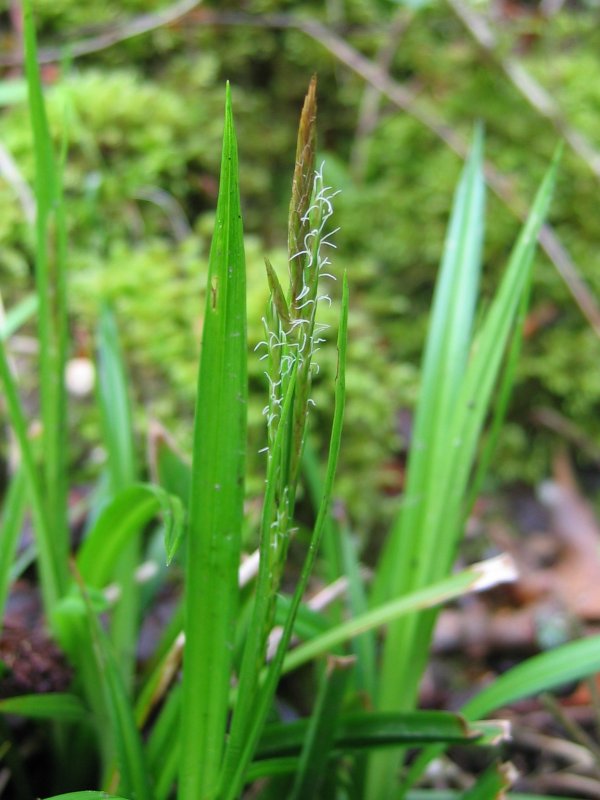
Photo: Kristian Peters -- Fabelfroh 18:35, 10 August 2006 (UTC), CC BY-SA 3.0 · source

Ornamental grass · Cyperaceae
Wood sedge
Carex sylvatica
In other languages: Boszegge (Nederlands) · Laîche des bois (Français)
Wood sedge is a native sedge of damp deciduous woodland across almost all of Europe, including the woods of Belgium. It forms loose, evergreen tufts of narrow, soft, fresh green leaves that arch gracefully. In May and June thin stems appear, with a slender male spike at the top and a few slim, drooping female spikes on long stalks below. Gardeners value it because it does well in deep shade, under trees and on heavy soil, where a lawn or most ornamental grasses fail. Planted in groups, it makes a calm, natural green carpet beneath trees and shrubs.
Light
Partial shade or shade
tolerates little sun
Moisture
Normal
no wet feet
Legal basis
Loam or clay
neutral to chalky
Hardiness
Fully hardy
down to -25 °C
Size
0.5 m
tall, 0.4 m wide
Flowering
May–June
| Pruning months | March and July |
|---|---|
| Height | 0.5 m |
| Native to Belgium | Yes |
| Poisonous to people and pets | Not known to be poisonous |
| Flowering | May–June |
Identify
Wood sedge: how do you recognise it?
- Habit
- Loose evergreen tuft 30–50 cm tall and about 40 cm across.
- Leaves
- Narrow, 3–6 mm wide, soft and fresh green, gracefully arching.
- Flowers
- In May–June: a slender brownish male spike at the top and a few slim green female spikes on long, drooping stalks.
- Stems
- Thin and three-angled, often leaning or arching.
- Seed
- Small nutlets in summer; it self-seeds moderately.
- Roots
- Dense, fibrous root ball without long runners.
Flowering: May–June · Plants: March–May and September–October · Pruning: March and July
In your garden
Why grow it?
- One of the few grass-like plants that thrive in deep shade.
- Green all year: a calm backdrop for spring flowers and ferns.
- Native, so ideal for a natural shade or woodland garden.
- In groups it forms soft green underplanting beneath trees and shrubs.
- Compact and modest: it does not swamp its neighbours.
- Little work: just some tidying in spring.
Wood sedge: where does it grow best?
- Partial to deep shade; full sun is too dry and too harsh.
- Loam or clay, humus-rich, neutral to chalky.
- Normally moist soil that does not dry out completely in summer.
- Plant 30–40 cm apart, in groups of three or more for a natural effect.
- Light
- Partial shade and shade
- Soil type
- Loam or clay
- Acidity
- Neutral or chalky
- Moisture
- Normal
- Size
- 0.5 m tall, 0.4 m wide
- Hardiness
- Hardy (to -25 °C)
Goes well with
- Lady fern: Fine, airy fern fronds in the same shade, a classic woodland-floor pairing.
- Wood anemone: White spring flowers between the tufts, before the trees come into leaf.
- Sweet woodruff: A native ground cover with small white starry flowers in May.
- Solomon’s seal: Arching stems with hanging white bells in May.
- Snowdrop: Early white flowers in February, when the sedge is the only green plant around.
Maintenance
Wood sedge: when and how to plant it?
Plant in March–May and September–October.
- Plant from March to May or in September–October, when the soil is moist.
- Dig a hole twice as wide as the pot and mix in some leaf mould.
- Set the plant at the same depth as it was in the pot and firm the soil well.
- Space plants 30–40 cm apart, about 7–9 plants per m².
- Water in well and keep the soil moist for the first few weeks.
- Spread a thin layer of leaf mould or shredded leaves around the plants, like a woodland floor.
Care
- Water
- Water in dry spells during the first year. Once established it copes, except in long dry summers.
- Feeding
- Not needed. Leave fallen leaves in autumn: they turn into humus by themselves.
- Tidying
- In March, comb the dead leaves out of the tuft with gloved fingers.
- Flower stems
- If you do not want seedlings, cut the spent stems off at the base in July.
- Mulching
- A layer of leaf mould in spring keeps the soil cool and moist.
Tip: Plant wood sedge in groups among ferns and spring flowers and leave the autumn leaves where they fall: you get a natural green woodland floor with no effort.
Wood sedge: when to prune it?
Pruning months: March and July.
When: An evergreen sedge that you do not cut back. In March you clear out dead leaves; in July you can cut off the spent flower stems.
How:
- In March, gently comb or pull the dead leaves out of the tuft and leave the green leaves in place.
- Cut the flower stems off at the base after flowering if you want to limit seedlings.
- If an old tuft looks very untidy, divide it in spring rather than cutting it short.
Propagation
- Division
- In March–April or September: lift the tuft, pull or cut it into pieces with roots and leaves, and replant them at once.
- Seed
- Sow fresh seed in autumn in a pot left outdoors over winter. Self-sown seedlings in the garden are easy to move while young.
Wood sedge: how does it get through the winter?
Hardy to −25 °C.
- Fully hardy, to about −25 °C: no protection is needed in Belgium.
- The leaves stay green; by the end of winter they sometimes look a little tired, but fresh growth follows in spring.
- Leave fallen tree leaves between the tufts as a natural blanket.
Diseases and pests
- Drying out: Brown, limp leaves in dry summers, especially under trees. Water and mulch with leaf mould.
- Untidy tuft: Lots of dead leaves after a few years. Comb the tuft out in March or divide it.
- Rust: Orange-brown pustules on the leaves. Cut off affected leaves; it is usually harmless.
- Seedlings: In a spot it likes, young plants appear. Weed them out or move them to where you want them.
Through the year
- March: Comb out dead leaves. Plant or divide.
- April: Plant or divide. Mulch with leaf mould.
- May: Flowering: slim, drooping spikes.
- June: End of flowering. Water in dry spells.
- July: Cut off spent stems if you do not want seedlings.
- August: Water during long droughts.
- September: Plant or divide.
- October: Plant. Leave fallen leaves on the ground.
- December: Green leaves in the shade garden. Do not cut back.
You and this species
Did you know?
- ‘Sylvatica’ is Latin for ‘of the woods’: the name refers to its natural habitat.
- Wood sedge often grows in old deciduous woods and along woodland paths, and in parts of Europe it is regarded as a sign of ancient woodland.
- Sedges do not belong to the grass family but to the sedge family, Cyperaceae, like papyrus.