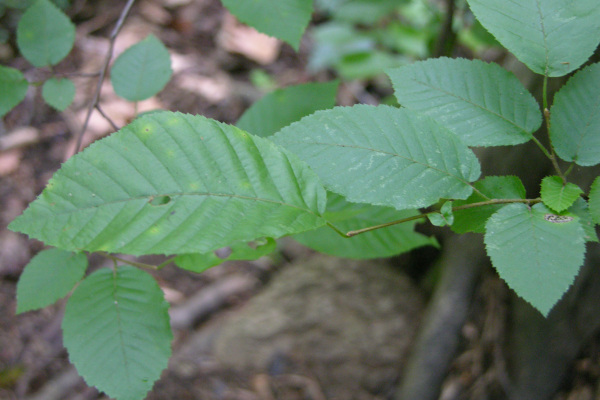
Photo: Photo by and (c)2005 Derek Ramsey (Ram-Man), CC BY-SA 2.5 · source

Tree · Betulaceae
American hornbeam
Carpinus caroliniana
In other languages: Amerikaanse haagbeuk (Nederlands) · Charme de Caroline (Français)
American hornbeam comes from eastern North America, where it grows as a small understorey tree, often along streams and in damp valleys. It stays smaller than our native hornbeam and has a distinctive smooth, blue-grey trunk with fluted, muscle-like ridges. In autumn the leaves turn yellow, orange and red. In spring catkins hang from the branches, and in summer clusters of small fruits dangle in three-lobed bracts. It grows slowly and suits a woodland edge or a shady garden.
Light
Sun to shade
not fussy
Moisture
Normal to wet
must not dry out
Legal basis
Sand, loam or clay
acid to neutral
Hardiness
Fully hardy
down to -35 °C
Size
9 m
tall, 8 m wide
Flowering
April–May
| Pruning months | February |
|---|---|
| Height | 9 m |
| Native to Belgium | No, planted |
| Good for bees, butterflies and birds | Yes, for birds |
| Poisonous to people and pets | Not known to be poisonous |
| Flowering | April–May |
Identify
American hornbeam: how do you recognise it?
- Habit
- Small, spreading tree or large shrub, about 9 m tall and 8 m wide; slow-growing.
- Trunk
- Smooth, blue-grey and fluted with muscle-like bulges, very decorative in winter.
- Leaves
- Oval, 6–12 cm, doubly toothed with prominent veins; dark green, yellow to orange-red in autumn.
- Flowers
- Catkins in April–May, male and female on the same tree; not showy.
- Fruit
- Small nutlets in three-lobed, leafy bracts, hanging in clusters.
Flowering: April–May · Plants: March–April and October–December · Pruning: February
In your garden
Why grow it?
- Distinctive blue-grey, fluted trunk with muscle-like ridges that stands out all year.
- Lovely autumn colour from yellow to orange-red.
- Tolerates partial shade and moist soil, where many other trees grow poorly.
- A small tree that fits a woodland edge or a smaller garden.
- The fruits and buds are a food source for birds.
American hornbeam: where does it grow best?
- Partial shade to shade; it colours best in a bright spot but tolerates a lot of shade.
- Moist, humus-rich soil: sand, loam or clay, acid to neutral.
- Normal to wet soil, including beside a stream or pond; it tolerates temporary waterlogging.
- Plant 4–6 m from buildings or other large trees and let the crown spread up to 8 m wide.
- Light
- Sun, partial shade and shade
- Soil type
- Sand, loam or clay
- Acidity
- Acid or neutral
- Moisture
- Normal or wet
- Size
- 9 m tall, 8 m wide
- Hardiness
- Hardy (to -35 °C)
Goes well with
- Ferns: A fresh woodland underplanting that tolerates shade and moist soil.
- Hosta: Large leaves for a shady edge.
- Wood anemone: Flowers in spring before the leaves open.
- Rhododendron: Likes the same moist, acid soil and light shade.
Maintenance
American hornbeam: when and how to plant it?
Plant in March–April and October–December.
- Plant in March–April or from October to December, when the soil is neither frozen nor waterlogged.
- Dig a hole twice as wide as the root ball and just as deep.
- Set the tree at the same depth as in its pot or at the nursery and backfill with the soil you dug out, mixed with a little compost.
- Add a stake and tie the trunk loosely with a tree tie.
- Water generously straight away and spread a 5–8 cm layer of leaf mould or wood chips around the base.
Care
- Water
- In the first two summers, water thoroughly every week in dry spells. Even an established tree appreciates water in a prolonged dry period.
- Feeding
- Usually unnecessary. A layer of compost in spring is enough.
- Mulching
- Leave fallen leaves in place or spread leaf mould around the base: it keeps the soil cool and moist.
- Staking
- Tie a young tree to a stake for 2–3 years and check the tie every year.
- Training
- In the first years, choose one or a few strong stems; after that it shapes itself nicely.
Tip: Put it in partial shade on moist soil, for example at a woodland edge or in a shady corner, and leave it in clear view in winter: that is when the remarkable trunk looks best.
American hornbeam: when to prune it?
Pruning months: February.
When: It needs little pruning; if needed, in winter, in January–February, when the tree is bare.
How:
- Remove dead, damaged and crossing branches.
- Cut small branches just outside the branch collar, never flush with the trunk.
- On a young tree, remove competing leaders and keep a single main leader.
- Never remove more than a fifth of the crown in one year.
Propagation
- Seed
- Sow the seed outdoors in autumn in a tray of light, moist soil, or after cold stratification in spring. The seed may lie dormant for a year before germinating.
- Nursery
- Seedlings grow slowly. For a handsome tree quickly, buy a young tree from a nursery.
American hornbeam: how does it get through the winter?
Hardy to −35 °C.
- Fully hardy, to about −35 °C: no protection is needed in Belgium.
- In winter the smooth, fluted trunk is an attractive focal point.
- In a hard winter, give young trees an extra layer of mulch around the base.
Diseases and pests
- Scorched leaf edges: Brown edges in drought or on a spot that is too sunny and dry. Water generously and apply a mulch.
- Powdery mildew: White powder on the leaves, mostly at the end of summer. Usually harmless; choose an airy position.
- Aphids: Sticky leaves in summer. Ladybirds and tits usually clear them up.
- Coral spot: Orange-red dots on dead twigs. Prune affected branches back into healthy wood.
Through the year
- February: Prune if needed. Remove dead branches.
- March: Plant. Apply mulch.
- April: Catkins open. Planting still possible.
- May: Leaves fully out. Water in dry weather.
- June: Water young trees in dry weather.
- July: Water during prolonged drought.
- September: Fruit ripens. Collect nutlets for sowing.
- October: Autumn colour from yellow to red. Plant.
- November: Plant. Leave the leaves as mulch.
- December: Rest. Plant while the soil is open.
Use
Good for wildlife
- Birds
- Berries, seeds or insects as food, or a place to nest.
You and this species
Did you know?
- In English the tree has nicknames such as musclewood and blue-beech, after its muscular, blue-grey trunk.
- The wood is hard and dense and was once used for tool handles and implements.
- It is related to our native hornbeam, but stays smaller and tolerates more shade.