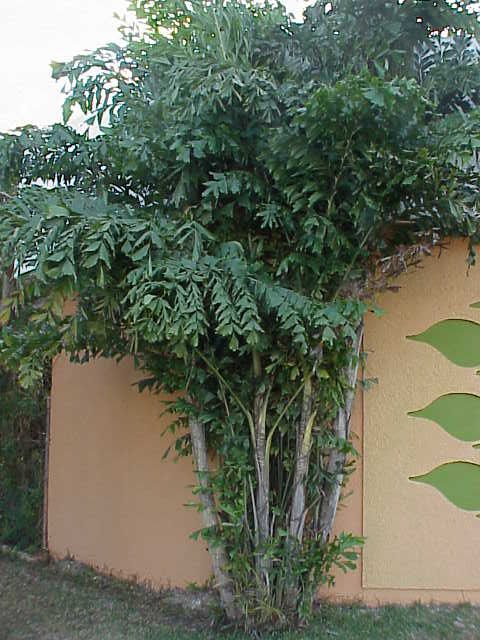
Photo: Wikimedia Commons, CC BY-SA 3.0 · source

Houseplant · Arecaceae
Fishtail palm
Caryota mitis
In other languages: Vissenstaartpalm (Nederlands) · Palmier queue de poisson (Français)
The fishtail palm comes from the tropical forests of South-East Asia, from Myanmar and southern China to Indonesia and the Philippines. It is instantly recognisable by its twice-divided leaves with triangular leaflets, ragged at the tip, that look like a fish’s tail. Caryota mitis grows in clumps: new stems keep appearing at the base, so it forms a full, broad plant. Indoors it reaches 1.5–2.5 m and brings a lush, tropical feel. It needs warmth, bright light without strong sun and humid air, and rewards you with an exotic centrepiece in a spacious room.
Caution: The fruits and sap contain sharp crystals (oxalates) that irritate the skin, mouth and throat. Keep the plant out of reach of children, cats and dogs, pick up fallen fruit and wear gloves when pruning or sowing.
Light
Partial shade
no harsh midday sun
Moisture
Normal to wet
must not dry out
Legal basis
Potting soil
Hardiness
Houseplant
min. 15 °C
Size
2.5 m
tall, 1.5 m wide
| Height | 2.5 m |
|---|---|
| Poisonous to people and pets | Yes, take care with children and pets |
Identify
Fishtail palm: how do you recognise it?
- Habit
- Multi-stemmed clump, 1.5–2.5 m tall and 1–1.5 m wide indoors; much larger in the tropics.
- Leaves
- Twice-divided, up to 1 m long or more, with triangular leaflets that are ragged at the tip.
- Stem
- Slender green to brown stems. Each stem dies after flowering, but the clump lives on.
- Flower and fruit
- Rare indoors. Hanging flower clusters, followed by small round fruits, red ripening to purplish black.
- Roots
- Fleshy and easily damaged; it prefers a deep pot.
Plants: April–May
In your garden
Why grow it?
- An exceptional leaf shape: no other indoor palm has such ragged, fishtail-like leaflets.
- Grows as a clump with several stems, so it stays full instead of going bare.
- Evergreen and a tropical eye-catcher all year in a spacious room.
- Tolerates a bright spot without direct sun, such as near a large east or west window.
- An impressive tub plant for a heated conservatory, winter garden or bright hall.
Fishtail palm: where does it grow best?
- Bright, but without strong midday sun: near a large east or west window, or set back from a south window.
- Warm: 18–25 °C, never below 15 °C, and out of draughts.
- Humid air: in dry indoor air it gets brown leaf tips and spider mite.
- Humus-rich, open compost that stays moist but drains well.
- Allow space: the leaves need 1–1.5 m of width.
- Light
- Bright, out of direct sun
- Potting soil
- Multi-purpose compost or airy, humus-rich compost
- Acidity
- Acid or neutral
- Watering
- Moderately or generously
- Size
- 2.5 m tall, 1.5 m wide
- Temperature
- Minimum 15 °C
Goes well with
- Kentia palm: A calm palm with simply divided leaves, as a contrast.
- Swiss cheese plant: Large, cut leaves for a real jungle corner.
- Calathea: Low, patterned leaves at its feet that also like humid air.
- Boston fern: Fresh green that enjoys the same warm, humid air.
Maintenance
Fishtail palm: when and how to plant it?
Plant in April–May.
- Repot in April or May, only when the roots fill the pot, every two or three years.
- Choose a deep, sturdy pot just slightly larger, with a drainage hole and a layer of clay pebbles.
- Use palm compost or good potting compost with some coarse sand or perlite.
- Ease the root ball out carefully, damage the fleshy roots as little as possible and set the plant at the same depth as before.
- Water in well and let the excess drain away.
- Large, older plants are no longer repotted: replace the top 3–5 cm of compost with fresh every spring.
Care
- Water
- Keep the compost evenly moist but never soggy: water when the top 2 cm is dry. Preferably use rainwater or water at room temperature.
- Humidity
- Stand the pot on a large tray of wet clay pebbles, group plants together or use a humidifier in winter.
- Feeding
- From April to September, liquid feed for foliage plants or palms once a month.
- Leaves
- Rinse off dust now and then under a lukewarm shower or wipe with a damp cloth.
- Turning
- Give the pot a quarter turn now and then, so the plant grows evenly.
Tip: Stand it on a large tray of wet clay pebbles and water evenly: that prevents the brown leaf tips palms so often suffer from in dry rooms.
Fishtail palm: when to prune it?
When: A fishtail palm is not pruned; remove dead leaves and stems as needed.
How:
- Cut completely brown leaves off close to the stem with sharp secateurs.
- Do not cut off green leaves: the palm needs them and makes new ones only slowly.
- You can trim brown leaf tips, but leave a thin brown edge.
- Cut a stem that has flowered and is dying back off at the base.
Caution: Wear gloves if the plant carries fruit: the fruit pulp irritates the skin.
Propagation
- Division
- In April–May, carefully separate a sucker with its own roots from the clump and pot it up on its own. Keep it warm and humid until it establishes.
- Seed
- Fresh seed in moist seed compost at 25–30 °C. Germination is slow and erratic and can take months. Wear gloves when cleaning the seeds.
Fishtail palm: how does it get through the winter?
- A house plant that wants warmth: never below 15 °C, not even at night.
- In winter give it the brightest spot, away from radiators and cold window panes.
- Water a little less, but never let the root ball dry out; stop feeding.
- Dry air is the biggest winter problem: raise the humidity.
Diseases and pests
- Brown leaf tips: Caused by dry air, irregular watering or too much feed. Raise the humidity and water evenly.
- Red spider mite: Fine webbing and grey-speckled leaves in dry air. Rinse the plant in the shower and raise the humidity.
- Scale and mealybug: Brown bumps or white fluffy tufts on leaf stalks and leaves. Wipe off with a cloth dipped in methylated spirit.
- Yellow lower leaves: Normal now and then, through age. If many leaves yellow at once, the compost is usually too wet: water less.
Through the year
- January: Keep it bright and warm. Raise the humidity.
- February: Check for red spider mite and scale.
- March: For large plants, replace the top layer of compost.
- April: Repot if needed. Start feeding again.
- May: Repot or take off suckers. Water regularly.
- June: Feed monthly. Keep out of strong sun.
- July: Keep evenly moist. Rinse the leaves in the shower.
- August: Water and feed.
- September: Last feed.
- October: Water a little less. Stop feeding.
- November: Move it away from the radiator.
- December: Raise the humidity. Cut off dead leaves.
Use
Edible and useful
Not edible. The fruits and sap of fishtail palm are full of needle-shaped crystals (oxalates), which cause itching and burning on the skin, and in the mouth intense burning pain and swelling of the mouth and throat. Indoors it rarely flowers; if it does bear clusters of red to black berries, pick them up at once and keep them out of reach of children, cats and dogs. Wear gloves when pruning, cutting off flower clusters and sowing, and wash your hands afterwards. If any is swallowed, call a poison centre (in Belgium 070 245 245) or your doctor at once.
You and this species
Did you know?
- Caryota is the only palm genus with twice-divided leaves.
- Each stem flowers once, from the top downwards, and then dies; the clump lives on through new stems.
- In Asia, the sap from the flower stalks of related species is used to make palm sugar.