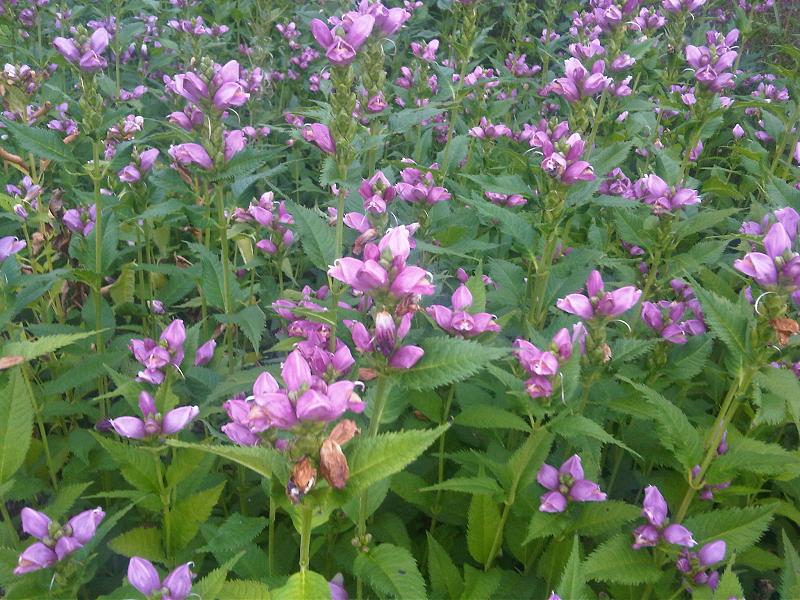
Photo: Emőke Dénes, CC BY-SA 4.0 · source

Perennial · Plantaginaceae
Rose turtlehead
Chelone obliqua
In other languages: Schildpadbloem (Nederlands) · Galane oblique (Français)
Rose turtlehead comes from the south-eastern and central United States, where it grows in swampy woods, along streams and in wet meadows. It is a sturdy, upright perennial of about 60–80 cm with dark green, toothed leaves. From August to October dense spikes of pink to purplish-pink flowers appear at the tops of the stems; their closed lips look like the head of a turtle. Gardeners like it because it flowers late, tolerates wet soil and stays in the same spot for years with little care. There is also a white-flowered form.
Light
Sun or partial shade
preferably some sun
Moisture
Normal to wet
must not dry out
Legal basis
Loam, clay or peat
acid to neutral
Hardiness
Fully hardy
down to -35 °C
Size
0.8 m
tall, 0.45 m wide
Flowering
August–October
| Pruning months | March and May |
|---|---|
| Height | 0.8 m |
| Native to Belgium | No, planted |
| Good for bees, butterflies and birds | Yes, for bees |
| Poisonous to people and pets | Not known to be poisonous |
| Flowering | August–October |
Identify
Rose turtlehead: how do you recognise it?
- Habit
- Upright clump 60–80 cm tall and about 45 cm across; spreads slowly by short rhizomes.
- Leaves
- Opposite, lance-shaped to oval, dark green and coarsely toothed.
- Flower
- Two-lipped, closed flowers of 2–3 cm in dense spikes at the stem tips, from August to October.
- Colour
- Pink to purplish pink; there is also a white form.
- Fruit
- Round seed capsules with flat seeds edged by a papery wing; they stay on the plant for a long time.
Flowering: August–October · Plants: March–April and September–October · Pruning: March and May
In your garden
Why grow it?
- Flowers late, from August to October, when many perennials are already over.
- One of the few flowering plants that thrive in wet soil and at the edge of a pond.
- Bumblebees crawl into the closed flowers: a real pleasure to watch.
- Sturdy stems that usually need no support, especially after a trim in May.
- The dark seed heads stay decorative through winter.
- A long-lived plant that slowly forms a dense clump and needs little work.
Rose turtlehead: where does it grow best?
- Sun or partial shade; full sun only if the soil stays really moist.
- Humus-rich loam, clay or peaty soil, acid to neutral.
- Moist to wet: ideal at a pond edge, in a bog border or in a spot that is wet in winter.
- On dry soil it wilts quickly and gets powdery mildew.
- Plant 40–45 cm apart, in groups of three to five for the best effect.
- Light
- Sun and partial shade
- Soil type
- Loam, clay or peat
- Acidity
- Acid or neutral
- Moisture
- Normal or wet
- Size
- 0.8 m tall, 0.45 m wide
- Hardiness
- Hardy (to -35 °C)
Goes well with
- Joe Pye weed: Tall pink flower heads for the same moist soil in late summer.
- Purple loosestrife: Purple spikes that also like wet feet.
- Bugbane: White, scented spires in late summer, in the same partial shade.
- Miscanthus: A tall ornamental grass as a backdrop, attractive into winter.
Maintenance
Rose turtlehead: when and how to plant it?
Plant in March–April and September–October.
- Plant in March–April or September–October, when the soil is moist and not frozen.
- Dig a hole twice as wide as the pot and work in compost or leaf mould.
- Set the plant at the same depth as in the pot and firm the soil well.
- Leave 40–45 cm between plants.
- Water generously and do not let the soil dry out during the first months.
- Mulch with leaf mould to keep the soil moist and cool.
Care
- Watering
- Never let the soil dry out; water generously in dry summers, even by a pond if the plant sits above the water level.
- Feeding
- A layer of compost or well-rotted manure in spring is enough.
- Mulching
- A layer of leaf mould in April holds in moisture.
- Cutting back
- Cut the stems back by half in late May for a lower, sturdier plant that flowers a little later.
- Support
- In shade or rich soil the stems may flop: a ring or a few twiggy sticks help.
Tip: In late May, cut back only some of the stems by half and leave the rest: you get sturdier plants and a longer flowering season, because the trimmed stems flower later.
Rose turtlehead: when to prune it?
Pruning months: March and May.
When: In March, cut away last year’s dead stems. In late May you can cut the new stems back by half.
How:
- In March, cut all old stems back to just above the ground.
- In late May, cut the stems back by half: the plant becomes lower, sturdier and branches more.
- To spread the flowering, cut back only some of the stems.
- Leave the spent spikes standing in autumn for winter structure.
Caution: Do not cut back after early June, or it will flower too late or hardly at all.
Propagation
- Division
- In March–April or October, cut the clump into pieces with a spade, each with a few buds, and replant at once.
- Cuttings
- In May, root 8–10 cm cuttings of young shoots, for example from the trimmed stems, in moist cutting compost.
- Seed
- The seed needs a cold spell: sow in autumn in a tray outdoors and it will germinate in spring.
Rose turtlehead: how does it get through the winter?
Hardy to −35 °C.
- Very hardy, to −35 °C: no protection is needed in Belgium.
- Leave the stems and seed heads until March: they give structure and shelter insects.
- Wet soil in winter is no problem for this plant.
- In a pot: make sure the compost does not dry out and keep the pot sheltered.
Diseases and pests
- Powdery mildew: White powder on the leaves, especially in drought. Keep the soil moist, give plants space and cut off affected leaves.
- Slugs: They eat the young shoots in April–May. Pick them off in the evening or put a ring of coarse sand around the plant.
- Flopping stems: Too much shade or too rich a soil. Cut back by half in May or add some support.
- Brown leaf edges: A sign of drought or harsh midday sun. Water and mulch more, or move the plant to partial shade.
Through the year
- March: Cut dead stems down to the ground. Plant or divide.
- April: Planting. Mulch with leaf mould. Watch for slugs.
- May: In late May, cut the stems back by half. Take cuttings.
- June: Water in dry spells.
- July: Water; the flower buds are forming.
- August: Flowering begins. Bumblebees visit.
- September: Full flower. Plant or divide.
- October: Last flowers. Planting. Sow seed in a tray outdoors.
- November: Leave the seed heads standing.
- December: Rest. Winter structure from the dark seed heads.
Use
Good for wildlife
- Bees
- Nectar and pollen for honeybees and wild bees.
You and this species
Did you know?
- The name Chelone comes from the Greek word for tortoise; in a Greek tale the nymph Chelone was turned into a tortoise.
- The flowers are so tightly closed that mainly bumblebees are strong enough to push their way inside.
- The flat seeds have a papery edge, so wind and water can carry them away.