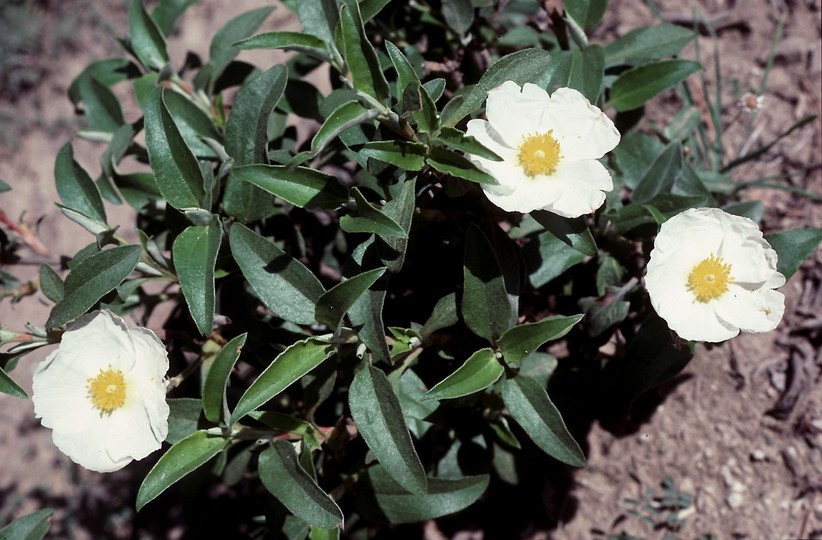
Photo: Leif Stridvall, CC BY-SA 2.5 · source

Shrub · Cistaceae
Laurel-leaved rockrose
Cistus laurifolius
In other languages: Rotsroos (Nederlands) · Ciste à feuilles de laurier (Français)
The laurel-leaved rockrose grows wild mainly in the mountains of Spain and Portugal, but also in southern France and North Africa, often on acid, stony soil. Used to cold winters there, it is regarded as the hardiest rockrose. It is an upright evergreen shrub up to 1.5 m with dark green, sticky leaves that smell resinous on warm days. In June and July it bears clusters of pure white flowers with a yellow centre, each open for just one day. It is ideal for a sunny, dry spot on sandy soil or in a gravel garden.
Light
Full sun
warm and bright
Moisture
Dry
tolerates drought
Legal basis
Sand or loam
acid to neutral
Hardiness
down to -15 °C
protect young plants
Size
1.5 m
tall, 1.5 m wide
Flowering
June–July
| Pruning months | April and August |
|---|---|
| Height | 1.5 m |
| Native to Belgium | No, planted |
| Good for bees, butterflies and birds | Yes, for bees |
| Poisonous to people and pets | Not known to be poisonous |
| Flowering | June–July |
Identify
Laurel-leaved rockrose: how do you recognise it?
- Habit
- Upright, fairly open evergreen shrub, 1–1.5 m tall and as wide.
- Leaves
- Lance-shaped to oval, 4–9 cm, dark green and sticky above, paler and felted beneath.
- Flowers
- Pure white, 5–6 cm across, with a yellow centre, in clusters on long stalks; each flower lasts one day. June–July.
- Scent
- In warm weather the sticky leaves give off a resinous smell.
- Roots
- Deep-rooted: it resents being moved.
Flowering: June–July · Plants: April–May · Pruning: April and August
In your garden
Why grow it?
- The hardiest rockrose: the best choice if you want a Mediterranean shrub that survives Belgian winters.
- Pure white flowers in June–July, after many spring bloomers have finished, busy with bees.
- Dark evergreen leaves that give structure all year and smell pleasantly resinous on warm days.
- Drought-tolerant and happy on poor, acid sandy soil where few other flowering plants do well.
- Lovely in a gravel garden, on a sunny bank or in a heather garden.
Laurel-leaved rockrose: where does it grow best?
- Full sun; the warmer the spot, the better the flowering.
- Poor, free-draining sandy or loamy soil, acid to neutral. It grows less well on chalky soil.
- Dry: no wet feet in winter. On heavier loam, plant on a mound or work in grit.
- Allow 1–1.5 m per plant; it looks best in a group of three.
- Light
- Sun
- Soil type
- Sand or loam
- Acidity
- Acid or neutral
- Moisture
- Dry
- Size
- 1.5 m tall, 1.5 m wide
- Hardiness
- Hardy (to -15 °C)
Goes well with
- Broom: Likes the same acid, dry sandy soil and flowers just before.
- Heather: The same acid sandy soil, with flowers in late summer.
- Lavender: Purple flowers beside the white ones, in a sunny, dry spot.
- Thyme: A low, fragrant edging in front of the shrub.
- Blue fescue: Blue-grey tufts that stand out against the dark leaves.
Maintenance
Laurel-leaved rockrose: when and how to plant it?
Plant in April–May.
- Plant in April–May, so it is well rooted before winter.
- Choose a young plant in a pot: small plants establish better than large ones.
- Dig a hole slightly larger than the pot and mix grit or coarse sand into heavier soil. No fertiliser or compost.
- Set the plant at the same depth as in the pot, no deeper, and firm the soil.
- Water at planting and during the first weeks in dry weather.
- Mulch with gravel or coarse sand so the base of the stems stays dry.
Care
- Watering
- In the first year during long dry spells. After that hardly ever: it copes with drought far better than with wet soil.
- Feeding
- Not needed: on rich soil it becomes floppy and flowers less.
- Mulching
- A layer of gravel around the base keeps the stems dry and suppresses weeds.
- Moving
- Best avoided: it roots deeply and struggles to re-establish after moving.
- Renewing
- After about ten years it often becomes bare and less attractive. Take cuttings in good time to replace it.
Tip: Plant it in the sunniest, driest spot you have, ideally on sandy soil or in gravel, and do not feed it: poor soil keeps it compact and free-flowering.
Laurel-leaved rockrose: when to prune it?
Pruning months: April and August.
When: A light trim straight after flowering, in August, keeps it compact. In April, remove any frost-damaged shoots.
How:
- Shorten this year’s young shoots by a third, at most by half.
- Always stay within the green, leafy part of the shoots.
- In April, cut dead or frosted shoots back to healthy wood.
Caution: Never cut into old, bare wood: a rockrose will not regrow from it.
Propagation
- Cuttings
- In July–August take semi-ripe cuttings of 8–10 cm from non-flowering shoots and insert them in a gritty mix of cutting compost and sand. Keep them slightly moist and overwinter them frost-free.
- Seed
- Sow indoors in spring in a warm place. Rockroses hybridise easily, so seedlings do not always resemble the parent.
Laurel-leaved rockrose: how does it get through the winter?
Hardy to −15 °C: protect young plants.
- Hardy to about −15 °C on dry soil: in most Belgian winters it stays outside without protection.
- In their first winter, cover young plants with fleece in hard frost and cold easterly winds.
- Wet soil is more dangerous than frost: make sure water drains away well in winter.
- In a pot: stand it against a sheltered wall in winter, out of the rain, and water sparingly.
Diseases and pests
- Root rot: The plant wilts and dies suddenly, often after a wet winter. Plant in free-draining soil and water sparingly.
- Yellow leaves: On chalky soil the leaves can turn yellow. Choose a spot with acid to neutral soil.
- Frost damage: Brown shoots after a very severe winter. Cut them back to healthy wood in April.
- Bare, sprawling shrub: Happens on rich soil or without pruning. Trim lightly every year after flowering and replace an old plant with a cutting.
Through the year
- January: In hard frost, protect young plants with fleece.
- April: Cut back frosted shoots. Plant.
- May: Plant. The flower buds swell.
- June: Flowering begins: new white flowers every day.
- July: Full bloom. Take cuttings.
- August: Trim lightly after flowering. Take cuttings.
- October: Move cuttings to a frost-free place for winter.
- December: In hard frost, protect young plants with fleece.
Use
Good for wildlife
- Bees
- Nectar and pollen for honeybees and wild bees.
You and this species
Did you know?
- The name laurifolius means with leaves like laurel, after the dark, elongated foliage.
- Rockroses produce a sticky, fragrant resin, labdanum, used in incense and perfume since ancient times. It is mainly collected from related species.
- Each flower lives for just one day: it opens in the morning and its petals drop by evening.