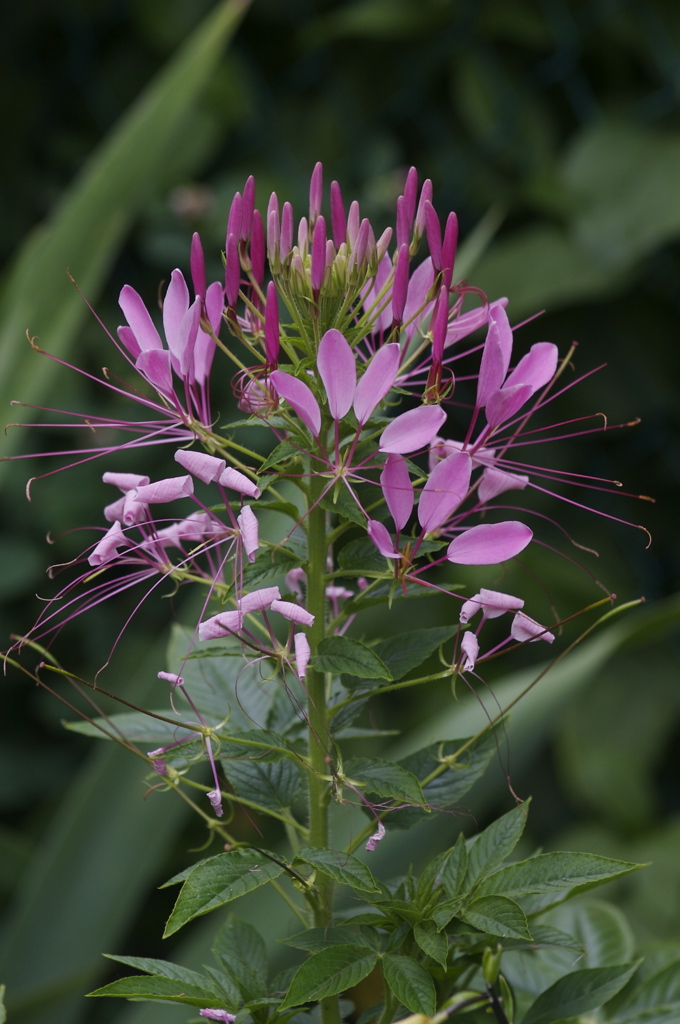
Photo: User:Schoinard, CC BY-SA 3.0 · source

Annual · Cleomaceae
Spider flower
Cleome hassleriana
In other languages: Kattensnor (Nederlands) · Cléome (Français)
Spider flower comes from South America, from south-eastern Brazil to Argentina, and is one of the most striking tall annuals. Sturdy, straight stems up to 1.2 m carry rounded clusters of flowers with four long-clawed petals and very long stamens that stick out like whiskers. Slender seed pods on long stalks soon appear below the flowers, while the cluster keeps growing and flowering at the top. It flowers from July until the frost in pink, purple, lilac and white. The hand-shaped leaves are sticky with a spicy smell, and there are small spines at the base of the leaf stalks.
Caution: The stems and leaf stalks carry small, sharp spines and the leaves are sticky. Wear gloves when cutting and clearing.
Light
Full sun
warm and bright
Moisture
Normal
no wet feet
Legal basis
Sand, loam or clay
any pH
Hardiness
down to 0 °C
protect in harsh winters
Size
1.2 m
tall, 0.5 m wide
Flowering
July–October
| Height | 1.2 m |
|---|---|
| Native to Belgium | No, planted |
| Good for bees, butterflies and birds | Yes, for bees and butterflies |
| Poisonous to people and pets | Not known to be poisonous |
| Flowering | July–October |
Identify
Spider flower: how do you recognise it?
- Habit
- Upright, sparsely branched plant 1–1.2 m tall and about 50 cm wide.
- Leaves
- Hand-shaped, divided into 5–7 narrow leaflets, sticky and hairy, with small spines at the base of the leaf stalk.
- Flower
- Rounded clusters of flowers with four long-clawed petals and long, protruding stamens; the cluster keeps extending from July to October.
- Scent
- The flowers are lightly fragrant; when touched, the leaves give off a strong, spicy smell that not everyone likes.
- Fruit
- Slender, pod-like seed capsules on long stalks that stand out at an angle from the stem.
Flowering: July–October · Sowing: March–April · Plants: May–June
In your garden
Why grow it?
- Adds height and an exotic touch to the border in a single summer.
- Flowers from July until the first frost, ever higher on the same stem.
- A good source of nectar for bees and butterflies in late summer.
- A striking cut flower for a large vase.
- Thrives in warm, sunny summers.
Spider flower: where does it grow best?
- Full sun and a warm spot: in shade it grows weak and flowers poorly.
- Ordinary, well-drained garden soil: sand, loam or clay, acid to chalky.
- Normally moist; once well rooted it copes with a short dry spell.
- Plant 40–50 cm apart, in groups of three or more for the best effect.
- A spot at the back of the border, somewhat out of the wind.
- Light
- Sun
- Soil type
- Sand, loam or clay
- Acidity
- Not fussy
- Moisture
- Normal
- Size
- 1.2 m tall, 0.5 m wide
- Hardiness
- Frost tender: plant out after the last frost (mid-May)
Goes well with
Maintenance
Spider flower: when and how to plant it?
Plant in May–June.
- Sow indoors in March–April at about 20 °C and cover the seed with a thin layer of compost. Germination can be erratic and take 1–3 weeks.
- Prick out the seedlings into individual pots and keep them warm and in good light: in the cold they hardly grow.
- Harden the plants off outdoors for a week in May and plant out after mid-May, when it is truly warm.
- Plant at the same depth as in the pot, 40–50 cm apart, and firm the soil.
- Water in well and keep the soil moist until the plant starts to grow.
Care
- Water
- Water during prolonged dry spells, especially in the first few weeks and in pots.
- Feeding
- Compost at planting is enough; too much fertiliser gives long, floppy stems.
- Support
- In a windy spot, put a cane beside the stem; usually it stands without support.
- Seed pods
- Cut off the pods below the cluster if you do not want seedlings; the energy then goes into new flowers.
- Gloves
- Wear gloves when cutting and clearing: the spines prick and the leaves are sticky.
Tip: Do not plant spider flower out too early: in cold soil it stands still for weeks. Wait until late May, when the soil is warm; then it grows away at once.
Spider flower: when to prune it?
When: No pruning is needed. From July to October, cut flowers for the vase and remove seed pods if needed.
How:
- If you do not want self-sown seedlings, cut off the pods as soon as they appear.
- Cut stems for the vase when the lowest flowers have just opened.
- In September, let a few clusters ripen if you want to save your own seed.
Caution: Wear gloves: the stems carry small, sharp spines.
Propagation
- Seed
- Indoors in March–April at 20 °C. In September–October, collect seed from ripe, brown pods and store it dry and cool.
- Self-sowing
- In a warm, open spot it sometimes self-sows. The seedlings appear late, in May–June, and then flower later.
Spider flower: how does it get through the winter?
Hardy to 0 °C: protect in harsh winters.
- Not hardy: it dies at the first frost.
- Clear the plants after the frost, wearing gloves because of the spines.
- Seed that falls to the ground sometimes survives the winter and germinates in late spring.
Diseases and pests
- Slow growth: In a cold spring young plants stand still for weeks. Do not plant out too early; with warmth it grows fast.
- Aphids: On young tips and buds. Spray off with water; ladybirds do the rest.
- Slugs: They eat young plants after planting out. Collect them in the evening and only plant out sturdy plants.
- Blowing over: Tall plants blow over in a windy spot. A cane beside the stem or a sheltered place at the back of the border helps.
Through the year
- March: Sow indoors at 20 °C.
- April: Sow more. Prick out seedlings and keep them warm.
- May: Harden off. Plant out after mid-May.
- June: Water in dry spells. Stake plants in windy spots.
- July: First flowers. Cut flowers for the vase.
- August: In full flower. Remove seed pods if you do not want self-sowing.
- September: In flower. Collect ripe seed pods.
- October: Last flowers until the frost. Store seed dry.
- November: Clear away dead plants.
Use
Good for wildlife
- Bees
- Nectar and pollen for honeybees and wild bees.
- Butterflies
- Nectar for butterflies.
You and this species
Did you know?
- In Dutch it is called ‘kattensnor’, cat’s whiskers, after the long stamens that stick out of the flower.
- The English name spider flower comes from the same long stamens, which look like spider legs.
- Spider flower belongs to its own family, the Cleomaceae, closely related to the cabbage and mustard family.