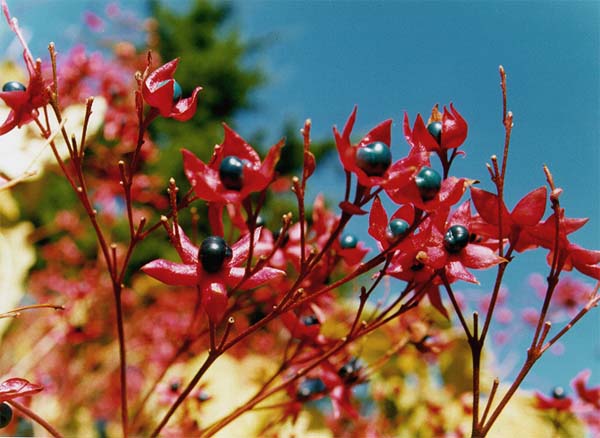
Photo: Wikimedia Commons, CC BY-SA 2.5 · source

Shrub · Lamiaceae
Harlequin glorybower
Clerodendrum trichotomum
In other languages: Kansenboom (Nederlands) · Clérodendron (Français)
The harlequin glorybower comes from China, Korea and Japan. It is a large, broad shrub or small tree of 3–4 m with big, soft leaves that give off an odd smell when bruised. In August and September it bears loose clusters of white, star-shaped flowers with long stamens, sweetly scented and attractive to butterflies and bees. Then comes the real show: glossy turquoise-blue berries set in star-shaped, crimson calyces. Few shrubs flower so late or offer such a striking autumn display.
Caution: It produces suckers, sometimes metres from the shrub, even in the lawn or among other plants. Do not plant it in a small border or right next to a terrace, and pull up or cut out the suckers every year before they become established.
Light
Sun or partial shade
preferably some sun
Moisture
Normal
no wet feet
Legal basis
Sand, loam or clay
any pH
Hardiness
down to -18 °C
protect young plants
Size
4 m
tall, 4 m wide
Flowering
August–September
| Pruning months | April–May |
|---|---|
| Height | 4 m |
| Native to Belgium | No, planted |
| Good for bees, butterflies and birds | Yes, for bees and butterflies |
| Poisonous to people and pets | Not known to be poisonous |
| Flowering | August–September |
Identify
Harlequin glorybower: how do you recognise it?
- Habit
- Broad shrub or small tree with a rounded crown, 3–4 m tall and as wide.
- Leaves
- Large, oval, 10–20 cm, softly hairy; they smell unpleasant when bruised. Late to emerge in spring.
- Flowers
- White, star-shaped, about 3 cm across, with long stamens, in loose clusters; sweetly scented, in August–September.
- Fruit
- Glossy turquoise-blue berries of about 1 cm in a star-shaped crimson calyx, in September–October.
- Roots
- Wide-spreading; sometimes produces suckers some distance from the shrub.
Flowering: August–September · Plants: April–May · Pruning: April–May
In your garden
Why grow it?
- Late flowering in August–September, when most shrubs have finished.
- Strongly and sweetly scented flowers that attract butterflies and bees.
- A unique autumn display of turquoise berries in red, star-shaped calyces.
- Grows fairly quickly and looks good as a specimen or a small tree with a broad crown.
- Recovers well after a hard winter: frozen shoots regrow from the base.
Harlequin glorybower: where does it grow best?
- Full sun or partial shade; in sun it flowers better and sets more berries.
- Any well-drained, fertile soil: sand, loam or clay, acid to chalky.
- Normally moist, in a spot sheltered from cold easterly winds, which can kill young shoots.
- Allow 3–4 m and expect suckers to appear in the lawn or border around the shrub.
- Light
- Sun and partial shade
- Soil type
- Sand, loam or clay
- Acidity
- Not fussy
- Moisture
- Normal
- Size
- 4 m tall, 4 m wide
- Hardiness
- Hardy (to -18 °C)
Goes well with
- Michaelmas daisy: Flowers at the same time and attracts the same butterflies.
- Ice plant: Flat pink heads at the base, busy with butterflies in September.
- Japanese anemone: Pink or white flowers in late summer, also in partial shade.
- Miscanthus: An ornamental grass with autumn plumes, as a backdrop for the blue berries.
Maintenance
Harlequin glorybower: when and how to plant it?
Plant in April–May.
- Plant in April–May, so the plant is well rooted before winter.
- Dig a hole twice as wide as the root ball and mix in a little compost.
- Set the plant at the same depth as in the pot and firm the soil well.
- Keep at least 2 m from other shrubs and buildings.
- Water in thoroughly straight away and regularly in dry weather during the first year.
- Spread a layer of mulch around the base; it protects the roots during the first winter.
Care
- Watering
- Regularly in dry weather in the first year; after that only in long dry spells.
- Feeding
- In April, a layer of compost or a little organic fertiliser.
- Mulching
- A layer of leaf mould or wood chips in autumn protects the roots of young plants.
- Suckers
- Pull them up as soon as you see them, or cut them off with a spade.
- Patience
- It only leafs out in May. Wait until then to judge which shoots have been killed by frost.
Tip: Simply pull up suckers as soon as you see them, and the shrub will stay neatly in its place. Only cut out frosted shoots once you can see which ones are breaking, in late April or May.
Harlequin glorybower: when to prune it?
Pruning months: April–May.
When: Prune in late April or May, when you can see which shoots are breaking. It flowers on new shoots, so spring pruning costs no flowers.
How:
- Cut frosted and dead shoots back to healthy wood or a bud that is breaking.
- For a small tree, choose one or a few stems and remove the low side branches and the suckers.
- Remove suckers all year round, at the base and in the lawn.
Caution: Do not prune too early: in March and early April you cannot yet see which shoots are alive.
Propagation
- Suckers
- In spring, sever a sucker with a piece of root and pot it up or replant it elsewhere straight away.
- Root cuttings
- In winter lay 5–8 cm pieces of root flat in a pot of cutting compost, under a thin layer of soil. They sprout in spring.
- Cuttings
- In July take semi-ripe cuttings of 10–15 cm and insert them in moist cutting compost under plastic.
Harlequin glorybower: how does it get through the winter?
Hardy to −18 °C: protect young plants.
- Hardy to about −18 °C. In a severe Belgian winter young shoots, or even all the top growth, can be killed, but it usually regrows from the base.
- Give young plants a thick layer of mulch around the base in autumn.
- A sheltered spot against a wall or among other shrubs limits frost damage.
Diseases and pests
- Suckers: Shoots popping up some distance from the shrub. Pull them up or cut them off; in the lawn, simply mow them.
- Frosted shoots: Bare, dead twigs in May. Cut them back to healthy wood; the shrub soon grows back.
- Few berries: After a cool summer or in too much shade. A warm, sunny spot helps.
- Aphids: On young shoots. Hose them off; natural predators usually deal with them.
Through the year
- January: Take root cuttings.
- April: Plant. Add compost. In late April, cut back frosted shoots.
- May: Late leafing. Remove dead wood. Clear suckers.
- June: Water in dry spells. Clear suckers.
- July: Take semi-ripe cuttings. Flower buds appear.
- August: Flowering: sweetly scented and full of butterflies.
- September: Last flowers; the berries turn turquoise.
- October: Blue berries in red calyces. Mulch around young plants.
- November: Leaf fall. The red calyces still decorate for a while.
Use
Good for wildlife
- Bees
- Nectar and pollen for honeybees and wild bees.
- Butterflies
- Nectar for butterflies.
You and this species
Did you know?
- The name Clerodendrum comes from the Greek kleros (chance, fate) and dendron (tree): tree of fate. The Dutch name kansenboom, chance tree, comes from the same idea.
- In Japan it is called kusagi, stinking tree, after the smell of its bruised leaves.
- In Japan the blue berries were once used to dye fabrics light blue.