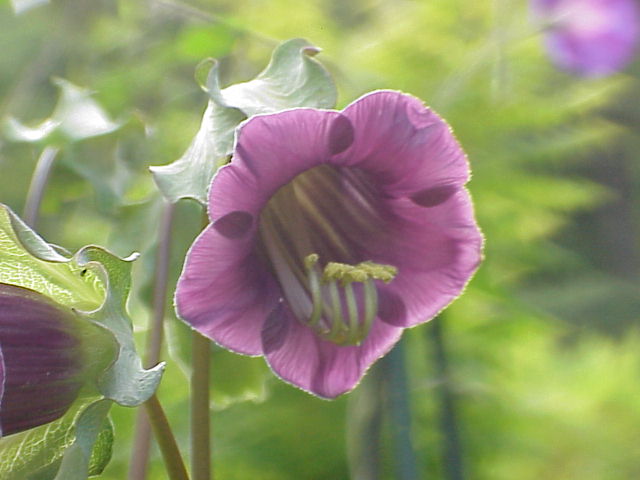
Photo: Kurt Stüber [1], CC BY-SA 3.0 · source

Annual · Polemoniaceae
Cup-and-saucer vine
Cobaea scandens
In other languages: Cobaea (Nederlands) · Cobée grimpante (Français)
The cup-and-saucer vine is a vigorous climber from Mexico, perennial in its homeland but grown as an annual here. It climbs with finely branched tendrils at the ends of its pinnate leaves and easily reaches 4 m in a single summer. From July until the first frost it carries large, bell-shaped flowers that open yellowish green and then turn deep purple-violet. Each bell sits on a broad green calyx, like a cup on a saucer, which explains its English name. Gardeners use it to cover a fence, pergola or trellis quickly. There is also a white-flowered form, ‘Alba’.
Light
Full sun
warm and bright
Moisture
Normal
no wet feet
Legal basis
Sand, loam or clay
any pH
Hardiness
down to 2 °C
protect in harsh winters
Size
4 m
tall, 1 m wide
Flowering
July–October
| Height | 4 m |
|---|---|
| Native to Belgium | No, planted |
| Good for bees, butterflies and birds | Yes, for bees |
| Poisonous to people and pets | Not known to be poisonous |
| Flowering | July–October |
Identify
Cup-and-saucer vine: how do you recognise it?
- Habit
- Vigorous climber, grown here as an annual, up to 4 m tall and about 1 m wide.
- Leaves
- Pinnate, with two or three pairs of oval leaflets and a branched tendril with tiny hooks at the tip.
- Flower
- Bell-shaped, about 5 cm long, yellowish green at first and later deep purple-violet, set on a broad green calyx at the end of a long stalk.
- Fruit
- A large, egg-shaped capsule with flat, winged seeds; here it only ripens after a warm late summer.
- Climbing
- The tendrils grip wire, mesh or twigs; it cannot climb a smooth wall without support.
Flowering: July–October · Sowing: February–March · Plants: May–June
In your garden
Why grow it?
- Grows incredibly fast: a green screen up to 4 m tall in a single summer.
- Large, striking bell flowers that change from green to purple, right up to the first frost.
- Bumblebees and bees visit the flowers.
- Ideal for quickly covering a bare wall, fence or pergola, or as a summer screen on the patio.
- Also grows in a large pot, as long as you give it enough water and support.
Cup-and-saucer vine: where does it grow best?
- Full sun and a warm, sheltered spot, for example against a south-facing wall or fence.
- Any good, free-draining garden soil: sand, loam or clay, acid to chalky.
- Moderately moist: water regularly in summer, especially in a pot.
- A sturdy trellis, mesh or wires at least 2–3 m high; allow about 1 m of width per plant.
- Light
- Sun
- Soil type
- Sand, loam or clay
- Acidity
- Not fussy
- Moisture
- Normal
- Size
- 4 m tall, 1 m wide
- Hardiness
- Frost tender: plant out after the last frost (mid-May)
Goes well with
- Black-eyed Susan vine: A smaller annual climber with orange or yellow flowers for the lower part of the trellis.
- Nasturtium: Climbs or trails at the base and fills the bottom metre with warm colours.
- Runner bean: Red flowers and edible beans on the same support.
- Sweet pea: Flowers from June–July, before the cup-and-saucer vine gets going.
Maintenance
Cup-and-saucer vine: when and how to plant it?
Plant in May–June.
- Sow indoors in February–March at 18–20 °C, setting the flat seed on its edge in a small pot of seed compost.
- Keep the compost slightly moist but not wet; the seed usually germinates within two to three weeks.
- Move the young plants to a bright, slightly cooler place, pot them on into larger pots and give them a cane to climb.
- In May, harden them off outside for a week or two and plant out after mid-May, once there is no more risk of frost.
- Plant against a sturdy support, at the same depth as in the pot, and water well.
- Mulch the base with compost to keep the soil moist.
Care
- Water
- Water generously in dry spells; plants in pots sometimes daily.
- Feeding
- Moderately: lots of nitrogen gives lots of leaves and few flowers. In a pot, a fertiliser for flowering plants every two to three weeks is enough.
- Training
- Tie the first shoots to the support; after that it climbs on its own with its tendrils.
- Pinching out
- Pinch out the tip of young plants once in April–May so they branch better.
- Pots
- Choose a pot at least 40 cm across with good compost and put in a sturdy trellis straight away.
Tip: Feed sparingly and give it the warmest wall in the garden: with lots of nitrogen it makes mostly leaves and flowers late.
Cup-and-saucer vine: when to prune it?
When: Grown as an annual, the cup-and-saucer vine is hardly pruned. Pinch out young plants in spring and clear the plant after the first frost.
How:
- In April–May, pinch out the tip of young plants just above a leaf for bushier growth.
- In summer, shorten shoots that grow too far or get in the way.
- After the first frost, cut the plant off at the base and pull the tendrils out of the support.
Propagation
- Seed
- The usual method: sow indoors in February–March at 18–20 °C, with the seed on its edge. Collecting your own seed only works here after a warm late summer.
- Cuttings
- Tip cuttings of 8–10 cm root in summer in moist cutting compost under plastic in a warm place. This lets you overwinter a young plant indoors.
Cup-and-saucer vine: how does it get through the winter?
Hardy to 2 °C: protect in harsh winters.
- Not hardy: the plant dies at the first frost, which is why it is usually grown as an annual.
- A plant in a pot can be overwintered: cut it back to 30–50 cm in October and keep it in a bright, frost-free place at 5–10 °C, with little water.
- Sowing afresh each February is usually easier than overwintering and gives vigorous plants.
Diseases and pests
- Aphids: On young shoot tips. Hose them off with water; ladybirds help too.
- Red spider mite: Fine yellow speckling and webbing on the leaves in hot, dry weather, especially against a wall or indoors. Spray the leaves with water and water regularly.
- Late flowering: It flowers late or hardly at all if sown too late, given too much nitrogen or too little sun. Sow early, feed moderately and choose a warm spot.
- Rotting seed: The flat seed rots in compost that is too wet. Set it on its edge and keep the compost only slightly moist.
- Slugs: They eat young plants after planting out. Pick them off in the evening and only plant out sturdy plants.
Through the year
- February: Sow indoors at 18–20 °C, seed on its edge.
- March: Sow. Pot on seedlings and give them a cane.
- April: Keep young plants bright and cool. Pinch out for bushier growth.
- May: Harden off. After mid-May, plant out against a sturdy support.
- June: Plant out the last plants. Train shoots onto the support. Water in dry weather.
- July: Flowering begins. Feed moderately.
- August: Full flower. Water generously.
- September: Flowering. Shorten overlong shoots.
- October: Flowers until the first frost. If you like, cut back a potted plant and bring it indoors.
- November: Clear away dead plants.
Use
Good for wildlife
- Bees
- Nectar and pollen for honeybees and wild bees.
You and this species
Did you know?
- The flowers open yellowish green and turn purple within a few days, so you see green and purple bells on the plant at the same time.
- The genus is named after Bernabé Cobo, a Spanish Jesuit and naturalist who worked in Latin America in the seventeenth century.
- In its homeland it is pollinated by bats, which are drawn to the large bells.