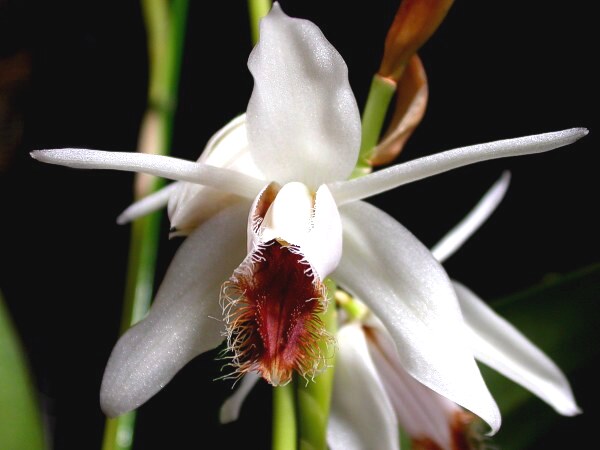
Photo: Dalton Holland Baptista, CC BY-SA 3.0 · source

Houseplant · Orchidaceae
Crested coelogyne
Coelogyne cristata
In other languages: Coelogyne (Nederlands) · Coelogyne (Français)
Coelogyne cristata comes from the mountain forests of the Himalaya, where it grows on tree branches and rocks in cool, moist air. It is an orchid with egg-shaped pseudobulbs and narrow, leathery leaves. In winter and early spring it carries hanging sprays of scented, snow-white flowers, with a yellow to orange crest on the lip. Houseplant growers value it because it prefers cooler conditions than most orchids and flowers freely year after year, as long as it gets a cool, nearly dry winter rest. The fuller the pot is with pseudobulbs, the more flowers it produces.
Light
Partial shade
no harsh midday sun
Moisture
Normal
no wet feet
Legal basis
Potting soil
Hardiness
Houseplant
min. 5 °C
Size
0.3 m
tall, 0.5 m wide
Flowering
January–April
| Height | 0.3 m |
|---|---|
| Poisonous to people and pets | Not known to be poisonous |
| Flowering | January–April |
Identify
Crested coelogyne: how do you recognise it?
- Habit
- Epiphytic orchid forming a dense clump about 30 cm tall and 50 cm wide, with 5–8 cm pseudobulbs on a creeping rhizome.
- Leaves
- Two narrow, leathery leaves of 15–30 cm per pseudobulb, glossy dark green.
- Flower
- Hanging sprays of 5–10 white flowers, 5–8 cm across, with a yellow to orange crest on the lip, from January to April.
- Scent
- Soft and sweet, strongest by day in a warm room.
- Roots
- Thick white aerial roots that grip bark; they dislike wet feet.
Flowering: January–April · Plants: April–May
In your garden
Why grow it?
- Flowers from January to April, in the darkest months of the year.
- The snow-white flowers with a yellow crest have a soft fragrance.
- Needs no warm room: a cool, bright spot in the house is enough.
- Stays for years in the same pot and grows into an impressive clump.
- Attractive foliage and pseudobulbs, even when it is not in flower.
Crested coelogyne: where does it grow best?
- Plenty of light but no fierce midday sun: an east or west window, or a north window with lots of daylight.
- In summer it can go outdoors to a sheltered spot in partial shade, away from strong wind and rain on the pseudobulbs.
- It grows best at 18–24 °C by day with cooler nights; in winter 8–12 °C, never below 5 °C.
- Aim for roughly 50–70 % humidity: stand the pot on a tray of damp clay pebbles, without letting the pot sit in water.
- Choose a pot that leaves room in front of the clump: the new pseudobulbs appear towards the edge of the pot.
- Light
- Bright, out of direct sun
- Potting soil
- Airy, humus-rich compost
- Acidity
- Acid
- Watering
- Moderately
- Size
- 0.3 m tall, 0.5 m wide
- Temperature
- Minimum 5 °C
Goes well with
- Moth orchid (Phalaenopsis): Same light and humidity, but it flowers at another time and prefers more warmth.
- Slipper orchid (Paphiopedilum): Another orchid for a bright, not-too-warm spot.
- Ferns: They keep the air around the plant more humid and set off the flower sprays.
- Calathea: The decorative foliage suits the humid, bright feel of a small indoor greenhouse.
Maintenance
Crested coelogyne: when and how to plant it?
Plant in April–May.
- Repot in April–May, straight after flowering, as soon as the new shoots appear. Only do this every 2–3 years or when the pseudobulbs spill over the rim.
- Choose a wide, shallow pot with drainage holes, only slightly bigger than the clump.
- Use coarse orchid bark, if you like mixed with a little sphagnum moss and perlite: air and moisture must be able to move through it.
- Place the oldest pseudobulbs against the rim and leave room in front of the new shoots. Do not bury the pseudobulbs: they should stay half above the compost.
- Water sparingly for the first two weeks and only mist the bark, so that damaged roots can heal.
Care
- Water
- During the growing season (April–September) water freely as soon as the top of the bark is dry, preferably with rainwater or other low-lime water. Never leave the pot standing in water.
- Feeding
- From April to August give half-strength orchid fertiliser in the water every 2–3 weeks. Stop from September.
- Humidity
- Keep the air humid with a tray of clay pebbles and mist the leaves in the morning; keep buds and flowers dry.
- Winter rest
- From November until the buds appear: cool (8–12 °C) and nearly dry. Give only a little water if the pseudobulbs start to wrinkle.
- After flowering
- Cut off the flower stem once all the flowers have faded, then gradually resume watering.
Tip: Keep it cool (8–12 °C) and nearly dry in winter until the buds appear. Repot rarely: it flowers best when the pot is full of pseudobulbs.
Crested coelogyne: when to prune it?
When: It is not pruned. Only cut off the faded flower stem, usually in April–May.
How:
- Cut the faded stem with clean scissors just above the pseudobulb.
- Remove completely dried-out leaves at the base.
- Leave old, leafless pseudobulbs in place while they are firm: they still feed the new shoots.
- Disinfect the scissors with alcohol between plants.
Propagation
- Division
- After flowering, when repotting: cut the clump into pieces with at least 3–4 pseudobulbs each and pot them up separately. Smaller pieces grow slowly and only flower after a few years.
Crested coelogyne: how does it get through the winter?
- It is not hardy and must stay indoors all year, at a minimum of 5 °C.
- In winter give it a cool spot of 8–12 °C, such as a bright unheated room, and keep it nearly dry until the buds appear.
- Do not put it above a radiator: heat and dry air cause flower buds to drop.
Diseases and pests
- No flowers: Usually the cool, dry winter rest is missing. Keep the plant cool and nearly dry from November until the buds appear, and give it enough light in summer.
- Wrinkled pseudobulbs: The plant is too dry or the roots are damaged. Check the roots and water more during the growing season. During the winter rest, slight wrinkling is normal.
- Rot or black patches: Caused by too much water or water standing in the new shoots. Let the compost dry out, water at the edge of the pot and remove rotten parts.
- Red spider mite and scale: Fine webbing and dull leaves (spider mite), or small brown shells and sticky leaves (scale). Wipe the leaves with a damp cloth, raise the humidity and repeat weekly.
Through the year
- January: In flower. Keep cool and bright, water sparingly.
- February: In flower. Do not move it and do not spray the flowers.
- March: In flower. As new shoots grow, slowly give more water.
- April: Flowering over: cut off the flower stem. Repot if needed. Start feeding.
- May: Repot if needed. Water freely. Feed every 2–3 weeks.
- June: Growing season: generous water, high humidity. May go outdoors in partial shade.
- July: Growing season: water and feed. Shade from fierce midday sun.
- August: Growing season: last feeds. New pseudobulbs swell.
- September: Stop feeding and water less. Bring indoors before cold nights.
- October: Move to a cooler spot, water less.
- November: Rest: cool (8–12 °C) and nearly dry until buds appear.
- December: Rest. As soon as flower buds grow, give a little more water.
You and this species
Did you know?
- The genus name comes from Greek: koilos (hollow) and gyne (female), after the hollow stigma of the flower.
- The species name cristata means ‘crested’ and refers to the yellow ridges on the lip of the flower.
- In the wild it grows in the Himalayan mountains, where winters are cool and dry. That explains its need for a cool rest period.