Photo: Wikimedia Commons, Public domain · source

Shrub · Cornaceae
Pagoda dogwood
Cornus alternifolia
In other languages: Kornoelje (Nederlands) · Cornouiller à feuilles alternes (Français)
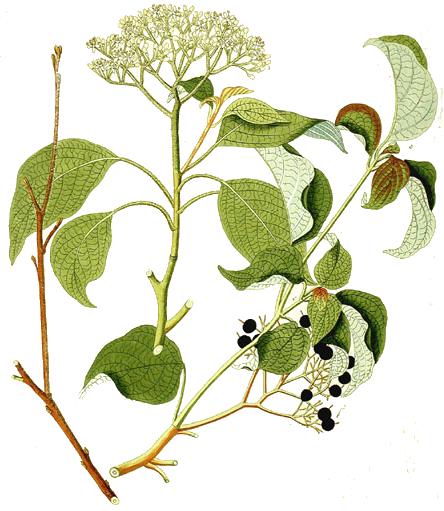
The pagoda dogwood comes from the deciduous woodlands of eastern North America, from Canada down to the south-eastern United States. It is a large shrub or small tree of around 4 m high and wide, with horizontal branches arranged in tiers, like the roofs of a pagoda. In May–June it bears flat clusters of small creamy-white flowers, followed by blue-black berries on red stalks. In autumn the leaves turn red to purple. The best-known cultivar is ‘Argentea’, with white-edged leaves, which grows more slowly and stays smaller.
Light
Partial shade or shade
tolerates little sun
Moisture
Normal to wet
must not dry out
Legal basis
Sand, loam or peat
acid to neutral
Hardiness
Fully hardy
down to -35 °C
Size
4 m
tall, 4 m wide
Flowering
May–June
| Pruning months | February |
|---|---|
| Height | 4 m |
| Native to Belgium | No, planted |
| Good for bees, butterflies and birds | Yes, for bees and birds |
| Poisonous to people and pets | Not known to be poisonous |
| Flowering | May–June |
Identify
Pagoda dogwood: how do you recognise it?
- Habit
- Large shrub or small tree, about 4 m high and wide, with horizontal branches in tiers; often multi-stemmed.
- Leaves
- Oval, 5–12 cm, with curved veins running towards the tip. Unlike most dogwoods, the leaves are alternate rather than opposite. Red to purple autumn colour.
- Flowers
- Small creamy-white flowers in flat clusters on top of the branches, in May–June.
- Fruit
- Small blue-black berries on coral-red stalks, ripe in July–August. Much loved by birds.
- Roots
- Fairly shallow and fibrous: it likes a cool, moist soil under a layer of mulch.
Flowering: May–June · Plants: March–April and October–November · Pruning: February
In your garden
Why grow it?
- A striking shape with tiers of horizontal branches: a focal point, even in winter.
- Flowers in May–June in partial shade, where few trees are as graceful.
- The flowers attract bees and other pollinators; birds quickly eat the berries in summer.
- Red to purple autumn colour.
- At around 4 m it stays small enough for an ordinary garden.
- Fully hardy and low-maintenance: it needs hardly any pruning.
Pagoda dogwood: where does it grow best?
- Partial or light shade, as at a woodland edge; in full sun the leaves scorch in dry spells.
- Humus-rich, moist to damp soil: sand, loam or peat, acid to neutral. It does poorly on chalky or dry soil.
- A sheltered spot out of cold winds keeps the branches and leaves looking good.
- Allow at least 4 m of space so the tiers can spread freely.
- Light
- Partial shade and shade
- Soil type
- Sand, loam or peat
- Acidity
- Acid or neutral
- Moisture
- Normal or wet
- Size
- 4 m tall, 4 m wide
- Hardiness
- Hardy (to -35 °C)
Goes well with
- Hosta: Large leaves at its feet, in the same cool partial shade.
- Ferns: Fresh underplanting that, like the dogwood, enjoys moist, humus-rich soil.
- Barrenwort: A ground cover that thrives in the shade under the branches.
- Rhododendron: Likes the same acid to neutral, humus-rich soil and fills the lower layer of the border.
- Snowdrop: Flowers in February under the bare branches, long before the dogwood comes into leaf.
Maintenance
Pagoda dogwood: when and how to plant it?
Plant in March–April and October–November.
- Plant in March–April or October–November, when the soil is neither frozen nor waterlogged.
- Dig a hole twice as wide as the root ball and mix in leaf mould or well-rotted compost.
- Set the plant at the same depth as it was in the pot and firm the soil well.
- Water in thoroughly straight away, even if it is raining.
- Spread a mulch of leaf mould or wood chips around the base, keeping it off the trunk.
Care
- Water
- Weekly in dry weather for the first two years. After that during long dry spells: it does not tolerate drying out.
- Feeding
- A layer of compost or a little organic fertiliser in April is enough.
- Mulching
- A layer of leaf mould or wood chips each spring keeps the roots cool and the soil moist.
- Around the base
- Keep the base free of grass and do not hoe deeply: the roots are just below the surface.
Tip: Let the horizontal branches grow freely and never shorten them: those tiers are what give the pagoda shape. A cool, moist root run under a layer of mulch matters more than feeding.
Pagoda dogwood: when to prune it?
Pruning months: February.
When: Prune as little as possible. If needed, do it in February, when the tree is bare and the tiers are easy to see; remove dead or diseased branches as soon as you notice them.
How:
- Remove dead, damaged and crossing branches, each time back to a healthy side branch or to the trunk.
- Never shorten the tips of the tiers: you would lose the pagoda shape.
- If you want a single trunk, remove competing leaders while the tree is still young.
- Cut diseased branches well back into healthy wood, then disinfect your secateurs.
Caution: It does not take hard pruning well: the natural tiered shape is slow to come back.
Propagation
- Softwood cuttings
- In June: 10 cm cuttings from young shoots, lower leaves removed, in moist cutting compost under plastic. Rooting powder helps.
- Layering
- In spring, bend a low branch down to the ground, lightly wound the bark on the underside and pin it under some soil. After a year, sever it and replant it.
- Seed
- Sow the berries fresh in autumn in a pot left outdoors. The seed is slow to germinate, often only after one or two winters.
Pagoda dogwood: how does it get through the winter?
Hardy to −35 °C.
- Fully hardy, to about −35 °C: no protection is needed in Belgium.
- In winter the tiered structure of the bare branches really stands out.
- It can also grow in a large container: keep the pot out of the wind and wrap it in hessian in severe frost.
Diseases and pests
- Golden canker: Branches suddenly wilt, the leaves wither and the bark turns yellow to orange. In dry weather, cut affected branches well back into healthy wood, and avoid drought stress.
- Leaf scorch: Brown, dry leaf edges in summer: too much sun or too dry a soil. Water, mulch and, if necessary, move it to a shadier spot.
- Leaf spot: Small brown or purple spots on the leaves in wet summers. Usually harmless: rake up fallen leaves and allow good air flow.
- Powdery mildew: White powder on the leaves, especially in dry late summers. Watering in dry spells and removing affected leaves helps.
Through the year
- February: Light pruning if needed: dead and crossing branches out.
- March: Planting. Apply compost.
- April: Planting. Mulch. The leaves unfold.
- May: Flowering starts. Bees on the flower clusters.
- June: Flowering. Take softwood cuttings. Water in dry spells.
- July: The berries turn blue-black on red stalks. Water in dry spells.
- August: Birds eat the berries. Cut out diseased branches.
- October: Red to purple autumn colour. Planting. Sow seed outdoors.
- November: Planting. Spread leaf mould around the base.
- December: Rest. The tiers stand out in the bare garden.
Use
Good for wildlife
- Bees
- Nectar and pollen for honeybees and wild bees.
- Birds
- Berries, seeds or insects as food, or a place to nest.
You and this species
Did you know?
- It is one of the few dogwoods with alternate leaves, which is what the name alternifolia refers to.
- Its larger Asian relative, Cornus controversa, has the same tiered habit; its variegated form is known as the wedding cake tree.
- When the berries are ripe, their stalks turn coral red.