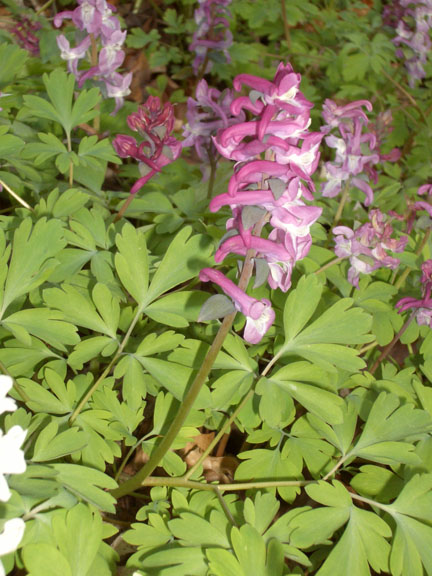
Photo: Dr. Erich W. Schreiner (user Ews), CC BY-SA 3.0 · source

Bulb or tuber · Papaveraceae
Hollowroot
Corydalis cava
In other languages: Holwortel (Nederlands) · Corydale creuse (Français)
Hollowroot is a woodland plant from Europe that also grows wild in Belgium, mainly in deciduous woods on chalky soil. In March and April dense spikes of purplish-pink or white flowers, each with a long spur, rise above grey-green, finely divided leaves. The tuber becomes hollow with age, hence the name. After flowering the plant retreats underground and by June it has vanished completely until the following spring. Gardeners value it as an early source of nectar for bumblebees and as a long-lived plant under trees, where in the right spot it slowly forms large carpets.
Caution: All parts, especially the tuber, are poisonous. Keep children away from the tubers when planting and do not let dogs and cats dig them up or eat them. Grazing animals such as horses, cattle and sheep are also at risk: do not plant it in or next to a pasture.
Light
Partial shade or shade
tolerates little sun
Moisture
Normal
no wet feet
Legal basis
Loam or clay
neutral to chalky
Hardiness
Fully hardy
down to -25 °C
Size
0.25 m
tall, 0.15 m wide
Flowering
March–April
| Height | 0.25 m |
|---|---|
| Native to Belgium | Yes |
| Good for bees, butterflies and birds | Yes, for bees |
| Poisonous to people and pets | Yes, take care with children and pets |
| Flowering | March–April |
Identify
Hollowroot: how do you recognise it?
- Habit
- Low, upright plant of 15–25 cm that dies back completely above ground after flowering.
- Leaves
- Grey-green, twice divided into three and finely cut; they appear in February–March.
- Flower
- Dense spikes of tubular flowers with a long, curved spur, in March–April. The bracts below the flowers are entire, not divided.
- Colour
- Purplish pink to lilac or pure white; both colours often grow together.
- Tuber
- Round tuber that becomes hollow with age and can grow quite large; it hardly produces any offsets.
- Fruit
- Narrow seed pod with shiny black seeds that carry a white appendage attractive to ants.
Flowering: March–April · Plants: September–October
In your garden
Why grow it?
- One of the first plants to flower under deciduous trees, before the trees come into leaf.
- An early nectar source for bumblebees and other bees, at a time when little else is in flower.
- Native and long-lived: in a good spot it stays for many years and slowly spreads.
- Takes up no space in summer: after flowering it disappears and other plants take over.
- Perfect for a natural woodland garden, a shady border or along the foot of a hedge.
Hollowroot: where does it grow best?
- Partial to full shade under deciduous trees or shrubs: light in spring, shade in summer.
- Humus-rich, loose loam or clay, preferably neutral to chalky.
- Moderately moist soil that does not dry out in spring and is never waterlogged for long.
- Plant in small groups, 10–15 cm apart, in a spot you do not dig or hoe.
- Light
- Partial shade and shade
- Soil type
- Loam or clay
- Acidity
- Neutral or chalky
- Moisture
- Normal
- Size
- 0.25 m tall, 0.15 m wide
- Hardiness
- Hardy (to -25 °C)
Goes well with
- Wood anemone: Native spring flower for the same spot under trees.
- Snowdrop: Flowers just before; together they give a long spring display.
- Lenten rose: Evergreen leaves and flowers at the same time, in the same shade.
- Ferns: Fill the gap in summer where the hollowroot has disappeared.
- Hosta: Large leaves that unfurl just as the hollowroot dies back.
Maintenance
Hollowroot: when and how to plant it?
Plant in September–October.
- Plant in September–October, as soon as you have the tubers: do not let them dry out.
- Loosen the soil and work in some leaf mould or well-rotted compost.
- Plant the tubers 10 cm deep. If you are unsure which way up they go, lay the tuber on its side: the shoot will find its own way.
- Space them 10–15 cm apart, in groups of at least five to ten tubers.
- Water in and cover with a thin layer of leaf mould or shredded leaves.
- Mark the spot so you do not dig up the tubers by accident in summer.
Care
- Watering
- Usually not needed. Only water in a dry spring, during growth and flowering.
- Feeding
- Not needed: a layer of leaf mould in autumn is enough.
- Mulching
- Leave fallen leaves in place in autumn: they are the plant’s natural food and protection.
- Foliage
- Let the leaves die back naturally after flowering, so the tuber can build up reserves for next year.
- Peace and quiet
- Do not dig or hoe in the spot: the tubers are vulnerable and the plant likes to be left alone.
Tip: Plant it in a spot you will leave alone for years, for example under a deciduous tree, and leave the fallen leaves where they land. The less you do, the bigger the carpet becomes.
Hollowroot: when to prune it?
When: No pruning is needed: after flowering the plant dies back on its own.
How:
- Leave the foliage until it turns yellow and disappears by itself, usually in May–June.
- Let the seed pods ripen if you want it to self-seed.
- Only clear withered leaves if they bother you; do not pull at stems that are still green.
Caution: Leaves removed too early weaken the tuber: flowering the following year will be poorer.
Propagation
- Seed
- Sow fresh seed as soon as it is ripe, in May–June, in a pot of humus-rich compost and stand it outdoors in the shade. It germinates after winter; seedlings take 3–4 years to flower.
- Self-seeding
- In a good spot ants spread the seeds and new plants appear by themselves. Leave the soil around the plant undisturbed.
- Tubers
- The tuber hardly forms offsets, so division rarely works. At most, move a whole clump in autumn.
Hollowroot: how does it get through the winter?
Hardy to −25 °C.
- Fully hardy, down to about −25 °C: no protection is needed in Belgium.
- In winter the plant is underground; the shoots appear in February and can cope with night frosts.
- A layer of fallen leaves or leaf mould protects the tubers and feeds the soil.
Diseases and pests
- Fails to appear: Tubers stored dry for too long are often dead. Buy them fresh in autumn or as pot plants in spring and plant straight away.
- Rot: In wet, compacted soil the tubers rot. Choose an airy, humus-rich spot that does not flood.
- Mice: Mice and voles sometimes eat the tubers. Plant in a basket of fine wire mesh if they do a lot of damage.
- Slugs: In a wet spring young shoots are sometimes eaten. Pick off slugs in the evening.
- Vanishes in June: That is normal: hollowroot is a spring plant that spends the summer underground.
Through the year
- January: Dormant. Do not dig in the spot.
- February: The first shoots appear.
- March: Flowering. Bumblebees visit the flowers.
- April: Flowering. Water if the spring is dry.
- May: Seed ripens and ants spread it. Let the foliage die back.
- June: The plant is underground. Sow fresh seed in a pot.
- September: Plant tubers 10 cm deep.
- October: Planting. Mulch with leaf mould or fallen leaves.
- November: Leave fallen leaves in place.
Use
Edible and useful
Not edible. All parts of hollowroot and fumewort are poisonous, especially the tuber: they contain alkaloids that act on the nervous system. The tuber of a related species is used in Chinese medicine, but do not make your own tea or remedies to swallow from these plants. Keep children away from the tubers when planting, and do not let dogs and cats dig them up or eat them. Grazing animals such as horses, cattle and sheep are at risk too: do not plant them in or next to a field, and do not throw tubers or plant remains into a field, pen or hutch. Call your vet if an animal has eaten some. If any is swallowed, call a poison centre (in Belgium 070 245 245) or your doctor at once.
Good for wildlife
- Bees
- Nectar and pollen for honeybees and wild bees.
You and this species
Did you know?
- The name Corydalis comes from the Greek word for crested lark and refers to the shape of the flower.
- Short-tongued bumblebees sometimes bite a hole in the spur to reach the nectar, without pollinating the flower.
- The seeds carry a fat-rich appendage that ants love to eat: they carry the seeds to their nest and so spread the plant.