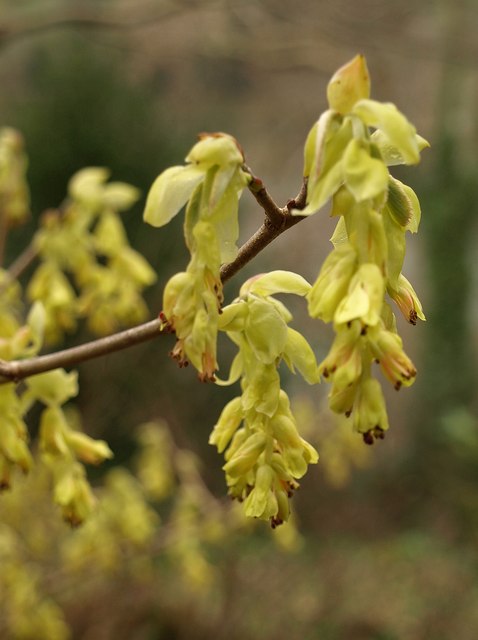
Photo: Derek Harper, CC BY-SA 2.0 · source

Shrub · Hamamelidaceae
Spike winter hazel
Corylopsis spicata
In other languages: Schijnhazelaar (Nederlands) · Corylopsis (Français)
Corylopsis spicata is a deciduous shrub from Japan and belongs to the same family as witch hazel. It grows into a broad, open shrub about 2 m tall and 2.5 m wide, with finely branched, spreading stems. In March–April, before the leaves appear, it is hung with countless clusters of small, pale yellow, bell-shaped flowers with purplish-red anthers and a soft, sweet scent. The leaves closely resemble those of hazel, hence the name, and turn yellow in autumn. Gardeners choose it as an elegant spring-flowering shrub for a sheltered spot in partial shade, in humus-rich soil of the kind rhododendrons enjoy.
Light
Sun or partial shade
preferably some sun
Moisture
Normal
no wet feet
Legal basis
Sand, loam or peat
acid to neutral
Hardiness
Fully hardy
down to -20 °C
Size
2 m
tall, 2.5 m wide
Flowering
March–April
| Pruning months | April |
|---|---|
| Height | 2 m |
| Native to Belgium | No, planted |
| Good for bees, butterflies and birds | Yes, for bees |
| Poisonous to people and pets | Not known to be poisonous |
| Flowering | March–April |
Identify
Spike winter hazel: how do you recognise it?
- Habit
- Broad, open shrub with finely branched, spreading stems, eventually 2 m tall and 2–2.5 m wide.
- Foliage
- Oval to rounded, 5–10 cm, with a toothed edge and prominent veins, like hazel; blue-green beneath, yellow in autumn.
- Flower
- Hanging clusters of 3–5 cm of small, pale yellow bells, in March–April, before the leaves emerge.
- Scent
- Soft and sweet, best enjoyed close up.
- Roots
- Fine and fairly shallow: it likes a cool, moist root run.
Flowering: March–April · Plants: March–April and October–November · Pruning: April
In your garden
Why grow it?
- One of the first shrubs to flower: fragrant yellow tassels on bare branches in March.
- An early source of food for bees and bumblebees.
- An open, graceful outline that never looks heavy, even in a smaller garden.
- Fresh foliage that turns yellow in autumn.
- Combines beautifully with spring bulbs and shade-loving plants.
Spike winter hazel: where does it grow best?
- Partial or light shade is ideal; sun only if the soil stays moist.
- Humus-rich, acid to neutral soil: sand, loam or peat. On chalky soil the leaves turn yellow.
- Normally moist: the soil must not dry out in summer.
- Sheltered from cold winds and preferably out of early morning sun: the flowers then suffer less from night frost.
- Allow 2–2.5 m of space and plant it where you can see it up close, beside a path or near the patio.
- Light
- Sun and partial shade
- Soil type
- Sand, loam or peat
- Acidity
- Acid or neutral
- Moisture
- Normal
- Size
- 2 m tall, 2.5 m wide
- Hardiness
- Hardy (to -20 °C)
Goes well with
- Lenten rose: Flowers at the same time at its feet, in white, pink or purple.
- Lungwort: Blue and pink flowers and spotted leaves in the same partial shade.
- Daffodil: Yellow or white daffodils flowering at the same time.
- Rhododendron: Likes the same acid, humus-rich soil and flowers just afterwards.
- Barrenwort: Fine foliage and small flowers in April beneath the shrub.
Maintenance
Spike winter hazel: when and how to plant it?
Plant in March–April and October–November.
- Plant in March–April or October–November, when the soil is not frozen.
- Dig a hole twice as wide as the root ball and mix in leaf mould or peat-free ericaceous compost.
- Set the shrub at the same depth as it was in the pot and firm the soil well.
- Keep 2–2.5 m away from other shrubs.
- Water in thoroughly straight away, ideally with rainwater, then during dry spells in the first year.
- Mulch with leaf mould, composted bark or pine needles.
Care
- Watering
- During dry spells, especially in the first few years; use rainwater where possible.
- Feeding
- In March–April, some compost or an organic fertiliser for acid-loving plants.
- Mulching
- Leaf mould or composted bark every spring keeps the soil cool, moist and slightly acid.
- Shape
- Let it keep its natural shape: it needs little pruning.
Tip: Plant it in front of a dark backdrop of evergreen shrubs: the pale yellow tassels will glow even more in March.
Spike winter hazel: when to prune it?
Pruning months: April.
When: Little is needed. If necessary, prune in April, straight after flowering.
How:
- Remove dead, damaged and crossing branches.
- On an old, congested shrub, take out a few of the oldest stems at the base every few years.
- Do not shorten all the branches: it would lose its graceful shape and next year’s flowers.
Caution: Do not prune in winter: the flower buds are already on the branches by then.
Propagation
- Softwood cuttings
- In June: 8–10 cm cuttings of young shoots, in moist cutting compost under plastic. They root within a few weeks; keep them frost-free during their first winter.
- Layering
- In spring, bend a low branch to the ground, peg it down under some soil and sever it after a year.
Spike winter hazel: how does it get through the winter?
Hardy to −20 °C.
- Hardy to about −20 °C: the shrub itself needs no protection in Belgium.
- Late night frost can turn open flowers brown; if hard frost threatens during flowering, cover a young shrub with fleece.
- In a pot: wrap the pot in hessian in severe winters and keep it in a sheltered spot.
Diseases and pests
- Yellow leaves: Chlorosis caused by chalky soil or hard tap water. Water with rainwater, mulch with pine needles or move it to more acid soil.
- Frosted flowers: Brown flowers after a night frost. Choose a sheltered spot without early morning sun.
- Scorched leaves: Brown leaf edges in a dry, sunny summer. Water and mulch, or move it to a cooler spot.
- Few flowers: In young plants or in deep shade. Give it a little more light and some patience: flowering increases over the years.
Through the year
- February: The flower buds swell. Keep fleece at hand for late frost.
- March: In flower on bare branches. Plant.
- April: Last flowers. Prune lightly after flowering. Mulch.
- May: The new leaves unfold.
- June: Take softwood cuttings.
- July: Water in dry spells, ideally with rainwater.
- August: Water in dry spells.
- October: Yellow autumn colour. Plant.
- November: Plant. Leaf mould around the base.
Use
Good for wildlife
- Bees
- Nectar and pollen for honeybees and wild bees.
You and this species
Did you know?
- The name Corylopsis means ‘resembling Corylus’, the hazel, because of the shape of the leaves.
- It belongs to the witch hazel family, whose members also flower on bare branches in winter or early spring.
- In this species the anthers in the little flowers are purplish red, a fine contrast with the pale yellow.