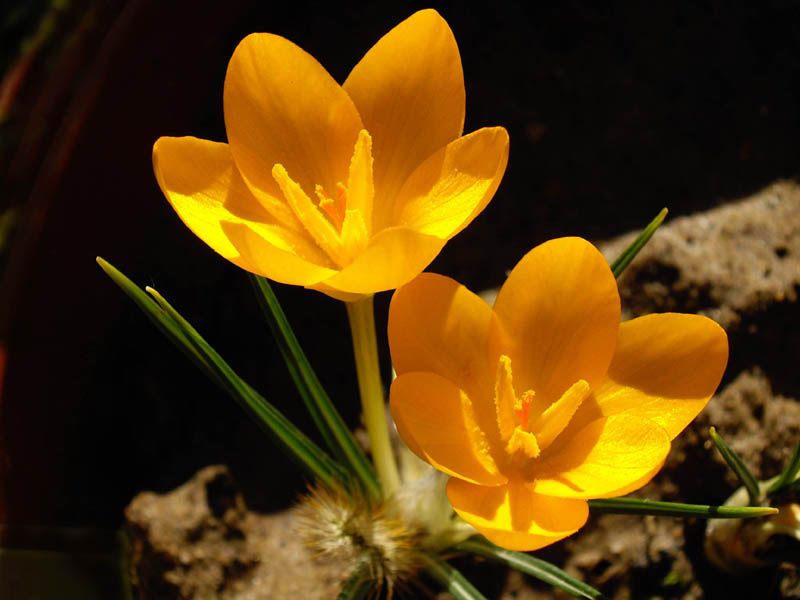
Photo: Ghislain118 http://www.fleurs-des-montagnes.net, CC BY-SA 3.0 · source

Bulb or tuber · Iridaceae
Ankara crocus
Crocus ancyrensis
In other languages: Crocus ancyrensis (Nederlands) · Crocus d’Ankara (Français)
The Ankara crocus, Crocus ancyrensis, is a small botanical crocus from central Turkey, named after Ankara, which was once called Ancyra. It is one of the very earliest crocuses: often in February each corm opens several small, warm orange-yellow flowers just above the ground. The well-known form ‘Golden Bunch’ gives up to ten flowers per corm. On a sunny day they open wide and the first bees buzz around in them. A cheerful spot of colour near a path, in a rock garden or in a pot by the front door.
Caution: Crocus corms contain substances that cause stomach and bowel upsets if swallowed. Do not confuse them with the highly poisonous autumn crocus (Colchicum), which flowers in autumn. Keep the corms away from children and pets.
Light
Full sun
warm and bright
Moisture
Dry to normal
no wet feet
Legal basis
Sand or loam
neutral to chalky
Hardiness
Fully hardy
down to -25 °C
Size
0.08 m
tall, 0.05 m wide
Flowering
February–March
| Height | 0.08 m |
|---|---|
| Native to Belgium | No, planted |
| Good for bees, butterflies and birds | Yes, for bees |
| Poisonous to people and pets | Yes, take care with children and pets |
| Flowering | February–March |
Identify
Ankara crocus: how do you recognise it?
- Habit
- Small corm 5–8 cm tall.
- Leaf
- Narrow, grass-like, dark green with a white central stripe, appearing with the flowers.
- Flower
- Small, cup-shaped flowers 2–3 cm across, deep orange-yellow, 3–10 per corm.
- Flowering
- February and March.
- Corm
- Small corm with a fibrous, netted tunic.
Flowering: February–March · Plants: September–November
In your garden
Why grow it?
- One of the earliest crocuses, often in flower in February.
- Warm orange-yellow flowers that stand out in the bare winter garden.
- Important early food for bees and bumblebee queens on sunny days.
- Many flowers per corm, especially in ‘Golden Bunch’.
- Small and easy: suits a pot, a rock garden or the edge of a lawn.
Ankara crocus: where does it grow best?
- Full sun: the flowers only open in sunshine.
- Light, well-drained soil: sand or light loam, chalky is fine.
- Dry to average; preferably dry in summer.
- At the front of a border, in a rock garden, in short grass or in pots.
- Plant 50–100 corms per m² for a good effect.
- Light
- Sun
- Soil type
- Sand or loam
- Acidity
- Neutral or chalky
- Moisture
- Dry or normal
- Size
- 0.08 m tall, 0.05 m wide
- Hardiness
- Hardy (to -25 °C)
Goes well with
- Snowdrop: White next to the warm orange-yellow in February.
- Winter aconite: Even more yellow in the same early weeks.
- Iris reticulata: Deep blue dwarf irises for contrast.
- Blue crocus: Lilac Crocus tommasinianus next to the orange-yellow flowers.
- Christmas rose: White or pink flowers at the same time.
Maintenance
Ankara crocus: when and how to plant it?
Plant in September–November.
- Plant the corms in September–November.
- Set them 5–8 cm deep, 3–5 cm apart.
- In heavy soil: some grit under and around the corms.
- Plant them in small groups near a path or window, so you can see them.
- In a pot: a layer of gravel at the bottom and compost mixed with sand.
Care
- Water
- Not needed in the ground; in a pot only in dry spells in spring.
- Feeding
- Not needed; a little compost in autumn is fine.
- Leaves
- Let the leaves die back after flowering: the corm draws its strength from them.
- Mowing
- In grass: mow only when the leaves have yellowed, late April–May.
- Mice
- Mice love crocus corms; plant them in a basket if needed.
Tip: Plant a pot full by the front door: in February, when the garden is still bare, you will have a warm welcome every day.
Ankara crocus: when to prune it?
When: No pruning is needed.
How:
- Just leave the faded flowers; they disappear by themselves.
- The leaves die back on their own in April–May.
Caution: Do not mow or cut the leaves while they are green.
Propagation
- Cormlets
- After a few years clumps form; lift them in summer and divide them.
- Sowing
- Let the seed ripen; in an open, sunny spot the plant sometimes self-sows.
Ankara crocus: how does it get through the winter?
Hardy to −25 °C.
- Very hardy, to −25 °C.
- No protection needed.
- The corm needs a cold winter to flower.
- Wet soil in summer is more dangerous than frost.
Diseases and pests
- Missing corms: Mice or squirrels have dug them up. Plant in a basket or under a piece of wire mesh.
- Pecked flowers: Sparrows sometimes peck at yellow crocuses. Plant them in larger groups.
- Few flowers: Too much shade or leaves mown too early. Choose a sunny spot.
Through the year
- February: Start of flowering. Bees on sunny days.
- March: Flowering ends.
- April: Leaves die back.
- May: Mow grass once the leaves are yellow.
- September: Plant corms.
- October: Plant corms.
- November: Last corms.
Use
Edible and useful
Not edible. Crocuses are mildly poisonous: eating a corm or leaves can cause stomach upsets, with vomiting and diarrhoea, and dogs and cats fall ill from them too. Dogs sometimes dig up newly planted corms: plant them where your dog does not dig, and keep loose corms in a labelled bag out of reach of children and pets. The yellow or orange stigmas in the flower are not saffron: that comes only from the saffron crocus (Crocus sativus), which flowers in autumn. Do not confuse crocuses with Colchicum either, which is sometimes called autumn crocus or meadow saffron but is not a crocus and is highly poisonous: a crocus has three stamens, Colchicum six. If you also buy or store Colchicum corms, keep them separate and labelled. If any is swallowed, call a poison centre (in Belgium 070 245 245) or your doctor at once.
Good for wildlife
- Bees
- Nectar and pollen for honeybees and wild bees.
You and this species
Did you know?
- In ancient times Ankara was called Ancyra, hence the name ancyrensis.
- Crocuses close their flowers in cloudy weather and at night to keep their pollen dry.