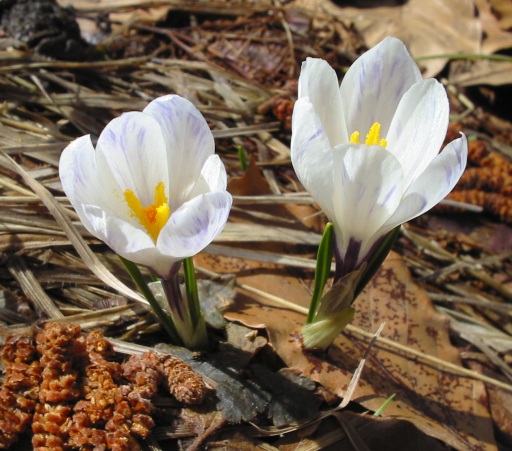
Photo: Bouba at French Wikipedia, CC BY-SA 3.0 · source

Bulb or tuber · Iridaceae
Spring crocus
Crocus vernus
In other languages: Voorjaarskrokus (Nederlands) · Crocus printanier (Français)
The spring crocus comes from the mountains of central and southern Europe, including the Alps, the Pyrenees and the Balkans. It is a small plant growing from a corm, about 10–12 cm tall, with narrow, grass-like leaves with a silvery white central stripe. In March and April cup-shaped flowers appear in purple, lilac, white or striped, with striking orange stigmas in the centre. The well-known large-flowered ‘Dutch’ crocuses are cultivars of this species, such as the white ‘Jeanne d’Arc’, the purple and white striped ‘Pickwick’ and the deep purple ‘Flower Record’. Gardeners love it because it is cheap, naturalises in the lawn by itself and is one of the first sources of food for bees.
Caution: Mildly poisonous: eating the corms or leaves can cause stomach and bowel upsets. Keep loose corms out of reach of children and pets. Do not confuse it with autumn crocus (meadow saffron), which looks like a crocus but is highly poisonous.
Light
Sun or partial shade
preferably some sun
Moisture
Normal
no wet feet
Legal basis
Sand, loam or clay
any pH
Hardiness
Fully hardy
down to -25 °C
Size
0.12 m
tall, 0.08 m wide
Flowering
March–April
| Height | 0.12 m |
|---|---|
| Native to Belgium | No, planted |
| Good for bees, butterflies and birds | Yes, for bees |
| Poisonous to people and pets | Yes, take care with children and pets |
| Flowering | March–April |
Identify
Spring crocus: how do you recognise it?
- Habit
- A small plant 10–12 cm tall growing from a corm, with one or a few flowers per corm and a tuft of narrow leaves.
- Leaves
- Narrow and grass-like, dark green with a silvery white central stripe; keep growing after flowering and die back in May–June.
- Flowers
- Cup-shaped, with six tepals on a long tube; open in the sun and close in cold or cloudy weather.
- Colour
- Purple, lilac, white or striped purple and white, with orange stigmas in the centre.
- Corm
- Small, round and somewhat flattened, with a fibrous brown tunic; forms new cormlets every year.
Flowering: March–April · Plants: September–November
In your garden
Why grow it?
- One of the first to flower: in March it colours lawn and border purple, white and lilac.
- An important early food source for bees and bumblebees emerging from their winter rest.
- Naturalises in the lawn and under shrubs: there are more flowers every year.
- Cheap and easy: once planted it needs hardly any care.
- Also lovely in pots and containers by the front door or on the patio.
Spring crocus: where does it grow best?
- Sun or partial shade; under deciduous trees and shrubs it gets enough light in March.
- Any ordinary garden soil: sand, loam or clay, acid to chalky, as long as water does not stand.
- Moist; in summer the soil may be dry, as the corm is then resting.
- In the lawn, under shrubs, in the border or in pots; plant in groups of 25 or more for effect.
- Light
- Sun and partial shade
- Soil type
- Sand, loam or clay
- Acidity
- Not fussy
- Moisture
- Normal
- Size
- 0.12 m tall, 0.08 m wide
- Hardiness
- Hardy (to -25 °C)
Goes well with
- Snowdrop: Flowers just before it and naturalises in the same places.
- Siberian squill: Bright blue bells among the purple and white crocuses.
- Winter aconite: Small yellow flowers that open just before and together with the crocuses.
- Daffodil: Small yellow daffodils give a fresh contrast with the purple.
- Hellebore: Large flowers in partial shade, with crocuses at their feet.
Maintenance
Spring crocus: when and how to plant it?
Plant in September–November.
- Plant the corms from September to November; the earlier, the better they root.
- Plant them 8 cm deep, pointed end up.
- Space them 5–8 cm apart, or scatter a handful and plant them where they fall for a natural look.
- In the lawn: lift a piece of turf, place a small group of corms underneath and put the turf back, or use a bulb planter.
- Firm the soil and water if it is dry.
Care
- Watering
- Not needed in open ground. In a pot, keep the compost slightly moist in autumn and spring.
- Feeding
- Not needed in ordinary garden soil. In a pot, give a little bulb fertiliser after flowering.
- Leaves
- Let the leaves turn yellow after flowering: this is how the corm builds up its reserves for next year.
- Mowing
- Only mow the grass once the crocus leaves turn yellow, usually about six weeks after flowering.
- Spent flowers
- No need to remove them: they shrivel by themselves.
Tip: Plant the corms in large, loose groups in the lawn and only mow there from mid-May: after a few years you will have a lawn full of crocuses.
Spring crocus: when to prune it?
When: A crocus is not pruned. After flowering, simply leave it alone.
How:
- Let the spent flowers shrivel; that way it can also set seed.
- Let the leaves turn completely yellow and only remove them once they come away by themselves.
- In the lawn, only mow once the leaves are yellow, usually from mid-May.
Caution: Do not mow or cut the leaves while they are green: it will then flower less or not at all the following year.
Propagation
- Dividing cormlets
- Lift dense clumps in June, once the leaves have died back, or in September. Separate the young cormlets and replant them straight away.
- Seed
- It sometimes self-seeds, even in the lawn. Seedlings take several years to flower.
Spring crocus: how does it get through the winter?
Hardy to −25 °C.
- Fully hardy to about −25 °C: in Belgium no protection is needed.
- It needs the winter cold to flower well in spring.
- In a pot: keep it outdoors in a sheltered spot and make sure water can drain away.
Diseases and pests
- Mice and squirrels: They dig up the corms and eat them. Plant them in a basket of fine wire mesh or lay a piece of mesh on the soil after planting.
- No flowers: The leaves were mown too early, or the corms are too crowded or in too much shade. Mow later and divide crowded clumps.
- Corm rot: The corms fail to come up or are soft and mouldy in wet soil. Plant them in a better-drained spot.
- Slugs: They sometimes eat the flowers in a wet spring. Pick them off in the evening.
Through the year
- February: The first leaf tips appear.
- March: In flower. Bees and bumblebees collect pollen and nectar.
- April: Last flowers. Leave the leaves in place.
- May: Let the leaves turn yellow; only mow the grass once they are yellow.
- June: Leaves have died back. Lift and divide dense clumps.
- September: Plant new corms 8 cm deep.
- October: Plant in lawn, border or pot.
- November: Last chance to plant.
Use
Edible and useful
Not edible. Crocuses are mildly poisonous: eating a corm or leaves can cause stomach upsets, with vomiting and diarrhoea, and dogs and cats fall ill from them too. Dogs sometimes dig up newly planted corms: plant them where your dog does not dig, and keep loose corms in a labelled bag out of reach of children and pets. The yellow or orange stigmas in the flower are not saffron: that comes only from the saffron crocus (Crocus sativus), which flowers in autumn. Do not confuse crocuses with Colchicum either, which is sometimes called autumn crocus or meadow saffron but is not a crocus and is highly poisonous: a crocus has three stamens, Colchicum six. If you also buy or store Colchicum corms, keep them separate and labelled. If any is swallowed, call a poison centre (in Belgium 070 245 245) or your doctor at once.
Good for wildlife
- Bees
- Nectar and pollen for honeybees and wild bees.
You and this species
Did you know?
- A crocus’s ovary sits below ground: what looks like a stem is actually a long flower tube.
- Saffron comes from a related species, the saffron crocus, which flowers in autumn: it is the dried stigmas.
- Despite its name, the so-called autumn crocus (meadow saffron) is not a crocus at all and even belongs to a different plant family.