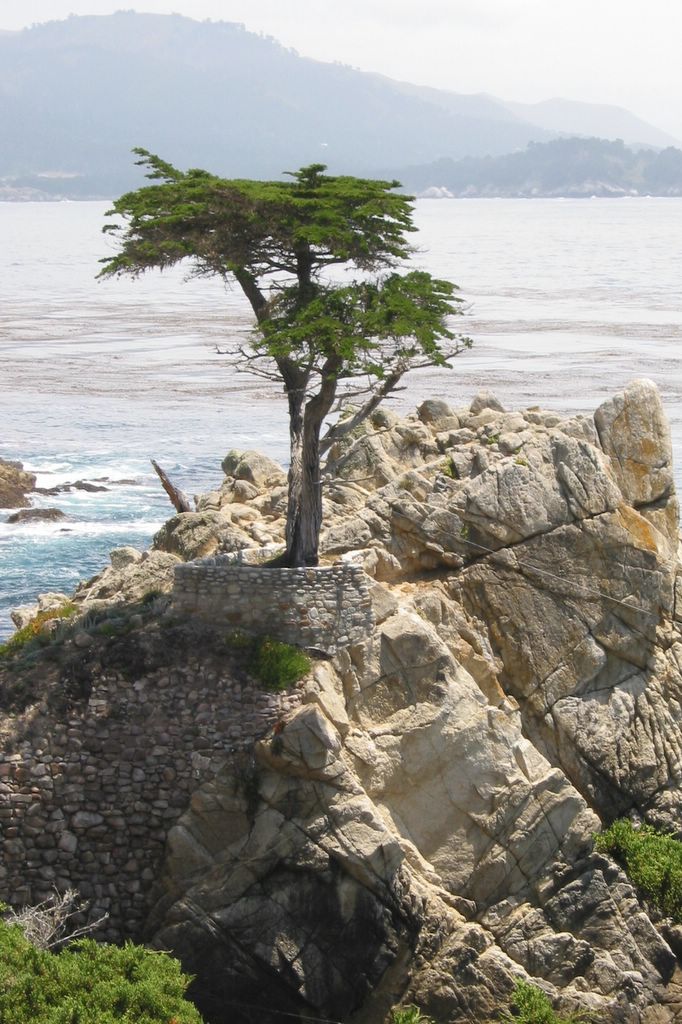
Photo: Wikimedia Commons, CC BY-SA 3.0 · source

Tree · Cupressaceae
Monterey cypress
Cupressus macrocarpa
In other languages: Montereycipres (Nederlands) · Cyprès de Lambert (Français)
The Monterey cypress comes originally from just two small groves on the Californian coast, but it has been planted worldwide as a windbreak. It is an evergreen conifer with dense, fine, scale-like foliage that grows into a large tree and can take on a striking, irregular shape in the wind. It tolerates sea wind and salty air very well, which makes it a classic by the coast. Yellow forms such as ‘Goldcrest’ are widely sold as pot and garden plants, but they can still grow large. In our climate it is less hardy than many other conifers, so choose a sheltered spot.
Light
Full sun
warm and bright
Moisture
Normal
no wet feet
Legal basis
Sand or loam
any pH
Hardiness
down to -15 °C
protect young plants
Size
20 m
tall, 8 m wide
| Pruning months | April and August |
|---|---|
| Height | 20 m |
| Native to Belgium | No, planted |
| Poisonous to people and pets | Not known to be poisonous |
Identify
Monterey cypress: how do you recognise it?
- Habit
- Evergreen tree about 20 m tall and 8 m wide; conical when young, later broader, with an open crown as it ages.
- Foliage
- Dense, fine and scale-like on flattened twigs; green, or yellow-green to golden yellow in forms such as ‘Goldcrest’.
- Cones
- Round, woody cones about 3 cm across. The species name macrocarpa means ‘large-fruited’.
- Bark
- Fibrous, grey-brown, with lengthwise ridges.
- Scent
- The foliage smells resinous; in yellow forms with a light lemony scent when crushed.
Plants: April–May and September · Pruning: April and August
In your garden
Why grow it?
- Tolerates sea wind and salty air extremely well, ideal for coastal gardens.
- Evergreen, dense foliage: a good windbreak and screen all year.
- Yellow forms such as ‘Goldcrest’ bring colour to the garden, even in winter.
- The foliage gives a fresh, resinous scent, with a light lemony note in yellow forms.
- Grows fairly quickly, so you soon have a green wall or a sturdy specimen tree.
Monterey cypress: where does it grow best?
- Full sun for dense foliage and good colour; in shade it becomes open.
- Free-draining sandy or loamy soil, acid to chalky. Heavy, wet clay is best avoided.
- Normally moist; it does not tolerate wet feet.
- It copes well with sea wind, but cold, drying easterly winds inland are a risk.
- Allow 4–5 m of space for a specimen and 1–1.5 m between plants for a hedge or windbreak.
- Light
- Sun
- Soil type
- Sand or loam
- Acidity
- Not fussy
- Moisture
- Normal
- Size
- 20 m tall, 8 m wide
- Hardiness
- Hardy (to -15 °C)
Goes well with
- Sea buckthorn: Tough coastal shrub with orange berries; tolerates the same wind and salty air.
- Tamarisk: Feathery foliage and pink flowers; also stands up well to salty coastal wind.
- Lavender: Sunny, free-draining spot; purple flowers beside the yellow or green of the cypress.
- Stonecrop: Low, drought-tolerant and suited to the foot of the tree in sun.
Maintenance
Monterey cypress: when and how to plant it?
Plant in April–May and September.
- Plant in April–May or in September, when the soil is warm enough to root quickly.
- Dig a hole twice as wide as the root ball. Mix heavy soil with sand to improve drainage.
- Set the plant at the same depth as in its pot, preferably slightly raised, so water does not collect around the trunk.
- For tall plants or windy sites, fit a stake and tie the trunk loosely.
- Water in generously straight away and keep the soil lightly moist in the first year.
- Spread a layer of coarse mulch, such as bark, at the base, keeping it clear of the trunk.
Care
- Water
- In the first two years, water regularly in dry spells. After that it usually manages on its own.
- Feeding
- Hardly needed. On poor soil, give a little organic fertiliser or conifer feed in spring.
- Mulching
- A layer of bark keeps the soil moist and suppresses weeds; keep it clear of the trunk.
- Support
- Tie young, tall plants to a stake; sea wind can topple or distort them.
- Hedge
- Trim a hedge every year and keep it slightly narrower at the top than at the base so light reaches the bottom.
Tip: Plant it only in a sheltered, sunny spot or near the coast, and never cut into old brown, bare wood. What you cut there does not grow back.
Monterey cypress: when to prune it?
Pruning months: April and August.
When: Lightly in April and, if needed, a second time in August; not during frosty spells.
How:
- Trim only the young green shoots; one or two light trims a year are enough.
- Remove dead or damaged branches to keep the plant airy.
- On a hedge, only cut the top once it has reached the height you want.
- Keep a hedge slightly narrower at the top than at the base.
Caution: Never cut into brown, leafless wood: a cypress does not regrow from it and you are left with a bare hole.
Propagation
- Seed
- Sow in spring in a sandy mix. Seedlings vary in colour and shape.
- Cuttings
- Semi-ripe cuttings in August–September, in sand and potting compost; they root slowly. Yellow cultivars are propagated this way or by grafting.
Monterey cypress: how does it get through the winter?
Hardy to −15 °C: protect young plants.
- Hardy to about −15 °C: in our country it does best by the coast or in a sheltered spot, and it is more vulnerable inland.
- Hard winters with cold easterly winds can cause brown tips or dead branches; young plants may get some protection (a hessian screen) in their first winters.
- Wait until spring before cutting out damaged parts and see first what grows again.
Diseases and pests
- Cypress canker: Brown, resinous cankers on branches and dying branches. Monterey cypress is very susceptible. Cut affected branches back well, disinfect your secateurs and avoid planting too close for airy growth.
- Browning: Brown tips or bare patches after severe frost, cold wind or prolonged drought. Wait until spring and cut dead wood back to green.
- Root rot: The whole plant suddenly turns brown, especially on wet, compacted soil. Prevent it with free-draining soil; affected plants usually cannot be saved.
- Bare base: Lower branches die in the shade of the tree’s own crown. Give plenty of light and never cut into bare wood.
Through the year
- March: Look at winter damage; do not cut yet.
- April: Plant. Trim lightly and remove dead branches.
- May: Plant. Water young plants in dry weather.
- June: Water young plants in dry weather.
- July: Water young plants in hot weather.
- August: If needed, give a hedge a second light trim.
- September: Plant. Last chance to plant before winter.
- October: Shelter young plants from wind.
- November: Check the stake and ties.
You and this species
Did you know?
- In the wild, Monterey cypress grows in just two small places on the Californian coast, on the Monterey Peninsula.
- The well-known Leyland cypress is a cross between the Monterey cypress and the Nootka cypress.
- The species name macrocarpa comes from the Greek and means ‘large-fruited’: the cones are larger than those of many related cypresses.