Photo: Wikimedia Commons, Public domain · source

Tree · Cupressaceae
Italian cypress
Cupressus sempervirens
In other languages: Italiaanse cipres (Nederlands) · Cyprès de Provence (Français)
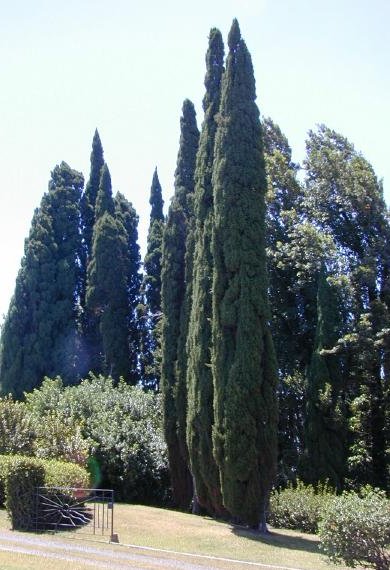
The Italian cypress is native to the eastern Mediterranean, from Greece and Turkey to Iran, but has been planted all around the Mediterranean since ancient times. Best known is the narrow columnar form that graces the hills of Tuscany; wild trees are usually broader, with spreading branches. It has fine, dark green, scale-like leaves that smell resinous when crushed, and round, woody cones of 2–4 cm. Well-known narrow cultivars are ‘Stricta’ and the very slim ‘Totem’; ‘Glauca’ has blue-green foliage. Gardeners choose it for a crisp, southern accent: a single column as a focal point or a row as a green wall in a sunny, dry spot.
Light
Full sun
warm and bright
Moisture
Dry to normal
no wet feet
Legal basis
Sand, loam or clay
any pH
Hardiness
down to -15 °C
protect young plants
Size
15 m
tall, 2 m wide
| Pruning months | May–August |
|---|---|
| Height | 15 m |
| Native to Belgium | No, planted |
| Poisonous to people and pets | Not known to be poisonous |
Identify
Italian cypress: how do you recognise it?
- Habit
- Narrow column 10–15 m tall and 1–2 m wide in the columnar forms; wild trees are broader and looser.
- Leaves
- Fine, scale-like, dark green leaves pressed close to the shoots, with a resinous scent when crushed.
- Cones
- Round to slightly oval, 2–4 cm, with 8–14 scales; green at first, later grey-brown, and they stay on the tree for years.
- Bark
- Grey-brown and thin, peeling in narrow strips with age.
- Roots
- Deep-rooting; young plants establish far better than large, old trees.
Plants: April–May and September · Pruning: May–August
In your garden
Why grow it?
- A crisp, columnar accent that instantly gives the garden a southern feel.
- Evergreen: dark green structure all year, including winter.
- Takes up little width: ideal for narrow strips, along a drive or as an exclamation mark in a border.
- Drought-tolerant once established: suits a sunny gravel garden.
- Foliage and wood have a pleasant resinous scent.
- Long-lived and low-maintenance: a light trim is enough.
Italian cypress: where does it grow best?
- Full sun and warmth: a south- or west-facing spot, ideally sheltered from cold east winds.
- Free-draining soil: sand, loam or clay, acid to chalky. Improve heavy clay with coarse sand or gravel.
- Dry to normally moist: wet feet in winter are worse than frost.
- As a specimen, allow 2 m all round; for a row or green wall, plant about 1–1.5 m apart.
- A spot in the lee of a wall or hedge limits winter damage on young plants.
- Light
- Sun
- Soil type
- Sand, loam or clay
- Acidity
- Not fussy
- Moisture
- Dry or normal
- Size
- 15 m tall, 2 m wide
- Hardiness
- Hardy (to -15 °C)
Goes well with
- Lavender: The same sunny, dry spot and a purple, fragrant base for the column.
- Rosemary: Mediterranean, aromatic and drought-tolerant, in the same warm spot.
- Feather grass: Fine, swaying stems as a soft contrast to the crisp column.
- Olive: Silver-grey leaves for a Tuscan scene; in a pot that you move to shelter in hard frost.
Maintenance
Italian cypress: when and how to plant it?
Plant in April–May and September.
- Plant preferably in April–May so it roots well before winter; September is possible on light, free-draining soil.
- Choose a young plant in a pot: small cypresses establish much better than large ones.
- Dig a hole twice as wide as the root ball; on heavy soil, mix coarse sand or gravel into the soil.
- Set it at the same depth as in the pot, not deeper, and firm the soil well.
- Drive a stake in at an angle next to the root ball, tie the trunk loosely with a soft tie and water in thoroughly straight away.
- Mulch with gravel or bark and water in dry spells during the first year.
Care
- Watering
- Weekly in dry spells during the first year. After that it tolerates drought well; only plants in containers need regular watering.
- Feeding
- Hardly needed. On poor soil, a handful of organic conifer feed in April.
- Tying in
- Wrap a soft tie around the column in a loose spiral so snow and wind do not push the branches apart.
- Staking
- Leave the stake for two or three years and check that the tie does not cut into the trunk.
- In a container
- It can live for years in a large, heavy pot filled with a mix of compost and grit; stand the pot against a sheltered wall in winter.
Tip: Plant a small, young cypress in spring in a free-draining spot: it then roots deeply and becomes far sturdier than a large tree. From the start, tie the column loosely with a soft tie in a spiral.
Italian cypress: when to prune it?
Pruning months: May–August.
When: Pruning is hardly needed. To keep it slimmer or neater, trim lightly between May and August, not late in autumn.
How:
- Lightly shorten twigs that stick out, only in the green, scaly part of the branches.
- Tie splaying branches back against the column instead of sawing them off.
- Remove brown or dead branches back to healthy wood.
- If you plant a row as a hedge, trim a little every year rather than a lot every few years.
Caution: Never cut into bare, brown wood without green: a cypress will not regrow from it and the bare patch stays visible.
Propagation
- Seed
- Sow in spring in seed compost. The cones open if you leave them somewhere dry and warm for a while. Seedlings of columnar forms do not all grow narrow: pick out the slimmest.
- Cuttings
- Semi-ripe heeled cuttings of 10–15 cm in August–September, in moist cutting compost under glass or plastic. They root slowly and not all of them take; this way cultivars stay true.
Italian cypress: how does it get through the winter?
Hardy to −15 °C: protect young plants.
- Hardy to about −15 °C: no problem in most Belgian winters, but in a severe winter the foliage may brown or a young plant may be killed.
- Wet feet are more dangerous than frost: make sure the spot is free-draining.
- For the first few winters, protect young plants from cold east winds with a windbreak or fleece.
- Tie the column together against the weight of snow and shake heavy snow off the branches straight away. Stand containers against a sheltered wall and wrap them in hessian.
Diseases and pests
- Splaying column: Snow, ice or wind push the branches apart. Tie the column in good time with a soft tie in a spiral.
- Winter browning: Brown foliage after a severe winter or cold, drying wind. Wait until May: often the branches turn green again; then remove only what is truly dead.
- Root rot: The tree turns dull and brown and dies back, especially on wet, heavy soil. Prevent it with a free-draining spot; affected trees rarely recover.
- Cypress canker: Individual branches turn reddish brown, with resin bleeding and sunken patches in the bark. Cut affected branches well back into healthy wood and disinfect your secateurs.
Through the year
- January: Rest. Shake heavy snow off the branches.
- February: Check the tie around the column. Protect young plants from cold wind.
- March: Remove windbreaks in mild weather. Check stake and tie.
- April: Planting. Leave brown branches until May.
- May: Planting. Cut out winter damage. Trim lightly into shape.
- June: Light trim. Water young plants in dry spells.
- July: Water young plants and containers in dry spells.
- August: Last light trim.
- September: Planting on light soil. Tie the column in before winter.
- October: Move containers against a sheltered wall.
- November: Protect young plants from cold east winds.
- December: Rest. Shake heavy snow off the branches.
You and this species
Did you know?
- Around the Mediterranean the cypress has been planted in cemeteries for centuries, as a symbol of mourning and eternity.
- Cypresses can live a very long time: the cypress of Abarkuh in Iran is estimated to be thousands of years old.
- The narrow columnar form was selected and spread by people; wild trees in Greece and Turkey usually grow broader, with spreading branches.