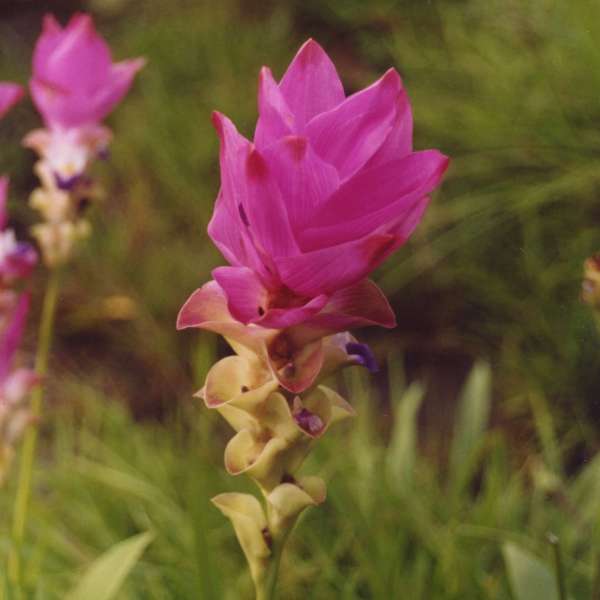
Photo: Ahoerstemeier (talk) (Uploads), CC BY-SA 3.0 · source

Houseplant · Zingiberaceae
Siam tulip
Curcuma alismatifolia
In other languages: Curcuma (Nederlands) · Tulipe du Siam (Français)
Curcuma alismatifolia, the Siam tulip, comes from South-East Asia, especially Thailand. Despite its name it is not a tulip but a relative of ginger and turmeric. In spring a rhizome with fleshy tuberous roots sends up fresh green, lance-shaped leaves, and in summer upright stalks carrying a cone of pink bracts. The true flowers are small and hidden between those bracts. In Europe you grow it as a pot or patio plant, and as a cut flower. In autumn the foliage dies back and the rhizome rests until the following spring.
Light
Partial shade
no harsh midday sun
Moisture
Normal
no wet feet
Legal basis
Potting soil
Hardiness
Houseplant
min. 15 °C
Size
0.5 m
tall, 0.3 m wide
Flowering
June–September
| Height | 0.5 m |
|---|---|
| Poisonous to people and pets | Not known to be poisonous |
| Flowering | June–September |
Identify
Siam tulip: how do you recognise it?
- Habit
- Clump 50 cm tall and 30 cm wide, from a rhizome with a bundle of fleshy tuberous roots.
- Leaves
- Lance-shaped, fresh green, 30–40 cm long, with a clear midrib; dies back in autumn.
- Flower
- Upright flower stalks with a cone of pink to magenta bracts with a green base; the true flowers are small, June to September.
- Roots
- A rhizome with a bundle of fleshy tuberous roots in which food is stored.
- Rest
- In autumn the leaves die and the rhizome rests dry until March.
Flowering: June–September · Plants: March–April
In your garden
Why grow it?
- Striking pink flower cones from June to September, in summer when many houseplants flower little.
- A distinctive, tropical look with fresh green foliage.
- Lasts well in a vase: also suitable as a cut flower.
- Stays compact: 50 cm tall and 30 cm wide, also suitable for a small pot.
- The rhizome overwinters dry and grows again the following spring.
Siam tulip: where does it grow best?
- Bright partial shade: plenty of light but no fierce midday sun; an east or west window or a sheltered spot outdoors.
- Light, humus-rich and free-draining compost; acid to neutral.
- Evenly, lightly moist during growth, never wet.
- Warm: 20–30 °C in the growing season, never below 15 °C.
- Outdoors only from June, when nights stay warm (at least 15 °C), in a sheltered, warm spot.
- Light
- Bright, out of direct sun
- Potting soil
- Multi-purpose compost or airy, humus-rich compost
- Acidity
- Acid or neutral
- Watering
- Moderately
- Size
- 0.5 m tall, 0.3 m wide
- Temperature
- Minimum 15 °C
Goes well with
Maintenance
Siam tulip: when and how to plant it?
Plant in March–April.
- Pot the rhizomes in March–April, as soon as it is warm enough (at least 18–20 °C).
- Choose a 20–25 cm pot with drainage holes and fill it with light, airy compost with perlite.
- Lay the rhizome horizontally or with the tuberous roots pointing down and cover it with about 5 cm of compost.
- Put about 2–3 rhizomes in such a pot, 8–10 cm apart.
- Water a little; not too much at first, until the first shoots appear (after 3–6 weeks).
- Put the pot somewhere warm and bright; bottom heat speeds up sprouting.
Care
- Water
- After sprouting keep the compost evenly moist; do not let it dry out and avoid wet feet. When the leaves turn yellow in autumn, gradually cut back.
- Feeding
- From sprouting until flowering give half-strength flowering plant food every 2 weeks. Stop when the leaves turn yellow.
- Humidity
- Keep the air fairly humid and mist the leaves now and then.
- Faded flowers
- Cut a faded flower stalk off at the base; new ones often follow.
- Position
- Turn the pot now and then so that the flowers stay nicely upright.
Tip: The leaves die back after flowering: let the rhizome overwinter dry at 15–20 °C and repot it in fresh compost in March.
Siam tulip: when to prune it?
When: It is not pruned. Cut off faded stalks and, in autumn, the dead foliage.
How:
- Cut a faded flower stalk off just above the compost.
- In autumn, when the leaves have turned yellow, cut all the leaves off just above the compost.
- Use clean scissors to prevent infection.
Caution: Only cut the foliage off once it is completely dried: until then it feeds the rhizome.
Propagation
- Division
- In March–April, when replanting: divide the bundle into pieces, each with at least one eye and two or three tuberous roots. Let the cuts dry for a day and plant them separately.
Siam tulip: how does it get through the winter?
- Not hardy: the rhizome needs at least 15 °C and must never get frost or cold.
- When the leaves die in autumn, stop watering. Let the rhizome overwinter dry in its pot at 15–20 °C.
- Repot it in March in fresh compost, keep it warm and only water when the first shoots appear.
Diseases and pests
- Rotting rhizome: From cold, wet compost or water in winter. Keep the rhizome dry and warm during its rest; throw away soft or slimy rhizomes.
- No shoots: Too cold or too wet. Put the pot somewhere warm (20 °C or more) and water very little until shoots appear.
- Few or no flowers: Too little light or feeding, or a start that is too late or too cold. Give more light, feed regularly and start on time.
- Spider mite and thrips: Fine webbing or silvery flecks on the leaves, especially in dry air. Rinse the leaves, raise the humidity and repeat weekly.
Through the year
- January: Rest: leave the pot dry and warm (15–20 °C).
- February: Rest: keep dry and warm.
- March: Replant the rhizomes in fresh compost. Put somewhere warm.
- April: Plant the rhizomes. Little water until shoots appear.
- May: Shoots grow. Keep evenly moist, start feeding.
- June: First flowers. Put outdoors when nights stay warm.
- July: Full flower. Water and feed. Cut flowers for the vase.
- August: In flower. Water and feed. Shade from fierce sun.
- September: Last flowers. Stop feeding. Bring indoors before it turns cold.
- October: Leaves dry out: gradually water less.
- November: Rest: stop watering, cut off the leaves.
- December: Rest: keep dry and warm (15–20 °C).
You and this species
Did you know?
- The pink ‘petals’ are actually bracts; the true flowers are small and hidden between the lower bracts.
- It is related to turmeric (Curcuma longa) and ginger, and belongs to the ginger family.
- In Europe the rhizomes are sold in spring as ‘bulbs’; you pot them up to flower in summer.