Photo: Kurt Stüber [1], CC BY-SA 3.0 · source

Perennial · Papaveraceae
Western bleeding heart
Dicentra formosa
In other languages: Mariatranen (Nederlands) · Dicentra (Français)
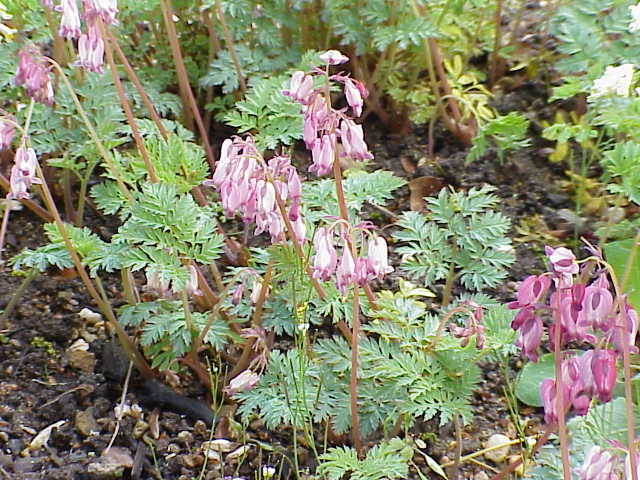
Western bleeding heart comes from the moist woodlands of the west coast of North America, from British Columbia to California. It is a graceful perennial with finely cut, blue-green, fern-like leaves. From April to June, small pink, heart-shaped flowers hang in clusters from slightly arching stems above the foliage, and it often keeps flowering on and off into summer. Its short rhizomes let it spread slowly into a loose ground cover for partial shade. There are cultivars with dark red flowers, such as ‘Bacchanal’, as well as white forms.
Caution: All parts are poisonous if eaten and the sap can irritate the skin. Do not plant it where small children, dogs, cats or grazing animals could nibble it, and wear gloves.
Light
Partial shade or shade
tolerates little sun
Moisture
Normal to wet
must not dry out
Legal basis
Loam or clay
acid to neutral
Hardiness
Fully hardy
down to -35 °C
Size
0.4 m
tall, 0.45 m wide
Flowering
April–June
| Pruning months | March and July |
|---|---|
| Height | 0.4 m |
| Native to Belgium | No, planted |
| Good for bees, butterflies and birds | Yes, for bees |
| Poisonous to people and pets | Yes, take care with children and pets |
| Flowering | April–June |
Identify
Western bleeding heart: how do you recognise it?
- Habit
- Loose clumps 30–40 cm tall that spread slowly by short rhizomes to 45 cm and more.
- Leaves
- Finely cut and fern-like, blue-green to grey-green, on long stalks.
- Flowers
- Hanging, heart-shaped flowers of 1–2 cm in clusters above the leaves, from April to June.
- Colour
- Pink to reddish pink; dark red or white in some cultivars.
- Roots
- Fleshy, brittle rhizomes just below the surface.
Flowering: April–June · Plants: March–April and September–October · Pruning: March and July
In your garden
Why grow it?
- A long flowering season: from April to June, and often a few flowers here and there into summer.
- Fine, fern-like foliage that is graceful even without flowers.
- Dies down in summer less quickly than the large bleeding heart, so it leaves no gap in the border.
- A loose ground cover for partial shade under shrubs and trees.
- Bumblebees love visiting the hanging flowers.
Western bleeding heart: where does it grow best?
- Partial shade or shade; in full sun the leaves scorch and the plant dies down early.
- Humus-rich loam or clay, slightly acid to neutral.
- Soil that stays moist; a cool spot under trees or shrubs is ideal.
- Plant 5–6 plants per m², 40–45 cm apart.
- Light
- Partial shade and shade
- Soil type
- Loam or clay
- Acidity
- Acid or neutral
- Moisture
- Normal or wet
- Size
- 0.4 m tall, 0.45 m wide
- Hardiness
- Hardy (to -35 °C)
Goes well with
- Ferns: Fine foliage beside fine foliage, in the same cool shade.
- Hosta: Large leaves as a calm contrast to the fine foliage.
- Columbine: Flowers alongside in May–June, with very different flower shapes.
- Lungwort: An early flower for the same partial shade.
- Barrenwort: An evergreen ground cover that also covers the soil in winter.
Maintenance
Western bleeding heart: when and how to plant it?
Plant in March–April and September–October.
- Plant in March–April or in September–October, when the soil is neither frozen nor too wet.
- Dig a hole twice as wide as the pot and work in plenty of leaf mould.
- Set the plant at the same depth as in the pot and handle the brittle rhizomes with care.
- Space 5–6 plants per m², 40–45 cm apart.
- Water in generously straight away.
- Mulch with leaf mould or well-rotted compost to keep the soil cool and moist.
Care
- Watering
- Keep the soil moist, especially in spring and summer. In drought it dies down early.
- Feeding
- A layer of compost or leaf mould in spring; nothing more is needed.
- Mulching
- A mulch of leaf mould keeps the roots cool.
- Spent flowers
- Cut off faded stems; it then keeps flowering for longer.
- Gloves
- Wear gloves when handling the plant: the sap can irritate the skin.
Tip: Keep the soil cool and moist with a mulch of leaf mould: the foliage then stays attractive all summer and the plant flowers for longer.
Western bleeding heart: when to prune it?
Pruning months: March and July.
When: Little is needed. If the foliage looks tired in July, cut it back. In March, clear away dead leaves.
How:
- Cut spent flower stems off at the base.
- If the foliage turns yellow or untidy after flowering, cut it back to just above the ground and water: fresh leaves often follow.
- Remove dead foliage in March, before the new shoots appear.
Caution: Work carefully in March: the young shoots are brittle and snap easily.
Propagation
- Division
- In early spring or autumn: cut off pieces of rhizome with a bud and replant them at once.
- Seed
- Sow fresh seed in summer in a pot left outdoors: the seed needs cold and only germinates the following spring. It also sometimes self-seeds.
Western bleeding heart: how does it get through the winter?
Hardy to −35 °C.
- Fully hardy, to about −35 °C: no protection is needed.
- It dies back above ground in winter and regrows in March.
- A late frost can damage the young shoots; in a hard night frost in March or April, cover the plant with fleece.
Diseases and pests
- Slugs and snails: They love the young shoots in spring. Pick them off in the evening.
- Early dieback: In dry soil or sun the leaves turn yellow and die in summer. Water, mulch and choose a cooler spot.
- Frost damage: Black, limp shoots after a cold spring night. Cut them off: the plant will regrow.
- Few flowers: Usually soil that is too dry or shade that is too deep. Water and give a little more light.
Through the year
- March: Clear away dead foliage. Apply compost. Planting. Watch out for night frost.
- April: Flowering begins. Watch out for slugs. Planting.
- May: Full flower. Water during dry spells.
- June: Last flowers. Cut off spent stems.
- July: Cut back tired foliage. Water during dry spells. Sow fresh seed.
- August: Water during dry spells.
- September: Planting and dividing.
- October: Planting and dividing.
- November: The plant dies down for winter.
Use
Edible and useful
Not edible. All parts of these relatives of bleeding heart are poisonous: they contain alkaloids that cause vomiting, stomach ache and, in larger amounts, trembling and seizures if swallowed. In grazing livestock, especially cattle and sheep, poisoning by related species is known: do not plant them in or beside a field, and never throw plant remains into a field or pen. Keep small children, dogs and cats away from the plant, and wear gloves when working with it, as the sap can irritate the skin. They self-seed easily, in walls and between paving too: pull out unwanted seedlings wearing gloves. If any is swallowed, call a poison centre (in Belgium 070 245 245) or your doctor at once.
Good for wildlife
- Bees
- Nectar and pollen for honeybees and wild bees.
You and this species
Did you know?
- The seeds carry a fatty appendage that ants love: they drag the seeds to their nest and so spread the plant.
- The name Dicentra means ‘two spurs’, after the two swollen spurs on the flower.
- The large bleeding heart, once also a Dicentra, is now called Lamprocapnos spectabilis.