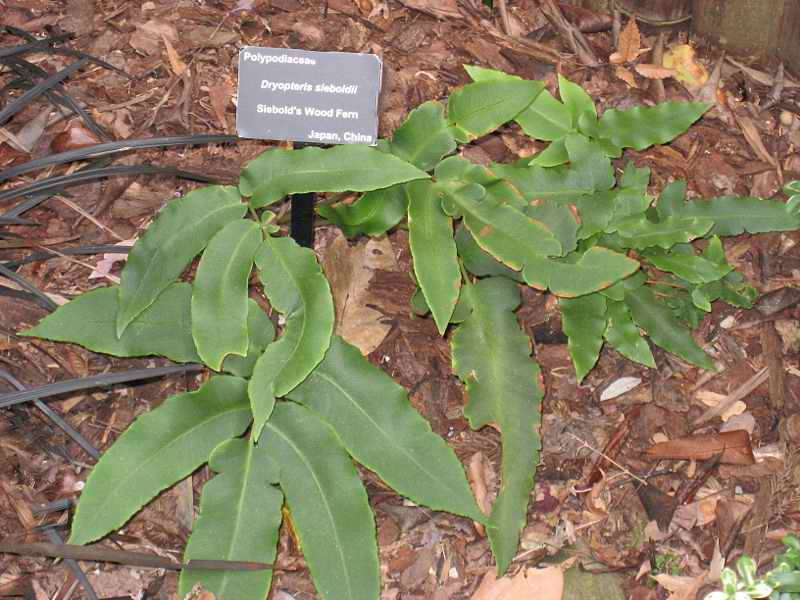
Photo: --FinitoR originally uploaded as Daderot, CC BY-SA 3.0 · source

Fern · Dryopteridaceae
Siebold’s wood fern
Dryopteris sieboldii
In other languages: Dryopteris (Nederlands) · Dryopteris (Français)
Dryopteris sieboldii is a fern from East Asia, including Japan, named after the German naturalist Philipp Franz von Siebold. It hardly looks like an ordinary fern: each frond has only a few pairs of large, broad, leathery, grey-green leaflets. The plant grows about 60 cm tall and wide and gives a striking, almost tropical structure to the shade garden. It is hardy down to about −20 °C and stays green in mild winters. Plant it in shelter in humus-rich soil and give it a permanent spot.
Light
Partial shade or shade
tolerates little sun
Moisture
Normal
no wet feet
Legal basis
Sand, loam or clay
acid to neutral
Hardiness
Fully hardy
down to -20 °C
Size
0.6 m
tall, 0.6 m wide
| Pruning months | March |
|---|---|
| Height | 0.6 m |
| Native to Belgium | No, planted |
| Poisonous to people and pets | Not known to be poisonous |
Identify
Siebold’s wood fern: how do you recognise it?
- Habit
- Upright, funnel-shaped clump about 60 cm tall and wide.
- Fronds
- Leathery, grey-green; each frond has a few pairs of large, long, broad leaflets. Stays green in mild winters.
- Spores
- Ferns do not flower: the spores sit in small groups on the underside of the leaflets.
- Roots
- A short, sturdy rhizome with fibrous roots; the plant grows slowly.
- New fronds
- In spring the new fronds unroll like a crozier; they are soft and vulnerable then.
Plants: March–May and September–October · Pruning: March
In your garden
Why grow it?
- A distinctive fern with large, leathery leaflets that look unlike other ferns.
- Grey-green foliage that contrasts with hostas and other shade plants.
- Evergreen in mild winters: interest even in the cold months.
- Easy and calm: no pruning, no feeding, hardly any diseases.
- A fine accent plant for under trees, the north side of a wall or a pot.
Siebold’s wood fern: where does it grow best?
- Part shade to shade; in full sun the fronds scorch.
- Humus-rich, moisture-retentive but free-draining soil: sand or loam, acid to neutral.
- Sheltered from cold winter wind and from fierce summer sun.
- Allow 50–60 cm of space per plant.
- Light
- Partial shade and shade
- Soil type
- Sand, loam or clay
- Acidity
- Acid or neutral
- Moisture
- Normal
- Size
- 0.6 m tall, 0.6 m wide
- Hardiness
- Hardy (to -20 °C)
Goes well with
- Hosta: Large, soft leaves beside the tough, leathery fern foliage.
- Barrenwort: A carpet of leaves and small flowers under the same trees.
- Hellebore: Flowers in winter and is evergreen too.
- Wood anemone: A white spring flower that fades as the fern grows in full.
Maintenance
Siebold’s wood fern: when and how to plant it?
Plant in March–May and September–October.
- Plant in March–May or September–October, when the soil is neither frozen nor waterlogged.
- Dig a hole twice as wide as the root ball and mix in a few spadefuls of leaf mould.
- Set the plant at the same depth as in its pot, with the crown at soil level: do not bury the growing points.
- Firm the soil and water in generously straight away.
- Spread a layer of leaf mould around the base and keep the soil moist in the first year.
Care
- Water
- Keep the soil slightly moist; it does not tolerate long drought. In dry weather water generously, especially in the first year.
- Feeding
- A layer of leaf mould or compost in spring is enough.
- Mulching
- Leaf mould in autumn keeps the roots cool and moist and protects against frost.
- Tidying
- In March cut off damaged or brown fronds; leave healthy ones.
- Position
- Move it as little as possible; a quiet, permanent spot is best.
Tip: Give it a sheltered, shady spot and a layer of leaf mould: then the foliage stays nicely green in mild winters and it is ready early in spring.
Siebold’s wood fern: when to prune it?
Pruning months: March.
When: In March, before the new fronds unroll.
How:
- Cut damaged and brown fronds off at the base with sharp secateurs.
- Leave healthy green fronds; they protect the crown in winter.
- Take care of the young, rolled-up shoots in the middle of the clump.
Propagation
- Division
- In spring, if the plant has several crowns, carefully separate them with a sharp spade and replant at once. The plant grows slowly; only divide it if necessary.
- Spores
- Possible but slow and a test of patience: scatter ripe spores on damp compost kept moist under a clear cover and wait for months.
Siebold’s wood fern: how does it get through the winter?
Hardy to −20 °C.
- Hardy down to about −20 °C: no protection is needed in most Belgian winters.
- In mild winters the fronds stay green; in hard winters they turn brown. Cut them off in March then.
- In a pot: stand it against a wall and wrap the pot in hessian so the roots do not freeze.
Diseases and pests
- Scorched fronds: Brown edges caused by too much sun, wind or drought. Water more and choose a sheltered, shadier spot.
- Frost on new fronds: A late frost can damage the young shoots in April. Cover them with hessian or move them to shelter; they usually regrow.
- Slugs: Young, soft fronds are nibbled in spring. Look for them in the evening and remove them by hand.
- Wet feet: In heavy, wet soil the crown rots in winter. Plant in a well-drained spot or work in compost and a little sand.
Through the year
- March: Cut off damaged fronds. Apply compost. Plant.
- April: New fronds unroll. Plant. Protect young shoots from late frost.
- May: Plant. Water in dry spells.
- June: Water in dry spells.
- July: Water in dry spells.
- August: Water in dry spells.
- September: Plant.
- October: Plant. Mulch with leaf mould.
- December: Rest. In hard frost cover the crown.
You and this species
Did you know?
- The species name honours Philipp Franz von Siebold, a German physician and naturalist who worked in Japan in the 19th century and brought many Japanese plants to Europe.
- The name Dryopteris comes from Greek and means ‘oak fern’, because these ferns often grow under trees.
- Ferns do not form seeds but spores: they sit in small groups on the underside of the fronds.