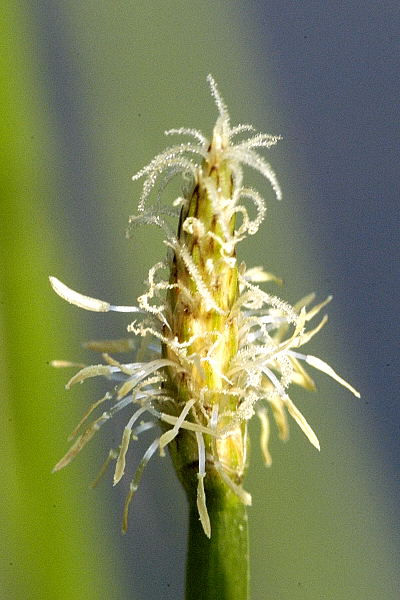
Photo: James K. Lindsey, CC BY-SA 3.0 · source

Water or marginal plant · Cyperaceae
Common spike-rush
Eleocharis palustris
In other languages: Gewone waterbies (Nederlands) · Scirpe des marais (Français)
Common spike-rush is a native, rush-like plant of the sedge family that grows in Europe, Asia and North America along banks, in shallow ponds and in wet grassland. With its creeping rhizomes it forms dense mats of thin, round, fresh green stems up to 50 cm tall, without true leaves. At the tip of each stem sits a single small, brown spikelet, which gives it a fine, graphic look. Gardeners use it in shallow water up to 20 cm deep to create a natural transition from water to bank. It is fully hardy, tolerates both acid and chalky soil and gives small aquatic creatures a safe hiding place.
Caution: Spreads by creeping rhizomes into dense mats. In a small pond, keep it in a basket, chop off runners in good time and never put garden plants into natural waters.
Light
Full sun
warm and bright
Moisture
Moist to wet
must not dry out
Legal basis
Loam, clay or peat
any pH
Hardiness
Fully hardy
down to -30 °C
Size
0.5 m
tall, 0.4 m wide
| Pruning months | March |
|---|---|
| Height | 0.5 m |
| Native to Belgium | Yes |
| Poisonous to people and pets | Not known to be poisonous |
Identify
Common spike-rush: how do you recognise it?
- Habit
- Dense mats of upright stems 20–50 cm tall, rising from creeping rhizomes.
- Stems
- Thin, round and fresh green; they do the work of leaves.
- Leaves
- Reduced to brownish sheaths at the base of the stems.
- Spikelet
- A single small, brown, egg-shaped spikelet 0.5–2 cm long at the tip of each stem.
- Roots
- Creeping rhizomes in the mud, by which it spreads.
Plants: April–June · Pruning: March
In your garden
Why grow it?
- Creates a soft, natural transition from water to bank.
- Fine, straight stems give a calm, grassy look in shallow water.
- The dense mats shelter tadpoles, young fish and water insects.
- Damselflies and dragonflies rest on the stems, and their larvae climb up them out of the water.
- Native, fully hardy and not fussy about soil.
Common spike-rush: where does it grow best?
- Full sun: in shade it grows thin and sparse.
- In shallow water up to 20 cm deep or on the wet bank.
- Loam, clay or peat, acid to chalky.
- Allow 30–40 cm between plants: they soon join up into a mat.
- Light
- Sun
- Soil type
- Loam, clay or peat
- Acidity
- Not fussy
- Moisture
- Wet
- Size
- 0.5 m tall, 0.4 m wide
- Hardiness
- Hardy (to -30 °C)
Goes well with
- Flowering rush: Pink umbels above the fine stems, in the same shallow water.
- Water plantain: Airy white flower sprays rising above the mat.
- Marsh marigold: Yellow spring flowers on the wet bank.
- Water forget-me-not: Small pale blue flowers among the stems along the shallow edge.
- Arrowhead: Arrow-shaped leaves that contrast with the thin, round stems.
Maintenance
Common spike-rush: when and how to plant it?
Plant in April–June.
- Plant from April to June, as the water warms up.
- Use a wide, shallow aquatic basket filled with heavy, low-nutrient aquatic soil, without fertiliser or compost.
- Plant the clump at the same depth as in the pot, with the rhizomes just below the soil, and firm in well.
- Top with a layer of gravel so the soil does not wash out.
- Set the basket 0–20 cm below the water surface.
- Keep 30–40 cm between plants.
Care
- Water
- Must never dry out. In dry summers, top up the pond with rainwater.
- Feeding
- Not needed: fertiliser in the pond encourages algae.
- Spread
- In spring, chop off pieces of mat growing outside the basket or too far up the bank.
- Division
- Divide every 3–4 years, when the basket is full and the centre goes bare.
- Blanket weed
- Remove blanket weed from among the stems by twisting it round a stick.
Tip: Plant it in full sun in shallow water up to 20 cm deep, where water meets bank: you get a soft, natural edge.
Common spike-rush: when to prune it?
Pruning months: March.
When: In March, before the new stems emerge.
How:
- Cut the old, brown stems back to a few centimetres above the water.
- Leave them standing through autumn and winter as shelter for insects.
- Remove the cut stems from the pond.
Propagation
- Division
- In April–May, chop off a piece of mat with its rhizomes or take it from the basket, and plant it separately. It establishes easily.
- Seed
- Sow in spring on wet aquatic soil in a pot standing in a saucer of water. Division is much quicker.
Common spike-rush: how does it get through the winter?
Hardy to −30 °C.
- Fully hardy, to about −30 °C: no protection needed.
- The stems lose their colour in winter; the rhizomes overwinter in the mud.
- A basket in shallow water may freeze solid without harm.
Diseases and pests
- Spreading: In a small pond, the mat grows over the rim of the basket and up the bank. Chop off runners in spring.
- Blanket weed: Algae among the dense stems. Remove it with a stick and use no fertiliser in or near the pond.
- Bare centre: An old mat goes bare in the middle. Divide it and replant the young pieces from the edge.
- Sparse growth: Thin, floppy stems and little growth due to too much shade. Give it a sunny spot.
Through the year
- March: Cut back old stems.
- April: Plant or divide.
- May: Plant. The new stems grow.
- June: Plant. Remove blanket weed.
- July: Top up the water in dry spells.
- August: Top up the water in dry spells. Keep runners in check.
- October: Leave the stems as winter shelter.
- December: Rest.
You and this species
Did you know?
- The leaves are reduced to small sheaths at the base: the green stems do the work of leaves.
- The Chinese water chestnut, familiar from Asian cooking, belongs to the same genus, Eleocharis.
- The name Eleocharis comes from Greek words meaning ‘marsh’ and ‘grace’.