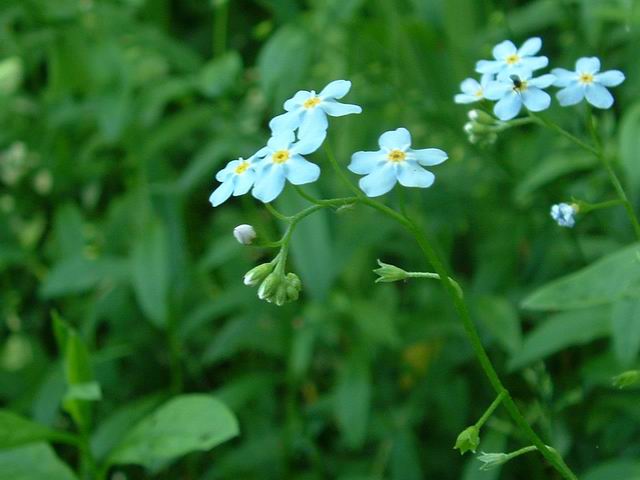
Photo: Wikimedia Commons, CC BY-SA 3.0 · source

Water or marginal plant · Boraginaceae
Water forget-me-not
Myosotis scorpioides
In other languages: Moerasvergeet-mij-nietje (Nederlands) · Myosotis des marais (Français)
Water forget-me-not is a native perennial of ditch banks, wet meadows and riversides throughout Europe. Unlike the familiar biennial garden forget-me-not, it is a perennial and spreads with creeping stems and runners through wet soil and shallow water. From May into September it bears sky-blue flowers with a yellow eye, in sprays that are at first coiled like a scorpion’s tail. It forms a loose mat 20–30 cm high that neatly hides the edge of a pond. The compact cultivar ‘Mermaid’ is well known, and there is also a white-flowered form.
Light
Sun or partial shade
preferably some sun
Moisture
Moist to wet
must not dry out
Legal basis
Loam, clay or peat
any pH
Hardiness
Fully hardy
down to -25 °C
Size
0.3 m
tall, 0.4 m wide
Flowering
May–September
| Pruning months | March and July |
|---|---|
| Height | 0.3 m |
| Native to Belgium | Yes |
| Good for bees, butterflies and birds | Yes, for bees |
| Poisonous to people and pets | Not known to be poisonous |
| Flowering | May–September |
Identify
Water forget-me-not: how do you recognise it?
- Habit
- Loose mat 20–30 cm high and about 40 cm across, with creeping stems that root at the nodes.
- Leaves
- Oblong, 3–8 cm, soft and finely hairy to almost smooth; fresh green and slightly glossy.
- Flowers
- Small flowers up to 1 cm across in coiled sprays that slowly unfurl, from May to September.
- Colour
- Sky blue with a yellow eye; the buds are often pink.
- Stems
- Angular, with runners that creep over wet soil and through shallow water.
Flowering: May–September · Plants: April–June and September · Pruning: March and July
In your garden
Why grow it?
- Flowers for five months, from May into September.
- Hides pond liner and hard edges under a loose green mat with blue flowers.
- Bees, hoverflies and other small insects visit the flowers.
- Newts fold their eggs into its soft leaves: a real wildlife pond plant.
- Native, easy and quick to establish, in sun or partial shade.
Water forget-me-not: where does it grow best?
- Sun or partial shade; it flowers best in sun.
- Wet soil at the edge of a pond, ditch or stream: loam, clay or peat, acid to chalky.
- Marsh zone: from boggy bank down to 10 cm below the water surface.
- Must not dry out; it will not last in an ordinary border.
- Allow 30–40 cm between plants.
- Light
- Sun and partial shade
- Soil type
- Loam, clay or peat
- Acidity
- Not fussy
- Moisture
- Wet
- Size
- 0.3 m tall, 0.4 m wide
- Hardiness
- Hardy (to -25 °C)
Goes well with
- Marsh marigold: Golden yellow in April, before the forget-me-not starts flowering.
- Monkeyflower: Bright yellow beside the sky blue, on the same wet edge.
- Water mint: Scented leaves and lilac flowers, also loved by newts and insects; keep it in a basket.
- Flowering rush: Pink flower heads in summer, a little deeper in the water.
- Yellow flag iris: Tall swords and yellow flowers behind the low blue mat.
Maintenance
Water forget-me-not: when and how to plant it?
Plant in April–June and September.
- Plant from April to June or in September, while the soil is still warm enough for rooting.
- Fill an aquatic basket with heavy garden soil or aquatic compost, without fertiliser or potting compost; on the bank, plant straight into the wet soil.
- Set the plant at the same depth as it was in its pot, firm it in and top the basket with gravel.
- Stand the basket 0–10 cm below the water; a marginal shelf in the pond is ideal.
- Space plants 30–40 cm apart; they soon grow together.
- Water in and keep the bank soil wet until the plants have rooted.
Care
- Water level
- Keep the base wet at all times; top up with rainwater in dry spells.
- Feeding
- Not needed in the pond. On the bank, perhaps a little compost in spring.
- Cutting back
- After the first flush of flowers in July, cut back by half: this gives fresh leaves and a second flowering.
- Runners
- It spreads steadily. Shorten or cut off runners that grow too long.
- Renewing
- Old plants go bare in the middle. Renew them every two or three years with rooted cuttings.
Tip: Stand it on a marginal shelf just below the water so it can spill over the edge: the pond liner soon disappears from view.
Water forget-me-not: when to prune it?
Pruning months: March and July.
When: Cut back by half in July after the first flowers, and clear dead stems and leaves in March.
How:
- In July, cut the faded stems back by half, just above a leaf.
- In March, remove dead and untidy leaves before new growth starts.
- Shorten runners that grow beyond where you want them.
- After the second flush, leave a few flower stems if you would like seedlings.
Propagation
- Cuttings
- From May to August, put 10 cm pieces of stem into wet soil or a glass of water; they root within a few weeks.
- Division
- In April or September, split a clump or sever a rooted runner and replant it elsewhere.
- Self-sown seedlings
- It sometimes self-seeds on wet ground; move the seedlings in spring.
Water forget-me-not: how does it get through the winter?
Hardy to −25 °C.
- Hardy to about −25 °C: no protection is needed in a Belgian winter.
- In mild winters some leaves stay green; in hard frost they die back and the plant regrows in spring.
- Leave old stems lying until March: they protect the young shoots.
Diseases and pests
- Powdery mildew: White powder on the leaves, especially in late summer or when the soil gets too dry. Cut back and keep the base wet.
- Aphids: On young shoots. Hose them into the water, where fish and other creatures eat them.
- Slugs: They eat young shoots on the bank. Pick them off in the evening.
- Bare plant: After a few years the centre becomes bare and open. Renew with cuttings or by division.
Through the year
- March: Clear dead leaves and old stems.
- April: Plant or divide.
- May: Flowering begins. Take cuttings.
- June: Full flower. Last month for spring planting.
- July: After the first flush, cut back by half.
- August: Second flush. Top up the water in dry spells.
- September: Last flowers. Planting or dividing is possible again.
- November: Resting. Leave stems lying until March.
Use
Good for wildlife
- Bees
- Nectar and pollen for honeybees and wild bees.
You and this species
Did you know?
- Newts lay their eggs one at a time on a leaf of soft plants like this one, then fold the leaf around each egg for protection.
- The species name scorpioides refers to the coiled flower spray, which looks like the curled tail of a scorpion.
- Myosotis means ‘mouse’s ear’ in Greek, after the shape of the leaves.