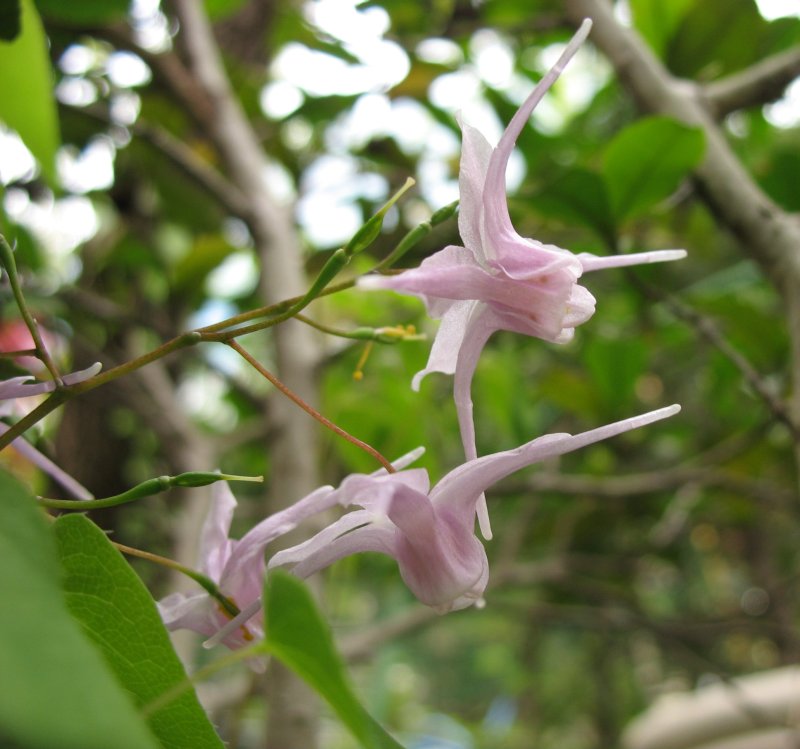
Photo: Sphl, CC BY-SA 3.0 · source

Perennial · Berberidaceae
Large-flowered barrenwort
Epimedium grandiflorum
In other languages: Elfenbloem (Nederlands) · Épimède à grandes fleurs (Français)
Large-flowered barrenwort comes from the woodlands of Japan, Korea and north-eastern China. It is a low, clump-forming perennial with elegant compound leaves made up of heart-shaped leaflets, often bronze-tinted as they unfurl. In April and May airy sprays of large, spurred flowers appear above the foliage, looking like little bishop’s mitres or tiny spiders, in white, pink, lilac or purple. Unlike the evergreen species, its leaves die back in winter. Well-known cultivars include the lilac ‘Lilafee’, the white ‘White Queen’ and the pink ‘Rose Queen’.
Light
Partial shade or shade
tolerates little sun
Moisture
Normal
no wet feet
Legal basis
Loam or clay
acid to neutral
Hardiness
Fully hardy
down to -30 °C
Size
0.3 m
tall, 0.3 m wide
Flowering
April–May
| Pruning months | February |
|---|---|
| Height | 0.3 m |
| Native to Belgium | No, planted |
| Poisonous to people and pets | Not known to be poisonous |
| Flowering | April–May |
Identify
Large-flowered barrenwort: how do you recognise it?
- Habit
- Compact, slow-growing clump 20–30 cm high and about 30 cm wide.
- Leaves
- Two or three times divided into threes, with heart-shaped, finely toothed leaflets; often bronze-red when young.
- Flower
- Large spurred flowers 2–4 cm across, in loose sprays on thin stalks, in April–May.
- Colour
- White, pink, lilac or purple, often two-toned with paler spurs.
- Roots
- A short, woody rhizome that spreads slowly; it is not invasive.
Flowering: April–May · Plants: March–April and September–October · Pruning: February
In your garden
Why grow it?
- Graceful, unusual flowers in spring, in a shady corner where little else flowers so delicately.
- Attractive leaves from spring to autumn: bronze as they unfold, later fresh green.
- Long-lived and tough: once established it can stay put for years with little work.
- After a few years it forms a dense clump that covers the ground under shrubs.
- Slugs usually leave the leaves alone.
Large-flowered barrenwort: where does it grow best?
- Partial or light shade, for example under shrubs or deciduous trees; no fierce midday sun.
- Humus-rich loam or clay, slightly acid to neutral, rich in leaf mould.
- Normally moist: the soil should not dry out, nor stay wet for long.
- Plant 25–30 cm apart, in small groups for a closed carpet.
- Sheltered from cold winds and late frosts, which can damage the young leaves and flowers.
- Light
- Partial shade and shade
- Soil type
- Loam or clay
- Acidity
- Acid or neutral
- Moisture
- Normal
- Size
- 0.3 m tall, 0.3 m wide
- Hardiness
- Hardy (to -30 °C)
Goes well with
- Ferns: The same cool, humus-rich spot; they unfurl as the barrenwort flowers.
- Hellebore: Flowers earlier in spring and likes the same partial shade.
- Lungwort: Blue and pink spring flowers and spotted leaves alongside.
- Hosta: Large summer leaves beside the fine barrenwort foliage.
- Snowdrop: Flowers earlier, just after you have cut away the old leaves.
Maintenance
Large-flowered barrenwort: when and how to plant it?
Plant in March–April and September–October.
- Plant in March–April or in September–October, when the soil is moist and not frozen.
- Loosen the soil well and mix in plenty of leaf mould or garden compost.
- Set the plant at the same depth as in the pot, with the rhizome just below the surface.
- Space plants 25–30 cm apart; allow 9–12 plants per m² for a carpet.
- Water in well and keep the soil moist during the first year.
- Spread a layer of leaf mould around the plants to keep the soil cool and moist.
Care
- Water
- Regularly in dry spells during the first year. Later, water in dry summers too: this species copes with drought less well than other barrenworts.
- Feeding
- A thin layer of compost or leaf mould in March; it needs nothing more.
- Mulching
- Leave fallen tree leaves between the plants in autumn or add leaf mould yourself: this mimics the woodland floor.
- Old leaves
- Cut away the old leaves in late February so the flowers can be seen clearly in April.
- Patience
- It grows slowly: allow a few years for a full clump.
Tip: Cut away all the old leaves in late February: in April the flowers then stand clear above the ground and you can enjoy them fully.
Large-flowered barrenwort: when to prune it?
Pruning months: February.
When: In late February, before the flower stems appear. Otherwise no pruning is needed.
How:
- Cut all the old, withered leaves off just above the ground.
- Work carefully: the new flower stems and leaves are already waiting at the base and snap easily.
- If you are late and can already see the flower buds, cut leaf by leaf and spare the young shoots.
- There is no need to deadhead.
Caution: Do not wait until April: by then it is easy to cut off the young flower stems as well.
Propagation
- Division
- In late August–September or early spring: lift the clump, cut the rhizome into pieces each with a few buds and replant at once. Keep them well watered.
- Seed
- Sow fresh seed as soon as it ripens, in June, in a pot of leaf mould left outdoors. It germinates slowly, often the following spring, and seedlings do not always resemble the parent.
Large-flowered barrenwort: how does it get through the winter?
Hardy to −30 °C.
- Fully hardy, to about −30 °C: no protection is needed in Belgium.
- The leaves die back or stay brown on the plant; leave them until late February as natural protection.
- A late frost in April can damage the young leaves and flowers. In hard frost, cover them with horticultural fleece.
- In a pot: keep it sheltered in the shade and the compost slightly moist.
Diseases and pests
- Vine weevil: Notched, half-moon-shaped leaf edges and ailing plants, because the larvae eat the roots. Pick off the adults at night by torchlight and use nematodes against the larvae in summer.
- Brown leaf edges: Drought or too much sun. Water, mulch and give it more shade.
- Frost damage: Black, shrivelled young leaves after a late frost. Cut them off; new leaves will follow.
- Slow growth: Normal for this species, but dry, poor or chalky soil slows it down even more. Add leaf mould and water in dry weather.
Through the year
- February: Cut away the old leaves.
- March: Plant. Add compost.
- April: Flowering. Protect from late frost. Plant.
- May: Flowering. Water in dry weather.
- June: Collect seed and sow it at once. Water in dry weather.
- July: Water in dry weather. Top up the mulch.
- August: Water in dry weather. Division is possible from late August.
- September: Divide and plant.
- October: Plant. Leave fallen tree leaves in place.
- November: Rest. The leaves colour and die back.
You and this species
Did you know?
- Barrenworts belong to the barberry family, so they are related to Berberis and Mahonia.
- It is also known as bishop’s hat, because the flower resembles a mitre.
- The seeds carry a fatty appendage that attracts ants: they carry the seeds off and so spread the plant.