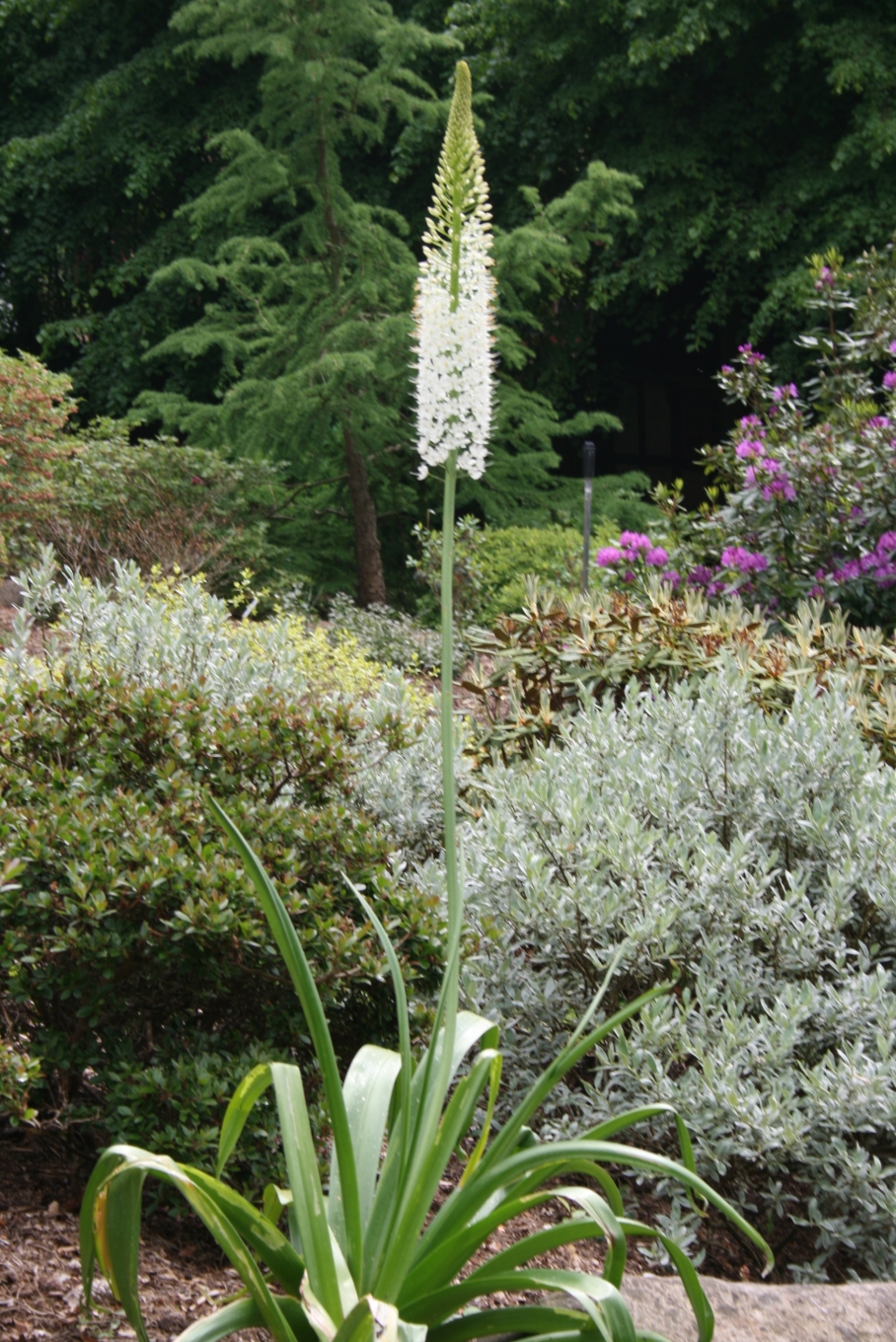
Photo: Sten Porse, CC BY-SA 3.0 · source

Bulb or tuber · Asphodelaceae
Himalayan desert candle
Eremurus himalaicus
In other languages: Eremurus himalaicus (Nederlands) · Eremurus himalaicus (Français)
Eremurus himalaicus comes from the mountains of the western Himalaya and Central Asia. From a rosette of narrow, grey-green leaves it sends up a sturdy flower stem 1.5 m tall in May–June, covered with countless pure white stars in a dense candle. It flowers earlier than most other Eremurus species and is fully hardy. After flowering the foliage dies back in summer, so plant it among perennials that fill the gap. A sunny spot and very free-draining soil are all it asks.
Light
Full sun
warm and bright
Moisture
Dry to normal
no wet feet
Legal basis
Sand or loam
neutral to chalky
Hardiness
Fully hardy
down to -25 °C
Size
1.5 m
tall, 0.5 m wide
Flowering
May–June
| Height | 1.5 m |
|---|---|
| Native to Belgium | No, planted |
| Good for bees, butterflies and birds | Yes, for bees |
| Poisonous to people and pets | Not known to be poisonous |
| Flowering | May–June |
Identify
Himalayan desert candle: how do you recognise it?
- Habit
- Crown-rooted plant with a rosette of narrow leaves, 50 cm wide; the flower stem grows 1–1.5 m tall.
- Leaves
- Long, narrow and grey-green; they die back completely after flowering, in summer.
- Flower
- A dense, candle-like raceme with countless pure white stars that open from the bottom up, in May–June.
- Roots
- A starfish-like crown with fleshy, brittle roots that radiate from the centre like the arms of an octopus.
- Dormancy
- Goes dormant in summer. The roots must stay dry then.
Flowering: May–June · Plants: September–October
In your garden
Why grow it?
- Tall, pure white flower candles up to 1.5 m: a showstopper in May–June.
- Flowers earlier than other species and so bridges the gap between spring and summer flowers.
- Bees visit the starry flowers for nectar and pollen.
- Fully hardy to about −25 °C, even in hard Belgian winters.
- A fine cut flower for large arrangements.
Himalayan desert candle: where does it grow best?
- Full sun in a warm, open spot.
- Very free-draining soil: sandy or loamy, neutral to chalky. Improve heavy clay with coarse sand or grit.
- Normal to dry soil; during summer dormancy the soil must above all not be wet.
- Shelter from strong wind. Allow 50–60 cm and plant among perennials that hide the dying foliage.
- Light
- Sun
- Soil type
- Sand or loam
- Acidity
- Neutral or chalky
- Moisture
- Dry or normal
- Size
- 1.5 m tall, 0.5 m wide
- Hardiness
- Hardy (to -25 °C)
Goes well with
- Hardy geranium: Fills the gap when the Eremurus foliage disappears.
- Catmint: A blue cloud at the base in the same sunny, dry soil.
- Sage: Violet and blue next to the pure white.
- Baby’s breath: An airy white cloud that hides the dying foliage.
- Ornamental grasses: Give structure in summer and hide the leaf remains.
Maintenance
Himalayan desert candle: when and how to plant it?
Plant in September–October.
- Plant the crowns in September–October. They dry out quickly, so plant them as soon as you get them.
- Dig a hole about 30 cm wide and 25 cm deep and make a mound of coarse sand or grit at the bottom.
- Set the crown on top of the mound and carefully spread the brittle roots out like a starfish.
- Cover with about 10 cm of soil, so the crown is well covered, and space plants 50–60 cm apart.
- Water lightly after planting; after that, the autumn weather is enough.
- Mark the spot with a small stake, as there is nothing to see in winter and summer.
Care
- Water
- In a dry spring, water while the leaves are growing. Stop watering after flowering.
- Feeding
- A little compost or organic fertiliser in spring; not too much nitrogen.
- Spring frost
- The shoots come up early and can be frosted. Cover them with brushwood or fleece on frosty nights.
- Support
- In a windy spot a stake can support the heavy flower stem.
- Spent flowers
- Cut the stem after flowering or leave the seed heads as decoration.
Tip: Plant it among perennials that hide the dying foliage in summer, and give the crown a mound of sand or grit to keep its feet dry.
Himalayan desert candle: when to prune it?
When: It is not pruned; you only clear the flower stem and the dead foliage.
How:
- Cut the faded stem in July, or leave it for the attractive seed heads.
- Let the leaves turn yellow and die back naturally; only remove them when they are completely dry.
- In autumn, spread a thin layer of dead leaves or bark over the spot to protect it, without smothering the crown.
Propagation
- Division
- In September, carefully lift the crown and divide it. The roots break very easily; only do this when the plant has become too big, every few years at most.
- Seed
- Sow in autumn or early spring, frost-free. Seedlings take several years (often about five) to flower.
Himalayan desert candle: how does it get through the winter?
Hardy to −25 °C.
- Fully hardy to about −25 °C: no protection from cold is needed.
- The danger is wet soil in winter. Provide free-draining soil with sand or grit under the crown.
- In a pot: use a deep pot with plenty of coarse sand and stand it against a wall in winter where it will not get too wet.
Diseases and pests
- Rotting crown: Caused by wet winters and heavy soil. Make a mound of coarse sand or grit and provide free-draining soil.
- Slugs: They eat the new shoots in early spring. Collect them in the evening and protect the shoots.
- Frosted shoots: Late night frost damages shoots that are already up. Cover them with brushwood or fleece in frost.
- No flowers: Newly planted crowns often only flower in the second year. Do not damage the brittle roots when planting.
Through the year
- March: Shoots appear. Keep slugs off. Have fleece ready for frost.
- April: Water in dry weather. A little compost.
- May: Flowering starts. Stake if needed.
- June: Full flower. Cut flowers for a bouquet.
- July: Cut off the faded stem. The leaves die back; stop watering.
- August: Summer dormancy. Keep dry.
- September: Plant or divide, 10 cm deep, on a mound of sand.
- October: Plant. Mark the spot.
- November: Spread a thin layer of dead leaves.
- December: Rest.
Use
Good for wildlife
- Bees
- Nectar and pollen for honeybees and wild bees.
You and this species
Did you know?
- The name Eremurus comes from Greek: eremos means desert and oura means tail, after the long flower spike.
- The flowers open from the bottom up, so the candle flowers for weeks.
- Eremurus belongs to the aloe family (Asphodelaceae), like red hot poker (Kniphofia) and daylily.