Photo: Wikimedia Commons, CC BY-SA 3.0 · source

Bulb or tuber · Asphodelaceae
Giant desert candle
Eremurus robustus
In other languages: Eremurus robustus (Nederlands) · Eremurus robustus (Français)
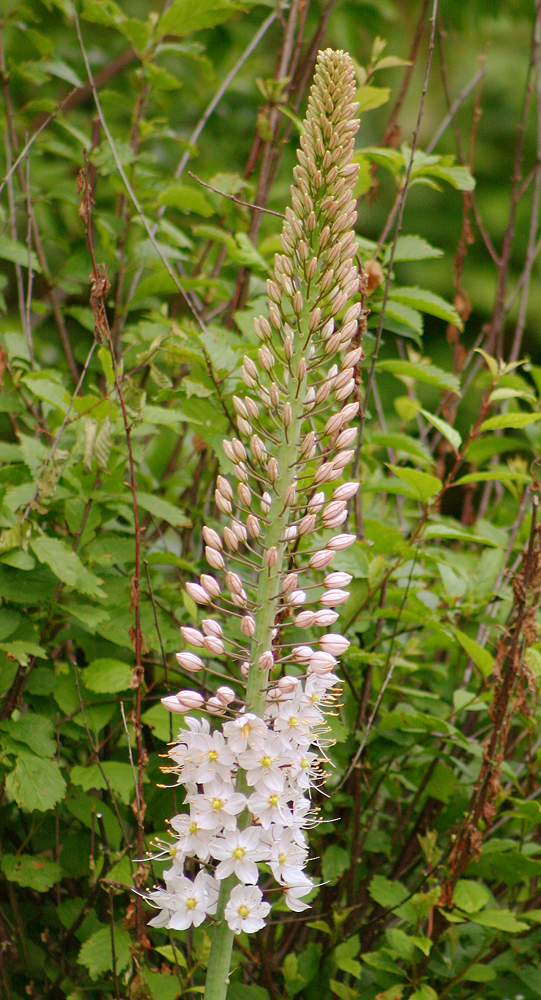
The giant desert candle comes from the mountains of Central Asia, including the Tian Shan and the Pamir-Alay, where it grows on dry, stony slopes. It grows from a fleshy, star-shaped root crown with a single fat bud in the centre. In spring a rosette of broad, blue-green, strap-shaped leaves appears, followed in June by a stem up to 2.5 m tall with a dense spike of hundreds of small, starry, pale pink flowers. The flowers open from the bottom upwards, so each candle flowers for weeks. It is one of the most spectacular bulbous plants for a sunny, dry garden.
Light
Full sun
warm and bright
Moisture
Dry to normal
no wet feet
Legal basis
Sand or loam
neutral to chalky
Hardiness
Fully hardy
down to -25 °C
Size
2.5 m
tall, 0.8 m wide
Flowering
June
| Height | 2.5 m |
|---|---|
| Native to Belgium | No, planted |
| Good for bees, butterflies and birds | Yes, for bees |
| Poisonous to people and pets | Not known to be poisonous |
| Flowering | June |
Identify
Giant desert candle: how do you recognise it?
- Habit
- Rosette of leaves from which a straight, bare flower stem rises to 2.5 m; about 80 cm across.
- Leaves
- Broad, strap-shaped, blue-green, up to about 1 m long; they die back during or shortly after flowering.
- Flower
- A dense, candle-shaped spike of hundreds of small starry flowers, in June, opening from the bottom up.
- Colour
- Pale pink, with prominent orange-yellow stamens.
- Roots
- A fleshy root crown like a starfish, with long, brittle roots around a single central bud.
Flowering: June · Plants: September–October
In your garden
Why grow it?
- A showstopper on a grand scale: pale pink candles up to 2.5 m tall, towering above everything else.
- Bees and bumblebees work their way up the flower spikes.
- An impressive cut flower for large vases.
- Hardy and drought tolerant once established.
- Takes up little ground space and adds height without crowding the border.
Giant desert candle: where does it grow best?
- Full sun, ideally in a warm spot sheltered from strong wind.
- Very free-draining soil: sand or loam, neutral to chalky.
- Dry to moist: in winter and after flowering it cannot stand wet feet.
- Allow 80–90 cm per plant; put lower plants in front to hide the dying foliage.
- Light
- Sun
- Soil type
- Sand or loam
- Acidity
- Neutral or chalky
- Moisture
- Dry or normal
- Size
- 2.5 m tall, 0.8 m wide
- Hardiness
- Hardy (to -25 °C)
Goes well with
- Ornamental onions: Purple globes in the same sunny, dry spot, just before or during flowering.
- Giant feather grass: Golden plumes that echo the height of the candles.
- Catmint: A low, blue foreground that hides the dying foliage.
- Woodland sage: Purple spikes in June, in the same dry soil.
- Hardy geranium: Spreads wide and fills the space after flowering.
Maintenance
Giant desert candle: when and how to plant it?
Plant in September–October.
- Plant in September–October, as soon as you have the root crowns: they dry out quickly.
- Dig a wide, shallow hole and make a small mound of coarse sand or fine gravel in the centre.
- Lay the crown on the mound and carefully spread the brittle roots like the spokes of a wheel.
- Cover with soil so that the bud sits about 10–15 cm deep; keep 80–90 cm between plants.
- Firm gently and water once.
- Mark the spot with a cane so you do not hit the crown with a spade.
Care
- Watering
- In spring, water in dry spells while the leaves are growing. After flowering, keep it dry.
- Feeding
- In March–April, a layer of compost or some organic fertiliser around the plant, not on the bud.
- Staking
- In a windy spot, put a sturdy cane next to the flower stem without damaging the roots.
- Cutting
- Cut spikes for the vase when the lower third of the flowers is open.
- Rest
- Let the leaves die back naturally and do not move the plant: it dislikes disturbance.
Tip: Plant the root crown on a mound of coarse sand or gravel, with the roots spread out like a starfish: this keeps the crown dry and prevents rot.
Giant desert candle: when to prune it?
When: The giant desert candle is not pruned. You only cut off the faded spike after flowering and clear the dried leaves in summer.
How:
- Cut the faded spike at the base in July, or leave it if you want to collect seed.
- Remove the leaves once they are completely yellow and dry.
- Work carefully around the plant: the roots lie just below the surface.
Caution: Do not hoe or dig around the plant: the brittle roots break easily and the crown may then rot.
Propagation
- Division
- After some years the crown has several buds. Lift it carefully in late August–September, divide it into pieces each with a bud and roots, and replant straight away.
- Seed
- Sow ripe seed in autumn in a deep pot left outdoors; it germinates after winter cold. Seedlings take several years to flower.
Giant desert candle: how does it get through the winter?
Hardy to −25 °C.
- Hardy to about −25 °C: the dormant crown can cope with a Belgian winter.
- Wet soil is the greatest enemy: a layer of coarse sand or gravel over the crown keeps it drier.
- The young leaves appear early in spring: cover them with a bucket or fleece when night frost is forecast.
- Not suitable for pots: the roots need a lot of room.
Diseases and pests
- Slugs: They eat the young shoots in spring. Pick them off in the evening and protect the bud with a collar.
- Crown rot: The plant fails to reappear or the crown turns soft. The cause is wet soil: plant on a mound of gravel.
- Frost damage: Brown leaf tips or a damaged flower spike after late night frost. Cover the young leaves when frost is forecast.
- No flowers: Young or newly planted crowns sometimes only flower after a year or two. Too much shade or moving the plant also hold back flowering.
Through the year
- March: Young shoots appear. Cover with a bucket or fleece on frosty nights. Watch for slugs.
- April: Give compost. Water in dry spells. Stake in a windy spot.
- May: The flower stem grows fast.
- June: In flower. Cut spikes for the vase when the lower flowers are open.
- July: Foliage dies back. Cut off the faded spike or let the seed ripen.
- August: Dormant. Mark the spot. Divide in late August if needed.
- September: Plant or divide root crowns.
- October: Plant. Put a layer of coarse sand over the crown.
Use
Good for wildlife
- Bees
- Nectar and pollen for honeybees and wild bees.
You and this species
Did you know?
- Eremurus comes from the Greek words eremos, desert, and oura, tail: desert tail, after the long, narrow flower spikes.
- The flowers open from the bottom upwards, so one spike flowers for several weeks.
- The fleshy root crown looks like a starfish or an octopus and is very brittle.