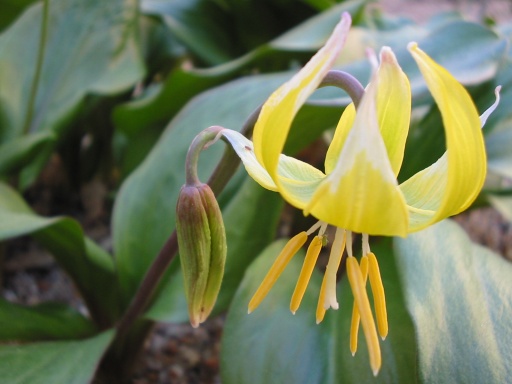
Photo: Bouba at French Wikipedia, CC BY-SA 3.0 · source

Bulb or tuber · Liliaceae
Tuolumne fawn lily
Erythronium tuolumnense
In other languages: Erythronium tuolumnense (Nederlands) · Erythronium tuolumnense (Français)
Erythronium tuolumnense is a dog’s-tooth violet from California, where it grows wild only in a small area of the Sierra Nevada foothills, near the Tuolumne River. In April it carries, on stems 20–30 cm tall, a few nodding, bright yellow flowers with swept-back petals, like little lanterns. The broad, glossy leaves are plain fresh green, unlike those of many other erythroniums. It likes the light shade of shrubs, in humus-rich soil that does not dry out. The well-known hybrid ‘Pagoda’, raised from this species, is even more vigorous and forms large clumps more quickly.
Light
Partial shade or shade
tolerates little sun
Moisture
Normal
no wet feet
Legal basis
Sand, loam or peat
acid to neutral
Hardiness
Fully hardy
down to -25 °C
Size
0.3 m
tall, 0.15 m wide
Flowering
April
| Height | 0.3 m |
|---|---|
| Native to Belgium | No, planted |
| Good for bees, butterflies and birds | Yes, for bees |
| Poisonous to people and pets | Not known to be poisonous |
| Flowering | April |
Identify
Tuolumne fawn lily: how do you recognise it?
- Bulb
- Elongated white bulb shaped like a dog’s tooth; it must never dry out.
- Leaves
- Usually two broad, glossy, fresh green basal leaves, without spots.
- Flowers
- A few nodding, bright yellow flowers per stem, with strongly swept-back petals, in April.
- Height
- Flower stems 20–30 cm; the leaves stay lower.
- Growth
- Forms dense clumps over the years through offsets; after flowering the leaves die back and the plant rests until the following spring.
Flowering: April · Plants: September–October
In your garden
Why grow it?
- Bright yellow, graceful flowers in April, when the shade border is only just waking up.
- Ideal under shrubs and trees, in light shade.
- Slowly spreads into a clump with more and more flowering stems.
- Bees and bumblebees visit the early flowers.
- After flowering it retreats underground, so summer plants can take over the spot.
Tuolumne fawn lily: where does it grow best?
- Partial to light shade, for example under deciduous shrubs or trees.
- Humus-rich, loose soil: sandy, loamy or peaty, acid to neutral.
- Evenly moist: no drought in spring and no waterlogging. During summer dormancy the soil may be a little drier, but not bone-dry.
- Sheltered from wind and harsh midday sun.
- Plant 10–15 cm apart, in small groups.
- Light
- Partial shade and shade
- Soil type
- Sand, loam or peat
- Acidity
- Acid or neutral
- Moisture
- Normal
- Size
- 0.3 m tall, 0.15 m wide
- Hardiness
- Hardy (to -25 °C)
Goes well with
- Ferns: They unfurl their fronds when the erythronium has finished and fill the space.
- Hosta: Emerges late and hides the dying leaves in June.
- Wood anemone: Small white flowers at the same time, in the same light shade.
- Lungwort: Blue and pink flowers in spring, lovely next to the yellow.
- Barrenwort: Graceful leaves and small flowers as ground cover under shrubs.
Maintenance
Tuolumne fawn lily: when and how to plant it?
Plant in September–October.
- Plant the bulbs in September–October, as soon as possible after buying: they dry out quickly.
- Until planting, keep them in slightly damp sand or leaf mould, never dry in a paper bag.
- Mix leaf mould into the planting spot.
- Plant the bulbs 10–15 cm deep, pointed end up, and 10–15 cm apart.
- Water in and spread a layer of leaf mould over the spot.
Care
- Watering
- Water in spring during dry spells; do not let the soil dry out completely, even in summer.
- Feeding
- A thin layer of leaf mould every autumn is enough.
- Mulching
- Leaf mould or fallen leaves keep the soil cool, moist and rich in humus.
- Dormancy
- After flowering the leaves die back. Mark the spot so you do not damage the bulbs when digging or planting.
- Faded flowers
- Cut them off if you do not want seed; then all the energy goes to the bulb.
Tip: Buy the bulbs early in autumn and plant them at once: they cannot stand drying out. After that, leave the clumps undisturbed and they will get better every year.
Tuolumne fawn lily: when to prune it?
When: No pruning is needed. After flowering simply let the leaves die back.
How:
- Cut off faded flower stems if you do not want seed.
- Leave the leaves until they turn yellow and disappear: they feed the bulb.
- Remove dead leaves only when they have died back completely.
Caution: Leave the clumps undisturbed: divide them only when really necessary, and then replant the bulbs straight away so they do not dry out.
Propagation
- Division
- Lift a dense clump in summer, once the leaves have died back, gently separate the offsets and replant them straight away. Never let them dry out.
- Seed
- Sow fresh seed in summer in a pot of humus-rich seed compost and leave it outdoors in the shade. It germinates after winter; seedlings take several years to flower.
Tuolumne fawn lily: how does it get through the winter?
Hardy to −25 °C.
- Hardy to about −25 °C: no protection is needed in Belgium.
- The bulbs rest in the soil; a layer of leaf mould in autumn keeps them cool and moist.
- In a pot: keep it sheltered in winter and never let the compost dry out completely.
Diseases and pests
- Slugs: They eat the young leaves and flowers in spring. Pick them off in the evening.
- Nothing comes up: Usually the bulbs dried out before planting. Buy them early in autumn and plant them at once.
- Few flowers: Clumps too congested or soil too dry. Divide the clumps in summer and add more leaf mould.
- Bulb rot: In wet, compacted soil the bulbs rot. Make sure the soil is loose, humus-rich and well drained.
Through the year
- March: The leaves emerge. Watch for slugs.
- April: Flowering. Water in dry weather.
- May: Cut off faded stems if you do not want seed.
- June: The leaves die back; the bulb goes dormant.
- July: Dormancy. Lift dense clumps, divide and replant at once. Sow fresh seed.
- September: Plant new bulbs 10–15 cm deep.
- October: Plant bulbs. Spread leaf mould over the spot.
- November: Leave fallen leaves as a mulch.
Use
Good for wildlife
- Bees
- Nectar and pollen for honeybees and wild bees.
You and this species
Did you know?
- The name dog’s-tooth violet comes from the elongated white bulb, which looks like a dog’s tooth.
- The name fawn lily refers to the mottled leaves of related species, which recall a fawn’s spotted coat; in this species the leaves are plain green instead.
- It is rare in the wild: it grows only in a small area of California.