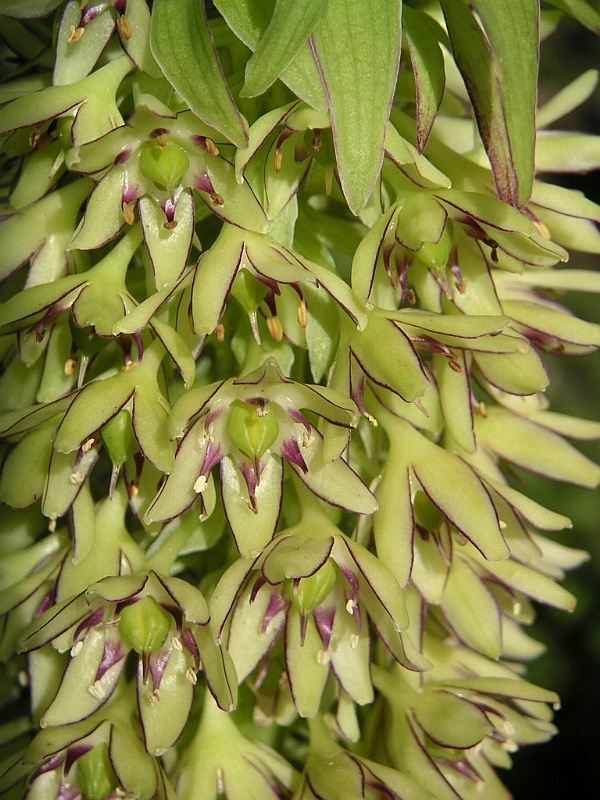
Photo: Jean-Jacques MILAN 18:07, 29 May 2005 (UTC), CC BY-SA 3.0 · source

Bulb or tuber · Asparagaceae
Pineapple lily
Eucomis bicolor
In other languages: Ananaslelie (Nederlands) · Lis ananas (Français)
The pineapple lily (Eucomis bicolor) comes from the east of South Africa. From a rosette of wavy, glossy green leaves it sends up a sturdy, purple-spotted stem about 50 cm tall in July–September, carrying a dense spike of pale green flowers. The petals have a purple edge, hence the name bicolor. On top sits a tuft of leaves, like the crown of a pineapple. It is a superb, exotic-looking bulb for a warm spot or a pot on the patio. Under a thick mulch it often survives our winters.
Light
Full sun
warm and bright
Moisture
Normal
no wet feet
Legal basis
Sand or loam
neutral to chalky
Hardiness
down to -10 °C
protect in harsh winters
Size
0.5 m
tall, 0.3 m wide
Flowering
July–September
| Height | 0.5 m |
|---|---|
| Native to Belgium | No, planted |
| Good for bees, butterflies and birds | Yes, for bees |
| Poisonous to people and pets | Not known to be poisonous |
| Flowering | July–September |
Identify
Pineapple lily: how do you recognise it?
- Habit
- Bulb plant about 50 cm tall and 30 cm wide, with a rosette of leaves at ground level.
- Leaves
- Long, strap-shaped, wavy and glossy green; they turn yellow in autumn.
- Flower
- A dense spike of pale green flowers with a purple edge, from July to September, with a leafy tuft on top.
- Stem
- Sturdy and purple-spotted, about 50 cm tall.
- Bulb
- A firm bulb with thick roots; prone to rot in cold, wet soil.
Flowering: July–September · Plants: April–May
In your garden
Why grow it?
- Exotic-looking flowers in July–September, when many borders are fading.
- The pale green flowers with purple edges and the purple-spotted stem make a striking, unusual combination.
- Bees visit the flowers and the seed capsules stay decorative into autumn.
- A good cut flower: the spikes stay attractive in the vase for a long time.
- Fine in a pot, so you can easily move it frost-free.
Pineapple lily: where does it grow best?
- Full sun in a warm, sheltered spot, for example against a south-facing wall or on a patio.
- Humus-rich, free-draining soil: sandy or loamy, neutral to chalky. It does not tolerate wet feet in winter.
- Keep the soil moist during growth: it comes from summer-rainfall regions and wants plenty of water in summer.
- Allow 25–30 cm between plants. In a pot, use a roomy, deep one with holes in the bottom.
- Light
- Sun
- Soil type
- Sand or loam
- Acidity
- Neutral or chalky
- Moisture
- Normal
- Size
- 0.5 m tall, 0.3 m wide
- Hardiness
- Half hardy (to -10 °C): protect it in harsh winters
Goes well with
- Ornamental grasses: Soft plumes that make the pale green flower spike stand out.
- Argentinian vervain: Airy purple flowers above and behind the compact bulb, echoing the purple of the stem.
- Sage: Violet and blue next to the pale green, in the same sunny soil.
- Dahlia: Flowers in the same period and adds more colour.
- Agapanthus: Also South African, likes the same warm spot and adds blue.
Maintenance
Pineapple lily: when and how to plant it?
Plant in April–May.
- Plant the bulbs in April–May, once the worst frosts are over.
- Dig a hole 15 cm deep and mix in compost and some coarse sand for free-draining soil.
- Set the bulb with the tip upwards, about 15 cm deep; in a pot, use a roomy, deep pot.
- Space plants 25–30 cm apart and plant several together for a full group.
- Water thoroughly after planting; after that wait until shoots appear.
- Spread a 5 cm layer of mulch over the spot.
Care
- Water
- During growth, water regularly and generously, especially in dry summers. Stop watering when the leaves die back.
- Feeding
- Every two weeks, a potash-rich feed from leaf growth until August, for example tomato feed. Not too much nitrogen.
- Mulching
- A layer of compost or bark keeps the soil moist and protects the bulb in winter.
- Late growth
- Shoots appear late, sometimes only in May–June. Give the spot time.
- Spent flowers
- Leave the seed capsules as decoration or cut the stem when it has turned brown.
Tip: Plant the bulb in April 15 cm deep in a warm spot or in a pot. Cover it with a thick mulch in winter or move the pot frost-free.
Pineapple lily: when to prune it?
When: It is not pruned; just cut off the stems and let the leaves die back.
How:
- Cut the stem when it is brown and dry, or leave it until autumn.
- Let the leaves turn yellow and die back; only cut them when they are completely dry.
- For cut flowers, take the stem when the lowest flowers are open.
Propagation
- Offsets
- In spring, when lifting or repotting, detach the small offset bulbs and plant them separately. They flower after a few years.
- Leaf cuttings
- In summer, cut off a whole leaf with a piece of the bulb base and insert it in sandy compost. New little bulbs form.
- Seed
- Sow in spring in seed compost at 18–20 °C. Plants take a few years to flower.
Pineapple lily: how does it get through the winter?
Hardy to −10 °C: protect in harsh winters.
- Hardy to about −10 °C, but only in a dry, sheltered spot under 10–15 cm of mulch.
- In heavy or wet soil, lift the bulbs once the leaves have died back, let them dry and store them dry at 5–10 °C, frost-free.
- In a pot: keep the pot dry and store it frost-free, for example in a cold greenhouse or garage.
Diseases and pests
- Rotting bulb: Caused by wet soil in winter. Plant in a free-draining spot and cover the bulb against rain in winter.
- Slugs: They eat the young leaves in spring. Collect them in the evening and protect young shoots.
- Vine weevil: The grubs eat bulbs in pots. Check when repotting and remove the white grubs by hand.
- No shoot: The plant starts late. Wait until June before giving up and do not let the soil dry out.
Through the year
- March: Check overwintered bulbs and repot if needed.
- April: Plant bulbs, 15 cm deep. Apply mulch.
- May: Plant. Keep slugs off. Wait for growth.
- June: Water in dry weather. Start potash feed.
- July: Flowering starts. Water generously.
- August: Full flower. Cut flowers for a bouquet. Feed.
- September: Flowering. Leave the seed capsules. Water less.
- October: Leaves turn yellow. Lift bulbs in heavy soil.
- November: Mulch thickly or move pots frost-free.
- December: Rest. Keep bulbs dry.
Use
Good for wildlife
- Bees
- Nectar and pollen for honeybees and wild bees.
You and this species
Did you know?
- The name Eucomis comes from Greek and means beautiful hair, after the tuft of leaves; bicolor refers to the two colours of the flower: green with a purple edge.
- The flowers open from the bottom up, so the spike flowers for weeks.
- The plant comes from summer-rainfall regions, so it wants plenty of water in summer and a dry rest in winter.