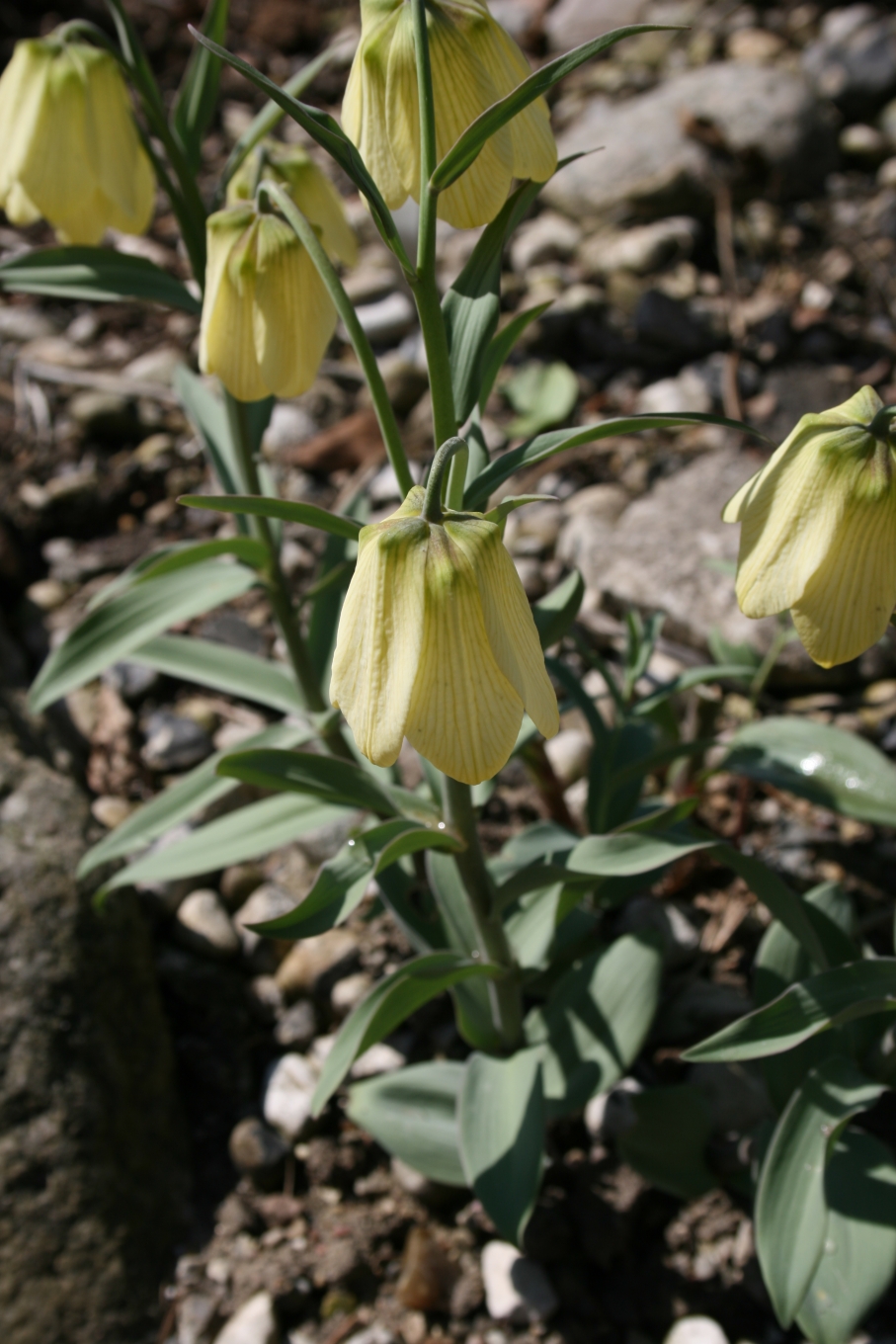
Photo: Sten Porse, CC BY-SA 3.0 · source

Bulb or tuber · Liliaceae
Fritillaria pallidiflora
Fritillaria pallidiflora comes from Central Asia and Siberia, where it grows on open mountain slopes and in grassland. Above broad, blue-green leaves hang one to a few large, pale yellow bells in April and May, with fine brown-green chequering inside. At 30–40 cm it is eye-catching without being pushy. It is regarded as one of the easiest fritillaries: it tolerates ordinary garden soil and light shade, and slowly spreads over the years. A fine choice for anyone starting out with species fritillaries.
Caution: All parts are poisonous, especially the bulb. Keep children and pets such as dogs and cats away, and do not mistake the bulbs for edible ones. Wear gloves when planting, to be safe.
Light
Sun or partial shade
preferably some sun
Moisture
Normal
no wet feet
Legal basis
Sand, loam or clay
neutral to chalky
Hardiness
Fully hardy
down to -25 °C
Size
0.4 m
tall, 0.15 m wide
Flowering
April–May
| Height | 0.4 m |
|---|---|
| Native to Belgium | No, planted |
| Good for bees, butterflies and birds | Yes, for bees |
| Poisonous to people and pets | Yes, take care with children and pets |
| Flowering | April–May |
Identify
Fritillaria pallidiflora: how do you recognise it?
- Habit
- A bulb with a straight stem 30–40 cm tall and about 15 cm wide.
- Leaves
- Broadly lance-shaped to oval, blue-green and slightly fleshy; the lower leaves grow together, higher up they are scattered along the stem.
- Flowers
- One to a few hanging bells about 3–4 cm long, pale yellow with brown-green chequering, in April and May.
- Bulb
- A fleshy, white bulb of a few scales without a protective tunic; it forms bulblets over time.
- Dormancy
- After flowering the leaves die back and the bulb rests in summer.
Flowering: April–May · Plants: September–October
In your garden
Why grow it?
- Large, pale yellow bells: a soft, rare colour among the many reds and browns of fritillaries.
- One of the easiest species, even in ordinary garden soil.
- Tolerates light shade, so it also suits a spot under shrubs or in a border.
- Flowers in April and May and feeds bumblebees and bees with nectar.
- The broad, blue-green foliage is already attractive in spring.
Fritillaria pallidiflora: where does it grow best?
- Sun to partial shade: a spot with sun in spring and light shade in summer suits it well.
- Ordinary, well-drained sandy, loamy or clay soil, neutral to chalky.
- Normally moist in spring; in summer the soil may be drier, but not bone dry.
- Plant about 15 cm apart, in groups of five to ten bulbs.
- Light
- Sun and partial shade
- Soil type
- Sand, loam or clay
- Acidity
- Neutral or chalky
- Moisture
- Normal
- Size
- 0.4 m tall, 0.15 m wide
- Hardiness
- Hardy (to -25 °C)
Goes well with
- Lady’s mantle: Its soft, pleated foliage fills the spot in summer, when the bulb is resting.
- Lenten rose: Flowers at the same time in shady corners and suits the same spring.
- Naturalised spring bulbs: Such as snowdrops and wild daffodils: they share the same growing cycle.
- Ferns: They unfurl their fronds once flowering is over and fill the gap.
Maintenance
Fritillaria pallidiflora: when and how to plant it?
Plant in September–October.
- Plant in September–October, as soon as possible after buying: the bulbs have no protective tunic and dry out.
- Dig a hole 10–12 cm deep, roughly three times the height of the bulb.
- On heavy clay, mix in some coarse sand so that water drains away well.
- Set the bulb on its flat base, about 15 cm from the next.
- Cover with soil, firm down and water if it is dry.
- Spread a thin layer of fine compost or leaf mould over the spot.
Care
- Watering
- In spring in dry weather. In summer usually nothing is needed, except in a very dry spell.
- Feeding
- After flowering, a light dose of potassium-rich feed or a little compost.
- Mulching
- A thin layer of fine compost or leaf mould in autumn keeps the soil loose.
- Leaves
- Leave the leaves until they turn yellow, usually in June: this is how the bulb refills its reserves.
- Spent flowers
- Cut off the seed pods if you do not want seed, or leave them if you wish to harvest it.
Tip: Plant it among perennials that take over the spot in summer: that way the dormant period goes unnoticed and the bulb stays dry.
Fritillaria pallidiflora: when to prune it?
When: This bulb is not pruned. At most you cut off spent flowers and, later, the dead leaves.
How:
- Cut off spent flowers if you do not want seed.
- Leave the leaves until they turn yellow, usually in June.
- Remove leaf remains only once they come away easily.
Caution: Never cut off green leaves: the bulb needs them to flower next year.
Propagation
- Separating bulbs
- In July–August, once the leaves have gone: lift a clump, gently separate the bulblets and replant them straight away 10–12 cm deep.
- Seed
- Sow fresh seed in autumn in a pot of sandy compost and leave it outdoors. It takes several years for the seedlings to flower.
Fritillaria pallidiflora: how does it get through the winter?
Hardy to −25 °C.
- Fully hardy, to about −25 °C: no protection needed.
- The leaves appear early in spring and tolerate light night frost.
- In a pot: put it in a sheltered spot and protect the pot from freezing through.
Diseases and pests
- Lily beetle: Bright red beetles and their slimy larvae on leaves and stems from April to June. Pick them off by hand.
- Slugs: They eat young shoots and buds in spring. Collect them in the evening or put down a barrier of coarse sand.
- Bulb rot: The bulb turns soft and the leaves yellow early or fail to appear. It is usually too wet; improve the drainage.
- Bulbs fail to come up: The bulbs were dried out when bought. Buy firm bulbs and plant them at once.
Through the year
- February: The shoots come up.
- March: Watch for slugs. Water in dry weather.
- April: Flowering begins.
- May: In flower. Cut off seed pods if you wish.
- June: The leaves turn yellow: do not cut them too early.
- July: Summer dormancy. Divide clumps if needed.
- August: Separate the bulbs and replant them straight away.
- September: Plant new bulbs.
- October: Plant bulbs. Thin layer of compost.
Use
Edible and useful
Not edible. All parts of fritillaries, such as snake’s head fritillary and crown imperial, are poisonous, especially the bulbs: they contain alkaloids that can cause vomiting, stomach ache and diarrhoea, in children as well as in dogs and cats. The bulbs have no protective papery skin: bare and white or yellowish, they can be mistaken for onions or garlic, although the crown imperial bulb has a strong foxy smell. So never store them with the kitchen onions, plant them as soon as you buy them (they dry out quickly), and do not leave loose bulbs lying where dogs or cats could chew them. Wear gloves when planting and when cutting the stems, and wash your hands afterwards. If any is swallowed, call a poison centre (in Belgium 070 245 245) or your doctor at once.
Good for wildlife
- Bees
- Nectar and pollen for honeybees and wild bees.
You and this species
Did you know?
- The species name pallidiflora comes from Latin and means ‘pale-flowered’.
- The bells are large for the size of the plant: they grow to about 3–4 cm long.
- Fritillary bulbs have no protective tunic, so they dry out faster than tulips or daffodils.