Photo: The original uploader was MPF at English Wikipedia., CC BY-SA 3.0 · source

Shrub · Garryaceae
Silk tassel
Garrya elliptica
In other languages: Garrya (Nederlands) · Garrya (Français)
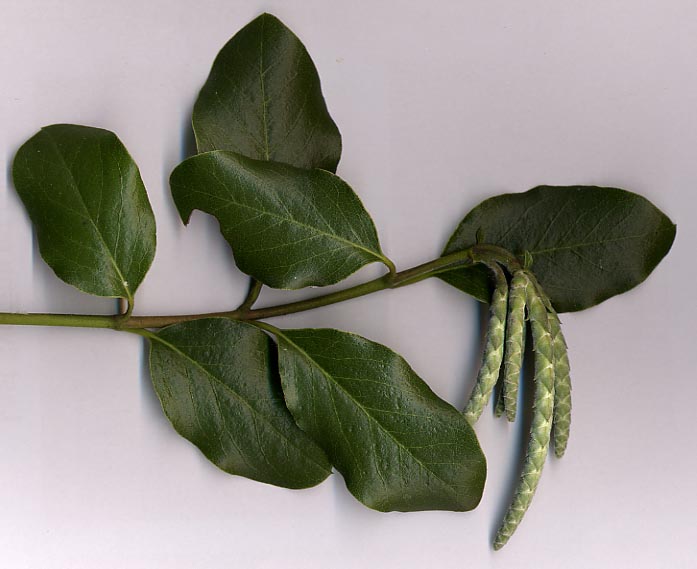
Silk tassel, Garrya elliptica, is an evergreen shrub from the coast of California and Oregon. In the depths of winter, from January to March, it is hung with long, silvery-grey catkins, sometimes more than 20 cm long, that sway in the wind like silk tassels. There are male and female plants; the males have the longest and finest catkins, especially the well-known ‘James Roof’. The leathery, wavy leaves are dark green above and grey and felted beneath. Against a sheltered wall it is one of the finest winter shrubs.
Light
Sun or partial shade
preferably some sun
Moisture
Dry to normal
no wet feet
Legal basis
Sand, loam or clay
any pH
Hardiness
down to -15 °C
protect young plants
Size
3 m
tall, 3 m wide
Flowering
January–March
| Pruning months | March–April |
|---|---|
| Height | 3 m |
| Native to Belgium | No, planted |
| Poisonous to people and pets | Not known to be poisonous |
| Flowering | January–March |
Identify
Silk tassel: how do you recognise it?
- Habit
- Dense, evergreen shrub 2–4 m tall and wide; taller against a wall.
- Leaf
- Oval, leathery, wavy-edged; dark green above, grey and felted beneath.
- Flower
- Long, hanging catkins, grey-green to silvery; 15–30 cm long on male plants.
- Flowering
- From January to March.
- Fruit
- Female plants bear clusters of purple-brown berries, but only with a male plant nearby.
Flowering: January–March · Plants: April–May · Pruning: March–April
In your garden
Why grow it?
- Spectacular silvery-grey catkins in midwinter, when there is little else to see.
- Evergreen: a dense, dark green shrub all year round.
- Easy to train against a wall or fence.
- Tolerates coastal wind and fairly poor, dry soil.
- Little work: a light trim after flowering is enough.
Silk tassel: where does it grow best?
- Sun to part shade; against a south- or west-facing wall it flowers best.
- Any well-drained soil: sand, loam or clay, chalky too.
- Rather dry to average; it dislikes wet feet in winter.
- Sheltered from cold east wind, which scorches the leaves and catkins.
- Allow 3 m of space, or plant 1.5 m from a wall to train it.
- Light
- Sun and partial shade
- Soil type
- Sand, loam or clay
- Acidity
- Not fussy
- Moisture
- Dry or normal
- Size
- 3 m tall, 3 m wide
- Hardiness
- Hardy (to -15 °C)
Goes well with
- Witch hazel: Yellow or orange winter flowers next to the grey catkins.
- Christmas rose: Flowers in the same months at its feet.
- Snowdrop: Small white flowers under the shrub in January–February.
- Mahonia: Another evergreen winter-flowering shrub with fragrant yellow sprays.
- Ivy: Green wall cover beside the shrub.
Maintenance
Silk tassel: when and how to plant it?
Plant in April–May.
- Plant in April–May, so it roots well before winter.
- Buy a pot-grown plant: it dislikes being moved.
- Choose a male form, such as ‘James Roof’, for the longest catkins.
- Dig a generous hole and mix in some compost.
- Water regularly in the first year until it is well rooted.
Care
- Water
- Regularly in the first year; after that only in long dry spells.
- Feeding
- Little needed; some compost in spring is enough.
- Training
- Against a wall: tie the main branches to wires and trim outward-growing shoots after flowering.
- Wind
- In an open spot, winter wind can brown the leaves; choose a sheltered place.
- Moving
- Best avoided: the roots dislike disturbance.
Tip: Plant it where you can see it from a window in winter: on a grey January day its long, silvery-grey catkins are a real show.
Silk tassel: when to prune it?
Pruning months: March–April.
When: After flowering, in March–April.
How:
- Remove the faded catkins when they start to look untidy.
- Cut back over-long or awkward branches to just above a leaf or side shoot.
- On a wall shrub: trim shoots growing away from the wall.
- Rejuvenate an old shrub over two or three years by removing a few old branches low down each time.
Caution: Do not prune after June: next winter’s catkins form in summer.
Propagation
- Cuttings
- Semi-ripe cuttings in July–August, in sandy cutting compost under plastic; they root slowly.
- Layering
- Peg a low branch into the soil in spring and cut it free after a year.
Silk tassel: how does it get through the winter?
Hardy to −15 °C: protect young plants.
- Hardy to about −15 °C; young plants are more tender.
- Flowers in midwinter: the catkins can be damaged by hard frost.
- Protect young plants with fleece in hard frost for the first few winters.
- Cut away leaves browned by a cold winter in spring.
Diseases and pests
- Brown leaves: Caused by cold wind or hard frost. Cut them off in spring; choose a more sheltered spot.
- Black spots on the leaves: A leaf spot disease in wet weather. Clear up affected leaves and keep growth airy.
- Few catkins: A female plant or too much shade. Choose a male form in sun.
Through the year
- January: Catkins. Protect young plants in hard frost.
- February: Catkins at their best.
- March: Last catkins. Prune after flowering.
- April: Finish pruning. Planting.
- May: Planting. Add compost.
- July: Take semi-ripe cuttings.
- August: Water in long dry spells.
- December: The first catkins appear.
You and this species
Did you know?
- The name silk tassel refers to the catkins, which look like the silk tassels on a curtain.
- The plant is named after Nicholas Garry of the Hudson’s Bay Company, who helped the plant hunter David Douglas in the 1820s.