Photo: Wikimedia Commons, CC BY-SA 3.0 · source

Perennial · Gentianaceae
Trumpet gentian
Gentiana acaulis
In other languages: Stengelloze gentiaan (Nederlands) · Gentiane acaule (Français)
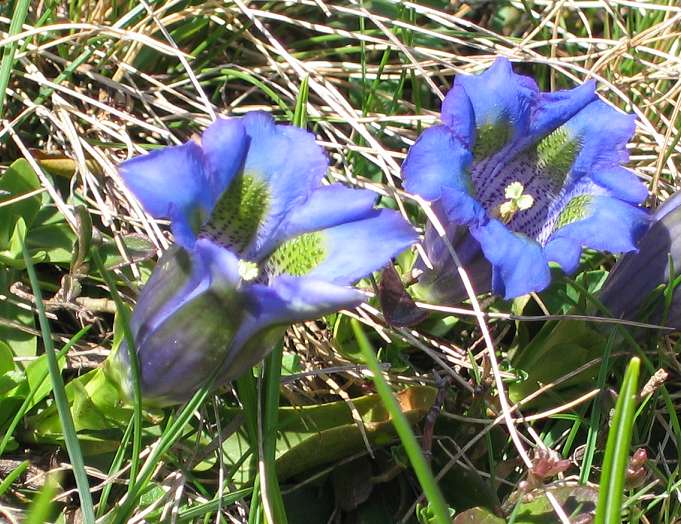
Trumpet gentian comes from the mountains of central and southern Europe, such as the Alps and the Pyrenees, where it grows in alpine meadows. It forms low, evergreen rosettes of glossy, oval leaves that slowly spread into a small mat. From April to June, surprisingly large, deep blue trumpet flowers 5–6 cm long appear above them, with green speckles in the throat. Gardeners treasure it for that intense blue, which few other garden plants can match. It has a reputation for being temperamental: in one spot it flowers profusely, in another hardly at all.
Light
Sun or partial shade
preferably some sun
Moisture
Normal
no wet feet
Legal basis
Sand or loam
any pH
Hardiness
Fully hardy
down to -35 °C
Size
0.1 m
tall, 0.3 m wide
Flowering
April–June
| Height | 0.1 m |
|---|---|
| Native to Belgium | No, planted |
| Good for bees, butterflies and birds | Yes, for bees |
| Poisonous to people and pets | Not known to be poisonous |
| Flowering | April–June |
Identify
Trumpet gentian: how do you recognise it?
- Habit
- A low mat of rosettes, 5–10 cm tall and up to 30 cm wide.
- Leaves
- Oval to lance-shaped, 2–4 cm, glossy dark green and somewhat leathery; evergreen.
- Flowers
- Upright trumpets 5–6 cm long, deep blue with green speckles in the throat, on a very short stalk; from April to June.
- Roots
- Fine, fibrous roots that need cool, moist soil.
- Growth
- It spreads slowly with new rosettes at the edge.
Flowering: April–June · Plants: March–April and September–October
In your garden
Why grow it?
- One of the most intense blues you can grow in a garden.
- Large flowers on a tiny plant: ideal for a rock garden, a trough or the edge of a border.
- Evergreen rosettes that look neat even in winter.
- Bumblebees and other bees crawl deep into the trumpets in search of nectar.
- Long-lived: a contented plant flowers for many years in the same spot.
Trumpet gentian: where does it grow best?
- Full sun or light partial shade, preferably with some shade in the hottest hours; in a hot, dry corner it flowers poorly.
- Sandy or loamy soil with humus, acid, neutral or chalky.
- Soil that holds moisture yet drains well: never bone dry, never waterlogged.
- Ideal in a rock garden, a trough or at the front of a border where the roots stay cool.
- Plant 20–25 cm apart, in a group of three or more for the best effect.
- Light
- Sun and partial shade
- Soil type
- Sand or loam
- Acidity
- Not fussy
- Moisture
- Normal
- Size
- 0.1 m tall, 0.3 m wide
- Hardiness
- Hardy (to -35 °C)
Goes well with
- Saxifrage: Low cushions for the rock garden, in white or pink beside the blue.
- Primrose: Yellow spring flowers that contrast beautifully with the deep blue, in the same cool soil.
- Dwarf daffodil: Small yellow daffodils that flower in April alongside the gentian.
- Bellflower: Low-growing kinds flower in summer, after the gentian has finished.
Maintenance
Trumpet gentian: when and how to plant it?
Plant in March–April and September–October.
- Plant in March–April or September–October.
- Mix the soil with some leaf mould and coarse sand or fine gravel, so it holds moisture yet drains well.
- Set the plant at the same depth as it was in its pot and firm the soil well: gentians like firm soil around their roots.
- Space plants 20–25 cm apart.
- Water straight away and keep the soil moist for the first few weeks.
- Spread a thin layer of fine gravel around the rosettes to prevent rot and drying out.
Care
- Watering
- Never let the soil dry out, especially in spring and in dry summers. Water at the base.
- Feeding
- Little needed. In March, sprinkle a thin layer of leaf mould or fine compost between the rosettes.
- Gravel
- A thin layer of fine gravel keeps the rosettes dry and the roots cool.
- Spent flowers
- Snip them off after flowering, unless you want to collect seed.
- Moving
- If it still does not flower after a few years, move it to a cooler spot; that sometimes works wonders.
Tip: Firm the soil well after planting and give it a cool spot with morning sun: in loose, warm soil it grows, but flowers little.
Trumpet gentian: when to prune it?
When: No pruning is needed. You only remove spent flowers and dead leaves.
How:
- After flowering, in June, snip off the faded flowers just above the rosette.
- In spring, remove dead or rotting leaves from between the rosettes.
- Always leave the evergreen rosettes themselves.
Caution: Never cut back the rosettes: they produce next year’s flowers.
Propagation
- Division
- In March–April: take a few rooted rosettes from the edge and replant them straight away. Keep them moist until they establish.
- Seed
- Sow fresh seed in autumn in a pot of gritty seed compost and stand it outdoors: the seed needs frost to germinate. Seedlings take several years to flower.
- Cuttings
- In late spring, insert cuttings of non-flowering rosettes in a mix of sand and cutting compost, kept cool and moist.
Trumpet gentian: how does it get through the winter?
Hardy to −35 °C.
- Extremely hardy, to about −35 °C: frost is not a problem in Belgium.
- Wet winters are a bigger risk: a layer of gravel and good drainage prevent rot.
- In a trough or pot it overwinters outdoors; make sure water drains freely, but do not let the soil dry out.
- The leaves stay green; do not cover it with fallen leaves, as it would rot underneath.
Diseases and pests
- Few or no flowers: Often too hot or too dry, sometimes soil that is too rich or too loose. Move it to a cooler spot, firm the soil and do not feed.
- Slugs: They eat the buds and young leaves. Pick them off in the evening and spread sharp grit around the plant.
- Rot: Brown, soft rosettes after a wet winter. Remove them and improve drainage with gravel.
- Vine weevil: In pots and troughs the grubs eat the roots and the plant suddenly wilts. Use nematodes against vine weevil in late summer.
Through the year
- March: Remove dead leaves. Plant or divide. Thin layer of leaf mould.
- April: Flowering begins. Watch for slugs.
- May: Full flower. Water in dry weather.
- June: Last flowers. Snip off spent flowers.
- July: Water in dry weather: the soil must stay cool.
- August: Water in dry weather.
- September: Plant. Collect seed.
- October: Plant. Sow fresh seed outdoors.
- December: Evergreen rosettes. Do not cover.
Use
Good for wildlife
- Bees
- Nectar and pollen for honeybees and wild bees.
You and this species
Did you know?
- According to the Roman writer Pliny, the name Gentiana refers to Gentius, a king of Illyria in the 2nd century BC.
- Acaulis means ‘without a stem’: the large flowers sit almost directly on the rosette.
- The bitter root of a related species, the great yellow gentian, is used to flavour bitter liqueurs and aperitifs.