Photo: Ghislain118 (AD) http://www.fleurs-des-montagnes.net, CC BY-SA 3.0 · source

Perennial · Geraniaceae
Dalmatian cranesbill
Geranium dalmaticum
In other languages: Ooievaarsbek (Nederlands) · Géranium de Dalmatie (Français)
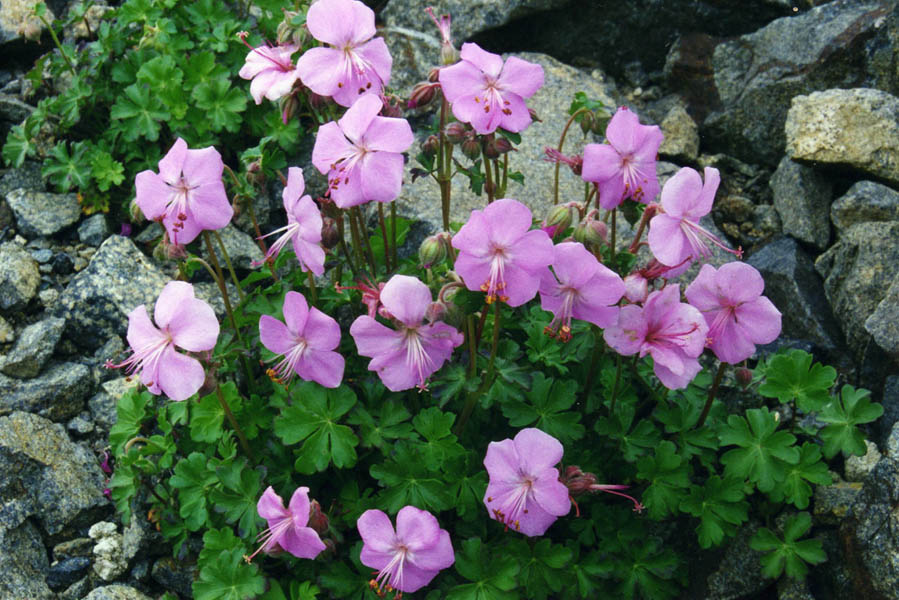
This dwarf cranesbill comes from the mountains along the Dalmatian coast, in Croatia, Montenegro and Albania. Using short runners, it forms a low, dense mat of small, glossy, palmately lobed leaves, barely 10–15 cm tall. In June and July the mat is smothered in soft pink flowers about 2.5 cm across. In autumn some of the leaves turn red and orange. Gardeners use it in the rock garden, between stones and as a low ground cover at the front of the border; there is also a white form, ‘Album’.
Light
Sun or partial shade
preferably some sun
Moisture
Dry to normal
no wet feet
Legal basis
Sand or loam
any pH
Hardiness
Fully hardy
down to -30 °C
Size
0.15 m
tall, 0.5 m wide
Flowering
June–July
| Height | 0.15 m |
|---|---|
| Native to Belgium | No, planted |
| Good for bees, butterflies and birds | Yes, for bees |
| Poisonous to people and pets | Not known to be poisonous |
| Flowering | June–July |
Identify
Dalmatian cranesbill: how do you recognise it?
- Habit
- A low mat 10–15 cm tall that slowly spreads by short runners to about 50 cm wide.
- Leaves
- Small, rounded and palmately cut into five to seven lobes, glossy fresh green; red to orange in autumn and partly evergreen.
- Flowers
- Flat, soft pink flowers about 2.5 cm across, in June and July.
- Fruit
- A beak-shaped fruit that flings out its seed when ripe.
- Roots
- Short, shallow rhizomes and runners.
Flowering: June–July · Plants: March–April and September–October
In your garden
Why grow it?
- A dense, low ground cover that gives weeds little chance.
- A sea of soft pink flowers in June and July.
- Glossy leaves that turn red and orange in autumn and partly persist through winter.
- Tough and easy: it grows in sun and partial shade, in dry to normal soil.
- Bees readily visit the open flowers.
Dalmatian cranesbill: where does it grow best?
- Full sun or partial shade; in sun it flowers most freely and colours best in autumn.
- Sandy or loamy soil, acid, neutral or chalky, that drains well.
- Dry to normal soil; it dislikes heavy, wet ground.
- Ideal in a rock garden, between paving, on a wall or at the front of the border.
- Plant 25–30 cm apart; after a few years the mat closes up.
- Light
- Sun and partial shade
- Soil type
- Sand or loam
- Acidity
- Not fussy
- Moisture
- Dry or normal
- Size
- 0.15 m tall, 0.5 m wide
- Hardiness
- Hardy (to -30 °C)
Goes well with
- Dalmatian bellflower: Comes from the same region and forms purple cushions in the same spot.
- Houseleek: Neat rosettes that contrast with the rounded, glossy leaves.
- Creeping thyme: A fragrant mat between stones, also a good bee plant.
- Stonecrop: Low-growing kinds with yellow or pink flowers to tuck between stones.
Maintenance
Dalmatian cranesbill: when and how to plant it?
Plant in March–April and September–October.
- Plant in March–April or September–October.
- Loosen the soil and lighten heavy soil with coarse sand or fine gravel.
- Set the plant at the same depth as it was in its pot and firm the soil.
- Space plants 25–30 cm apart.
- Water straight away and keep the soil lightly moist for the first few weeks.
- A thin layer of gravel between the plants keeps weeds down until the mat has closed.
Care
- Watering
- In dry weather during the first year; rarely needed after that.
- Feeding
- Not needed; in poor soil the mat stays compact.
- Spent flowers
- They can stay; cut them off after flowering if you want a tidier look.
- Weeding
- Keep the mat weed-free in the first year; after that it closes up by itself.
- Rejuvenating
- If the centre goes bare after some years, cut pieces from the edge in spring and replant them.
Tip: Let it spread between stones or paving slabs: in the cracks it soon forms a dense, glossy mat that turns red in autumn.
Dalmatian cranesbill: when to prune it?
When: No pruning is needed. After flowering, in July–August, you can cut off the spent flower stems.
How:
- After flowering, cut the spent flower stems back to the foliage.
- Leave the leaves in autumn: their red colour is attractive and protects the plant.
- In March, remove dead leaves from among the new growth.
Propagation
- Division
- In March–April or September: cut off a piece with roots and leaves from the edge and replant it straight away. It takes easily.
- Seed
- Possible in spring in a pot; the white form does not always come true from seed.
Dalmatian cranesbill: how does it get through the winter?
Hardy to −30 °C.
- Hardy to about −30 °C: in Belgium it needs no protection.
- Some of the leaves remain in winter, often tinted red.
- Wet soil in winter can cause rot: make sure drainage is good.
- In a trough or pot it overwinters outdoors, as long as water can drain away.
Diseases and pests
- Rot: Brown, soft patches in the mat after a wet winter. Improve drainage with gravel.
- Slugs: They sometimes eat young leaves. Pick them off in the evening.
- Bare centre: After some years the middle opens up. Cut young pieces from the edge and replant them.
- Few flowers: Shade that is too deep. Give it a sunnier spot.
Through the year
- March: Remove dead leaves. Plant or divide.
- April: Plant. Weed between young plants.
- May: The buds appear.
- June: Flowering begins. Bees on the flowers.
- July: Full flower. Water plants in pots in dry weather.
- August: Cut off spent flower stems.
- September: Plant or divide.
- October: Red and orange autumn colour. Plant.
Use
Good for wildlife
- Bees
- Nectar and pollen for honeybees and wild bees.
You and this species
Did you know?
- Dalmaticum refers to Dalmatia, the coastal region of Croatia where the plant grows wild.
- A cross with Geranium macrorrhizum produced Geranium × cantabrigiense, named after Cambridge; the same hybrid was later also found growing wild in Croatia.
- As in all cranesbills, the ripe fruit flings its seeds some distance.