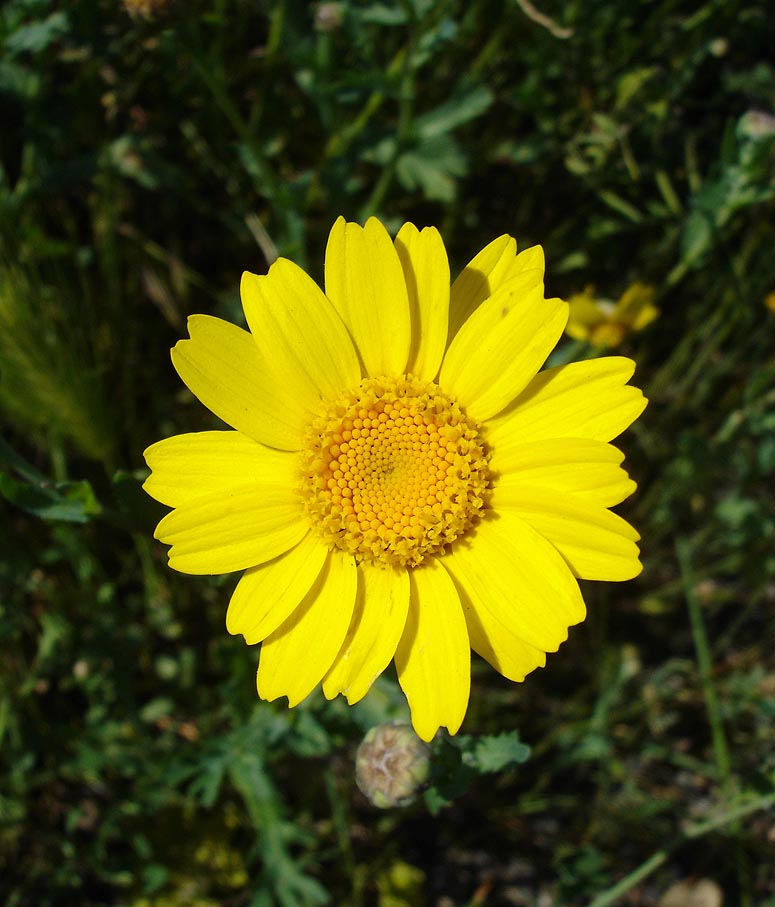
Photo: Wikimedia Commons, CC BY-SA 3.0 · source

Annual · Asteraceae
Corn marigold
Glebionis segetum
In other languages: Gele ganzenbloem (Nederlands) · Chrysanthème des moissons (Français)
Corn marigold (Glebionis segetum) is an old cornfield flower from the Mediterranean region that has grown in our regions for centuries. It used to be called Chrysanthemum segetum. It is an annual with blue-green, cut leaves and golden-yellow daisy-like flowers 3–5 cm across, from June to September. Intensive farming and cleaner seed have removed it from many fields, but in the garden it is an easy, colourful flower for a wildflower edge or a cutting patch, and a source of nectar for bees and butterflies.
Light
Full sun
warm and bright
Moisture
Normal
no wet feet
Legal basis
Sand or loam
acid to neutral
Hardiness
down to -5 °C
protect in harsh winters
Size
0.5 m
tall, 0.3 m wide
Flowering
June–September
| Height | 0.5 m |
|---|---|
| Native to Belgium | Yes |
| Good for bees, butterflies and birds | Yes, for bees and butterflies |
| Poisonous to people and pets | Not known to be poisonous |
| Flowering | June–September |
Identify
Corn marigold: how do you recognise it?
- Habit
- Annual, 30–60 cm tall and 30 cm wide, with branching, upright growth.
- Leaves
- Blue-green, cut or toothed, slightly fleshy; the leaves half clasp the stem.
- Flower
- Daisy-like flowers 3–5 cm across in golden yellow, from June to September.
- Seed
- Small seeds that self-sow readily.
- Origin
- An old cornfield flower from the Mediterranean region that has become rare in many places.
Flowering: June–September · Sowing: March–May and September
In your garden
Why grow it?
- Flowers from June to September with bright golden-yellow blooms, even on poor, sandy soil.
- A typical cornfield flower for a colourful wildflower edge or a naturalistic garden.
- Bees, hoverflies and butterflies visit the flowers for nectar and pollen.
- A good cut flower: the blooms last well in the vase.
- Easy to sow and self-seeds, so it comes back every year.
Corn marigold: where does it grow best?
- Full sun in an open spot.
- Free-draining, sandy to loamy soil, acid to neutral. It does less well on chalky soil.
- Normal moisture; it tolerates some drought but flowers longer if you water in dry spells.
- Poor soil is ideal: on rich soil you get lots of leaves and few flowers. Allow 20–30 cm between plants.
- Light
- Sun
- Soil type
- Sand or loam
- Acidity
- Acid or neutral
- Moisture
- Normal
- Size
- 0.5 m tall, 0.3 m wide
- Hardiness
- Tolerates light frost (to -5 °C)
Goes well with
- Cornflower: Blue next to the golden yellow; together a classic cornfield picture.
- Poppy: Red as a contrast to the yellow.
- Corncockle: Purple-red flowers among the yellow in a cornfield flower mix.
- Cosmos: Flowers in the same period and adds pink and white.
- Phacelia: A friend of bees, flowers in the same period.
Maintenance
Corn marigold: when and how to plant it?
- Sow in place in March–May, or in September for early flowers next year.
- Rake the soil to a fine, level tilth; poor, sandy soil needs no feeding.
- Broadcast the seed or sow it in shallow drills and cover only lightly, with 0.5–1 cm of soil.
- Keep the soil moist until the seed has germinated, usually after one to two weeks.
- Thin to 20–30 cm between plants so they can flower freely.
- Sow again every few weeks for a long flowering season.
Care
- Water
- Rain is normally enough; water at the base in long dry spells.
- Feeding
- Not needed; on rich soil it grows too lush and flops.
- Spent flowers
- Remove faded flowers to prolong flowering, or leave the last ones to self-seed.
- Support
- On rich or windy sites, a stake or twigs may help.
- Cut flowers
- Cut long-stemmed flowers just after they open; they last several days in the vase.
Tip: Sow in spring or in September on acid to neutral, sandy soil in full sun. Do not feed: poor soil gives the most flowers.
Corn marigold: when to prune it?
When: It is not pruned; during the season you only remove faded flowers.
How:
- Cut off faded flowers above a side shoot: this gives new buds.
- Cut flowers for the vase regularly: this encourages new buds.
- At the end of the season, pull up the plants or leave them to self-seed.
Propagation
- Seed
- Sow in place in March–May or in September, shallowly, at about 15–20 °C. Seedlings appear in one to two weeks.
- Self-sowing
- Let a few flowers set seed: without effort, new plants will appear next year.
Corn marigold: how does it get through the winter?
Hardy to −5 °C: protect in harsh winters.
- Annual: the plant dies at the end of the season. Young plants tolerate light frost down to about −5 °C.
- Sow in September for early flowers next year; in a mild area the seedlings often overwinter outdoors.
- In a pot: store seed dry and cool until spring.
Diseases and pests
- Few flowers: Common on soil that is too rich or in shade. Choose a sunny spot with poor soil and do not feed.
- Aphids: On young tips and buds. Rinse them off with water; ladybirds and hoverflies help.
- Slugs: They eat young seedlings. Collect them in the evening and protect the seedbed.
- Powdery mildew: White powder on the leaves in dry, close weather. Give space and water at the base.
Through the year
- March: Sow in place. Prepare the soil.
- April: Sow. Thin out. Keep slugs off.
- May: Last spring sowing. Thin out.
- June: Flowering starts. Cut the first flowers.
- July: Full flower. Remove faded flowers.
- August: Flowering. Water in dry weather.
- September: Last flowers. Collect seed. Sow for next year.
- October: Clear the plants or leave them to self-sow.
- November: Store seed dry.
- December: Rest. Plan the sowings.
Use
Good for wildlife
- Bees
- Nectar and pollen for honeybees and wild bees.
- Butterflies
- Nectar for butterflies.
You and this species
Did you know?
- The species name segetum means of the cornfields: the plant originally grew among the grain.
- It used to be called Chrysanthemum segetum and has now been placed in the genus Glebionis.
- Together with the poppy, cornflower and corncockle it belongs to the typical cornfield flora.