Photo: Wikimedia Commons, CC BY-SA 3.0 · source

Annual · Boraginaceae
Lacy phacelia
Phacelia tanacetifolia
In other languages: Phacelia (Nederlands) · Phacélie (Français)
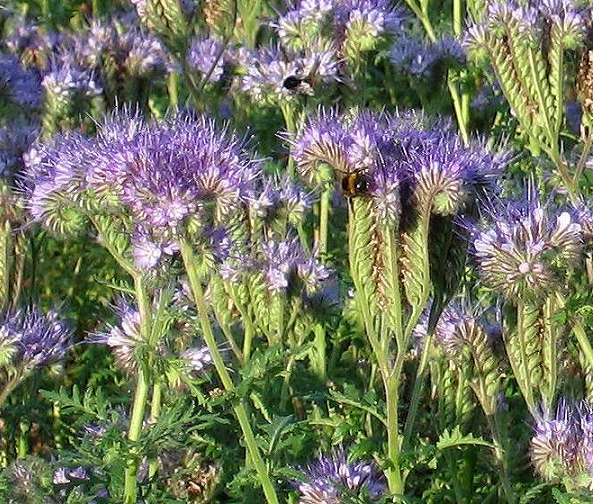
Lacy phacelia is an annual from the south-western United States and north-western Mexico, in the borage family. It quickly grows into a loose plant about 70 cm tall with finely cut, ferny leaves that recall those of tansy. From June to September it carries coiled clusters of lavender-blue flowers with long, protruding stamens, which gradually unroll like a fern’s crozier. Beekeepers and gardeners know it as one of the best bee plants, and in the vegetable garden it is a popular green manure. It flowers as little as six to eight weeks after sowing.
Light
Full sun
warm and bright
Moisture
Dry to normal
no wet feet
Legal basis
Sand, loam or clay
any pH
Hardiness
down to -8 °C
protect in harsh winters
Size
0.7 m
tall, 0.3 m wide
Flowering
June–September
| Height | 0.7 m |
|---|---|
| Native to Belgium | No, planted |
| Good for bees, butterflies and birds | Yes, for bees and butterflies |
| Poisonous to people and pets | Not known to be poisonous |
| Flowering | June–September |
Identify
Lacy phacelia: how do you recognise it?
- Habit
- Upright, branching annual 50–70 cm tall and about 30 cm wide.
- Leaves
- Deeply cut, ferny and grey-green, with stiff, rough hairs on leaves and stems.
- Flower
- Small bells about 1 cm across in dense, coiled clusters that slowly unroll; the long stamens stick out well beyond the petals.
- Colour
- Lavender-blue to pale purple.
- Roots
- A fine, densely branched root system that penetrates the topsoil and leaves it crumbly.
- Seed
- Small brown seeds that germinate in darkness: cover them well.
Flowering: June–September · Sowing: March–August
In your garden
Why grow it?
- One of the best nectar plants: honeybees, bumblebees and wild bees visit it all day long.
- It attracts hoverflies, whose larvae eat aphids: useful next to the vegetables.
- A fast green manure that covers the soil, smothers weeds and adds organic matter once dug in.
- It is not related to the common vegetables, so it fits easily into a crop rotation.
- It flowers six to eight weeks after sowing, so from March to August you can fill bare patches quickly.
- Also a pretty blue summer flower in a wildflower meadow or a sunny border.
Lacy phacelia: where does it grow best?
- Full sun gives the most flowers and the most bees; in partial shade it flowers less freely.
- It grows in almost any soil: sand, loam or clay, acid to chalky.
- Dry to moist: once up, it copes well with drought. It is less happy in wet, compacted soil.
- Poor to average soil is enough: in rich, manured soil it grows soft and flops.
- As a green manure, sow it broadcast; in a border, groups spaced 25–30 cm apart are enough.
- Light
- Sun
- Soil type
- Sand, loam or clay
- Acidity
- Not fussy
- Moisture
- Dry or normal
- Size
- 0.7 m tall, 0.3 m wide
- Hardiness
- Tolerates light frost (to -8 °C)
Goes well with
- Buckwheat: Another fast green manure and bee plant; together they cover an empty bed.
- Cornflower: Blue with blue in an annual wildflower meadow.
- Pot marigold: Orange flowers for contrast, and another easy sow-in-place annual among the vegetables.
- Borage: From the same family, with sky-blue flowers that also attract bees.
- Field poppy: Red next to lavender-blue in a sunny sown meadow.
Maintenance
Lacy phacelia: when and how to plant it?
- Sow from March to August directly where it is to grow; there is no need to raise it in pots or transplant.
- Clear the soil of weeds and rake it fine and level.
- Scatter the seed thinly, about 1–2 g per m², or sow in rows 20–25 cm apart.
- Rake the seed in and cover it with 1–2 cm of soil: it only germinates in the dark.
- Firm the soil lightly and keep it moist until the seedlings appear after 1–2 weeks.
- Thin crowded rows to 10–15 cm so the plants grow sturdier.
Care
- Water
- Only during germination and in the first weeks if it is dry. After that it looks after itself.
- Feeding
- Not needed. Fertiliser makes the stems soft and gives fewer flowers.
- Weeding
- Weed for the first few weeks; after that the dense foliage suppresses weeds by itself.
- Support
- Usually not needed. If a dense sowing flops after heavy rain, sow more thinly next time.
- Green manure
- Cut it down or dig it in at full flower, before it sets seed. Let the cuttings wilt for a few days, then work them in shallowly.
Tip: Sow a new patch every three to four weeks: you will have flowers for the bees from June into autumn.
Lacy phacelia: when to prune it?
When: Phacelia is not pruned. Instead, cut it down or dig it in once flowering has passed its peak, before it sets seed.
How:
- As a green manure: cut the plants low, chop them with a spade and work them into the top 10–15 cm of soil.
- In a border: pull out spent plants or cut them off at the base.
- Leave a few plants standing if you want to save your own seed.
Caution: If you let every plant ripen, it will seed itself all over the vegetable garden the following year.
Propagation
- Seed
- Sow from March to August where it is to flower and cover the seed with 1–2 cm of soil. It usually comes up within 1–2 weeks.
- Saving seed
- In late summer, cut a few brown, dry flower stems, let them finish drying in a paper bag and shake out the seed. Store it cool and dry.
Lacy phacelia: how does it get through the winter?
Hardy to −8 °C: protect in harsh winters.
- Annual: young plants tolerate light frost down to about −8 °C, but die in a hard winter.
- Sown in August, it covers the soil into winter; the frosted plants then form a layer of mulch.
- In March, work the dead remains in shallowly or rake them off before sowing again.
Diseases and pests
- Poor germination: Seed left on the surface or allowed to dry out germinates poorly. Cover it with 1–2 cm of soil and keep it moist.
- Flopping: In rich soil or after heavy rain the plants fall over. Sow more thinly and do not feed.
- Slugs: They sometimes eat the seedlings. Check in the evening and pick them off.
- Unwanted seedlings: If it sets seed, seedlings pop up the following year. Cut it down in time or weed them out while small.
- Itchy skin: The stiff hairs can irritate sensitive skin. Wear gloves if you pull up a lot of plants.
Through the year
- March: First sowing in situ. Dig in last year’s dead green manure.
- April: Sow. Keep seedlings moist.
- May: Sow. Weed between the young plants.
- June: First flowers: bees and hoverflies. Sow another patch.
- July: Full flower. Cut down and dig in spent plants. Sow again.
- August: Last sowing as a green manure for the winter. Flowering.
- September: Last flowers. Dig in before it sets seed, or save seed.
- October: The August sowing covers the soil.
- November: In hard frost the plants die and form a mulch.
Use
Good for wildlife
- Bees
- Nectar and pollen for honeybees and wild bees.
- Butterflies
- Nectar for butterflies.
You and this species
Did you know?
- The name comes from the Greek phakelos, ‘bundle’: the flowers are packed tightly together.
- Bees foraging on phacelia often carry strikingly dark blue loads of pollen on their legs.
- Farmers sow phacelia along field margins to attract hoverflies and other beneficial insects.