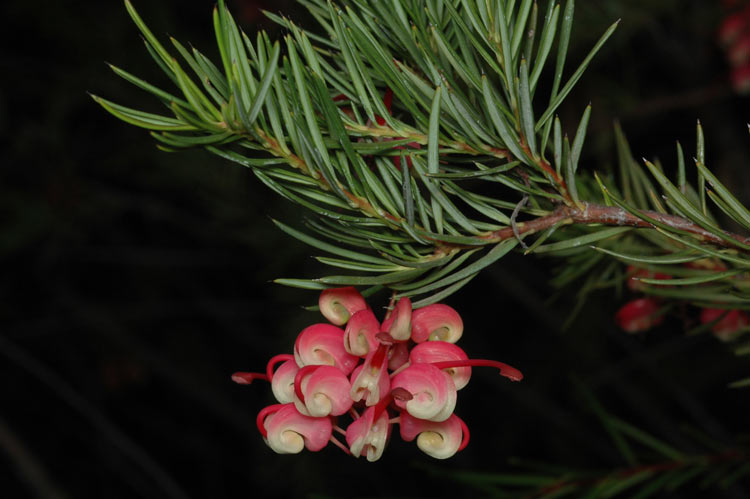
Photo: Murray Fagg, CC BY 3.0 au · source

Shrub · Proteaceae
Rosemary grevillea
Grevillea rosmarinifolia
In other languages: Grevillea (Nederlands) · Grévillée à feuilles de romarin (Français)
Grevillea rosmarinifolia comes from south-eastern Australia and is one of the hardiest species in the genus. It is a dense, evergreen shrub of 1–2 m with needle-like, dark green leaves that resemble rosemary, hence the name. From late spring into summer it carries clusters of red to pink spider-like flowers with long styles that are rich in nectar and visited by bees. The plant likes sun, acid, well-drained soil and a sheltered spot. In Flanders it is hardy to about −10 °C in a sheltered position, but needs protection in harder frosts.
Light
Full sun
warm and bright
Moisture
Dry to normal
no wet feet
Legal basis
Sand or loam
acid
Hardiness
down to -10 °C
protect in harsh winters
Size
1.5 m
tall, 1.5 m wide
Flowering
March–June
| Pruning months | June |
|---|---|
| Height | 1.5 m |
| Native to Belgium | No, planted |
| Good for bees, butterflies and birds | Yes, for bees |
| Poisonous to people and pets | Not known to be poisonous |
| Flowering | March–June |
Identify
Rosemary grevillea: how do you recognise it?
- Habit
- Dense, rounded to spreading shrub 1–2 m tall and wide, branched right down to the ground.
- Leaves
- Needle-like, 1.5–3 cm long, dark green, with a sharp tip and hairy beneath; evergreen.
- Flower
- Clusters of spider-like flowers in red to pink, with long curved styles; from March to June.
- Fruit
- Small, hard, leathery follicles containing one or two seeds.
- Roots
- Fine, shallow roots with so-called proteoid roots that take up nutrients from poor soil; very sensitive to phosphorus.
Flowering: March–June · Plants: April–May · Pruning: June
In your garden
Why grow it?
- An evergreen, finely textured shrub that gives interest all year.
- Red, spider-like flowers in spring and summer, when few other shrubs flower.
- The flowers are rich in nectar and visited by bees.
- Drought tolerant once established and undemanding.
- Lovely in a sunny, acid gravel or heather garden, as a hedge or in a large pot on the terrace.
Rosemary grevillea: where does it grow best?
- Full sun in a warm, sheltered spot, preferably against a south-facing wall.
- Acid (pH 5–6.5), well-drained sandy or loamy soil that is low in phosphorus; not suited to chalky soil.
- Dry to normal moisture: water in the first years, after that it manages in dry spells; avoid wet feet, especially in winter.
- Sheltered from cold east winds; also suitable for a large pot on a sunny terrace.
- Allow 1.2–1.5 m per plant.
- Light
- Sun
- Soil type
- Sand or loam
- Acidity
- Acid
- Moisture
- Dry or normal
- Size
- 1.5 m tall, 1.5 m wide
- Hardiness
- Half hardy (to -10 °C): protect it in harsh winters
Goes well with
- Heather: The same acid, poor soil; pink and purple beneath the red flowers.
- Bell heather: A small heath shrub that shares the same position.
- Rock rose: A low bloomer that appreciates the same dry, sunny spot.
- Sheep’s fescue: Fine blue-green grass that frames the shrub lightly.
Maintenance
Rosemary grevillea: when and how to plant it?
Plant in April–May.
- Plant in April or May, when the soil has warmed up and hard frosts are over, so the plant can root before winter.
- Dig a hole as deep as the pot and twice as wide; mix the soil with sand for better drainage.
- Take the root ball carefully out of the pot and disturb the roots as little as possible: they are sensitive.
- Set the plant at the same depth as in its pot and firm the soil; space 1.2–1.5 m apart.
- Water well after planting with rainwater, then regularly in dry weather during the first year.
- Spread a 5 cm layer of bark or pine bark around the base, keeping it clear of the stem.
Care
- Watering
- Regularly in the first year, after that only in long dry spells. Preferably use rainwater: hard tap water contains lime.
- Feeding
- Usually not needed. If you do feed, use a special low-phosphorus fertiliser and never an ordinary garden feed or a compost rich in phosphorus.
- Mulching
- A layer of bark or pine bark in spring keeps the soil cool and acid.
- In a pot
- Use acid, free-draining compost mixed with sand or perlite; repot every two to three years and preferably water with rainwater.
- Spent flowers
- Leave them or trim lightly; not necessary.
Tip: Needle-like leaves and red spider flowers in spring. Plant it in a sheltered spot in acid, well-drained soil and never give it a phosphorus-rich feed.
Rosemary grevillea: when to prune it?
Pruning months: June.
When: Straight after flowering, in June. It needs little pruning.
How:
- Lightly shorten faded branches, by about a third, to keep the shrub dense.
- Remove dead or frost-damaged branches back to healthy wood.
- Cut only into leafy wood; do not cut into bare, old wood.
Caution: Do not cut into bare wood: the shrub usually does not shoot again from it.
Propagation
- Semi-ripe cuttings
- In August–September: take 8–10 cm cuttings of semi-ripe wood and insert them in sandy, acid compost under plastic, in a bright, cool spot. Rooting takes several months.
- Seed
- The seed from the follicles germinates unevenly and gives plants that are not always identical to the parent. Sow in spring in sandy, acid soil.
Rosemary grevillea: how does it get through the winter?
Hardy to −10 °C: protect in harsh winters.
- Hardy to about −10 °C in a sheltered spot; in harder frost or cold east wind it can be damaged.
- Cover it with horticultural fleece when it drops below −5 °C and spread a layer of bark around the base in November.
- In a pot: put it in a cool, bright, frost-free room (5–10 °C) and water sparingly.
Diseases and pests
- Yellow leaves (chlorosis): Leaves turn yellow with green veins in chalky soil or with hard water. Use rainwater and acid compost.
- Root rot: The plant wilts and the leaves discolour in wet soil. Provide a free-draining spot and avoid overwatering.
- Phosphorus damage: Brown leaf edges and wilting shoots after feeding with ordinary fertiliser. Stop feeding and water generously.
- Frost damage: Brown, withered leaves after hard frost. Cut back to healthy wood in spring; the plant often recovers.
Through the year
- March: Flowering begins. Remove protective fleece.
- April: Plant or move. Check the soil is acid.
- May: Plant. Mulch. Water in dry weather.
- June: Flowering ends. Prune lightly after flowering.
- July: Water in dry weather, especially pots.
- August: Take semi-ripe cuttings.
- September: Look after cuttings. Prepare potted plants for indoors.
- October: Bring pots inside before the first frost.
- November: Top up mulch. Cover vulnerable plants.
Use
Good for wildlife
- Bees
- Nectar and pollen for honeybees and wild bees.
You and this species
Did you know?
- The genus Grevillea is named after Charles Francis Greville (1749–1809), one of the founders of the Royal Horticultural Society.
- Grevilleas belong to the Proteaceae and have special ‘proteoid’ roots that help them grow on very poor, low-phosphorus soil.
- The name rosmarinifolia means ‘with rosemary leaves’, after its needle-like foliage.