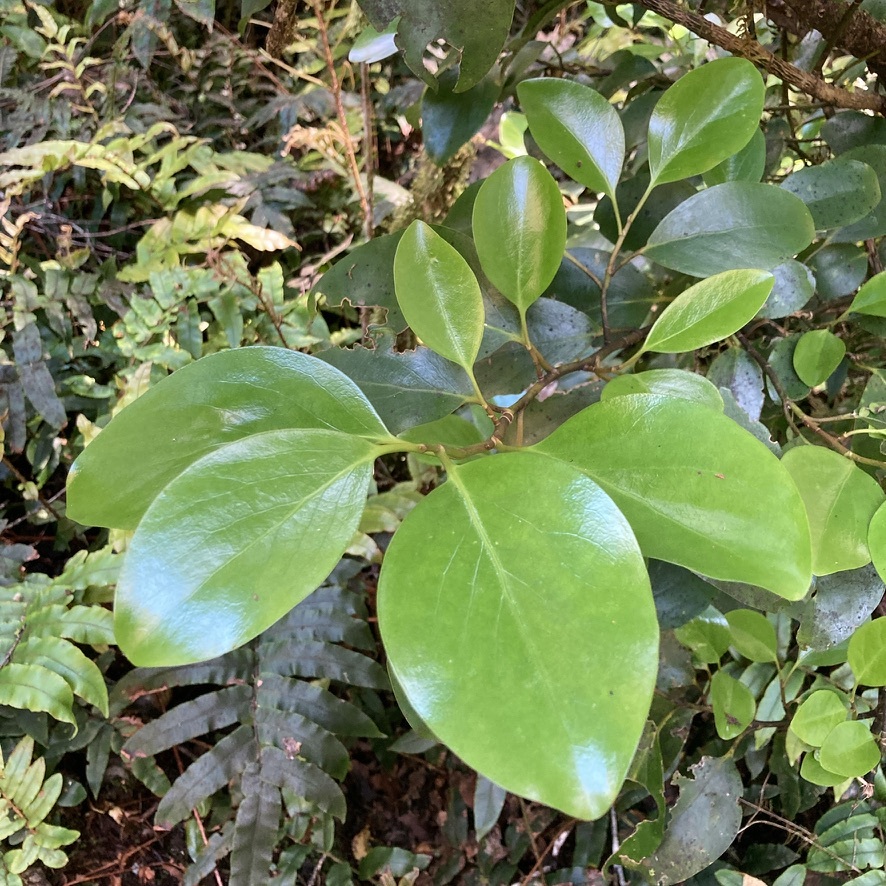
Photo: Mike Dickison, CC BY 4.0 · source

Shrub · Griseliniaceae
New Zealand broadleaf
Griselinia littoralis
In other languages: Griselinia (Nederlands) · Griselinia (Français)
New Zealand broadleaf comes from New Zealand, where it grows into a tree in the wild and is called kapuka by the Maori. In our gardens it is a dense, evergreen shrub with thick, glossy leaves in a strikingly fresh apple green. It tolerates sea wind and salt extremely well, which makes it one of the best hedging plants for coastal gardens. Inland it is vulnerable to hard frost, so plant it in a sheltered spot there. There is also a variegated form, ‘Variegata’, with cream-edged leaves.
Light
Sun or partial shade
preferably some sun
Moisture
Dry to normal
no wet feet
Legal basis
Sand, loam or clay
any pH
Hardiness
down to -10 °C
protect in harsh winters
Size
3 m
tall, 2 m wide
| Pruning months | April and June |
|---|---|
| Height | 3 m |
| Native to Belgium | No, planted |
| Poisonous to people and pets | Not known to be poisonous |
Identify
New Zealand broadleaf: how do you recognise it?
- Habit
- Dense, upright shrub 2–3 m high and about 2 m wide; a tree in the wild.
- Leaves
- Thick, leathery, oval to almost round, 4–10 cm, glossy apple green, arranged alternately.
- Twigs
- Greenish to yellow-green, giving the shrub a fresh, light look.
- Flowers
- Small, yellow-green flowers that hardly show; male and female flowers grow on separate plants.
- Fruit
- Only female plants sometimes bear small, purple-black berries.
Plants: April–May and September · Pruning: April and June
In your garden
Why grow it?
- Fresh apple green all year round: a light, cheerful hedge instead of a dark one.
- Tolerates sea wind and salt like few other hedging plants.
- Grows densely and quickly enough for a hedge of 1.5–2 m.
- No thorns and easy to trim.
- Also attractive as a free-standing shrub or in a large pot on a sheltered patio.
New Zealand broadleaf: where does it grow best?
- Sun or partial shade; on the coast even in an open, windy spot.
- Inland: sheltered from cold east and north winds, preferably against a wall or in a town garden.
- Any well-drained soil: sand, loam or clay, acid to chalky.
- Dry to moist; it does not like soil that stays wet for long.
- For a hedge, 2–3 plants per metre; as a specimen, allow 2 m of space.
- Light
- Sun and partial shade
- Soil type
- Sand, loam or clay
- Acidity
- Not fussy
- Moisture
- Dry or normal
- Size
- 3 m tall, 2 m wide
- Hardiness
- Half hardy (to -10 °C): protect it in harsh winters
Goes well with
- Ornamental grasses: Swaying stems in front of the fresh green screen, even by the sea.
- Hydrangea: Large flower heads against a light green background.
- Lavender: Silver-grey and blue for a sunny, dry edge.
- New Zealand flax: A bold focal point that, like griselinia, comes from New Zealand.
Maintenance
New Zealand broadleaf: when and how to plant it?
Plant in April–May and September.
- Plant in April–May or in September at the latest, so that it is well rooted before winter.
- Dig a hole twice as wide as the root ball; in heavy clay, plant on a slightly raised mound for better drainage.
- Mix compost into the excavated soil.
- Set the plant at the same depth as it was in the pot and firm the soil well.
- Water in generously straight away, then weekly in dry spells during the first year.
- Mulch around the base.
Care
- Watering
- Weekly in dry spells during the first year. After that it is fairly drought-tolerant.
- Feeding
- Some compost in April; no more is needed.
- Mulching
- Mulch keeps the base moist in summer and protects the roots in winter.
- In a pot
- Use a large pot with a drainage hole and free-draining potting compost. In winter, stand it against a sheltered wall.
- Frost damage
- In April, cut frosted, brown shoots back to healthy wood.
Tip: Inland, plant it against a wall or in the shelter of other shrubs, and give it time in spring: a shrub that looks brown after winter often simply shoots again.
New Zealand broadleaf: when to prune it?
Pruning months: April and June.
When: The main trim is in June. Cut out frost damage in April, once no more hard frost is expected.
How:
- Preferably use secateurs: half-cut leaves turn brown.
- Keep a hedge slightly wider at the bottom than at the top, so that it stays dense right down to the ground.
- Cut frost damage back to healthy wood; a shrub that is frosted back often shoots again from older wood.
- Do not prune after summer: new shoots need to harden off before winter.
Caution: Do not prune in autumn: soft new shoots would be killed by frost in winter.
Propagation
- Semi-ripe cuttings
- In August–September: cuttings of 10–15 cm, lower leaves removed, in moist cutting compost under plastic or in a cold frame. Overwinter them frost-free.
New Zealand broadleaf: how does it get through the winter?
Hardy to −10 °C: protect in harsh winters.
- Hardy to about −10 °C: usually no problem on the coast, but a risk inland in hard winters.
- Protect young plants in hard frost with a double layer of fleece.
- A shrub that is frosted back often shoots again from older wood: wait until April before cutting out brown branches.
- In a pot: stand it against a wall, wrap the pot in hessian and move it temporarily into a cool garage or shed in hard frost.
Diseases and pests
- Frost damage: Brown, dried-out leaves and dead twigs after a hard winter or cold east winds. Cut back to healthy wood in April.
- Root rot: Yellow leaves and a sickly plant in soil that stays wet for long. Ensure good drainage or plant on a raised mound.
- Bare base: A hedge that is wider at the top than at the bottom goes bare at the base. Trim it to a slightly tapering shape.
Through the year
- March: Leave frosted shoots in place for now.
- April: Cut out frost damage. Planting. Spread compost.
- May: Planting. Apply mulch.
- June: Trim the hedge or shrub.
- July: Water young plants in dry spells.
- August: Take semi-ripe cuttings.
- September: Last month for planting. Take cuttings.
- November: Have fleece ready for young plants.
- December: Protect young plants in hard frost.
You and this species
Did you know?
- The species name littoralis means ‘of the shore’.
- The genus is named after Francesco Griselini, an 18th-century Venetian naturalist.
- It is dioecious: male and female flowers grow on separate plants, and only female plants bear berries.