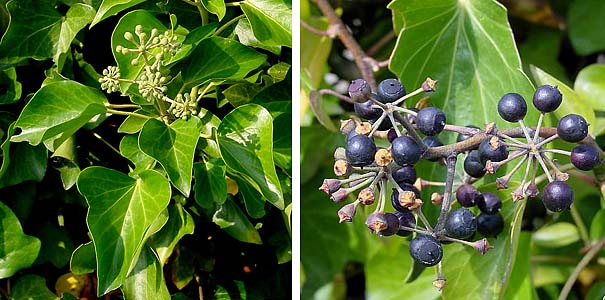
Photo: Wouterhagens at Dutch Wikipedia, CC BY-SA 3.0 · source

Climber · Araliaceae
Irish ivy
Hedera hibernica
In other languages: Ierse klimop (Nederlands) · Lierre d’Irlande (Français)
Irish ivy grows wild along the Atlantic coast of western Europe, from Ireland to the Iberian Peninsula. It looks very much like common ivy, but grows faster and has larger, glossy dark green leaves. With its aerial roots it covers a wall, fence or old tree trunk within a few years, and on the ground it forms a dense, evergreen mat. Gardeners choose it because it grows anywhere, from full sun to deep shade, and stays green all year. Its late flowers and winter berries also make it valuable for bees and birds.
Caution: The leaves and berries are poisonous if eaten and the sap can irritate the skin. Take care with young children and pets, and wear gloves when pruning. Keep it out of gutters and away from roof tiles and walls with loose mortar.
Light
Sun to shade
not fussy
Moisture
Normal
no wet feet
Legal basis
Sand, loam or clay
any pH
Hardiness
Fully hardy
down to -20 °C
Size
10 m
tall, 5 m wide
Flowering
September–November
| Pruning months | February and September |
|---|---|
| Height | 10 m |
| Native to Belgium | No, planted |
| Good for bees, butterflies and birds | Yes, for bees and birds |
| Poisonous to people and pets | Yes, take care with children and pets |
| Flowering | September–November |
Identify
Irish ivy: how do you recognise it?
- Habit
- Evergreen climber with aerial roots, up to 10 m tall and 5 m wide. Without support it creeps over the ground as ground cover.
- Leaves
- Large, leathery and glossy dark green, with three to five shallow lobes; clearly larger than those of common ivy.
- Flowering shoots
- At the top, where it can climb no further, it forms bushy shoots with unlobed, diamond-shaped leaves. Only these shoots flower.
- Flowers
- Rounded clusters of small, yellow-green flowers full of nectar, in September–November.
- Fruit
- Black berries in clusters, ripe in late winter and early spring.
Flowering: September–November · Plants: March–April and September–October · Pruning: February and September
In your garden
Why grow it?
- Quickly covers a bare wall, fence or garden wall and stays green all year.
- One of the best ground covers for deep shade, for example under trees.
- Flowers in September–November, when almost nothing else does: a last source of nectar for bees, hoverflies and butterflies.
- The black berries ripen in late winter, just when birds find little other food.
- A dense ivy wall offers nesting sites and shelter for birds and insects.
Irish ivy: where does it grow best?
- Sun, partial shade or deep shade: it grows anywhere, but the leaves look best in shade.
- Almost any soil that is not waterlogged: sand, loam or clay, acid to chalky.
- Moist; once established it copes well with drought, even under trees.
- Choose a wall in good condition, without loose mortar, and keep it away from timber cladding and gutters.
- Against a wall, plant one per metre; as ground cover, allow 3–4 plants per m².
- Light
- Sun, partial shade and shade
- Soil type
- Sand, loam or clay
- Acidity
- Not fussy
- Moisture
- Normal
- Size
- 10 m tall, 5 m wide
- Hardiness
- Hardy (to -20 °C)
Goes well with
- Ferns: Together they make an atmospheric green corner in the shade.
- Snowdrop: White among the dark green in February.
- Daffodil: Pushes up through the ivy carpet in spring.
- Lenten rose: Flowers in late winter in the same shade.
- Hosta: Large, lighter leaves against the dark ivy foliage.
Maintenance
Irish ivy: when and how to plant it?
Plant in March–April and September–October.
- Plant in March–April or September–October, when the soil is moist but not frozen.
- Dig a hole a little larger than the pot and mix in some compost. Against a wall, plant 30–40 cm out from it.
- Set the plant at the same depth as in the pot. Lean the shoots against the wall or tie them to a cane resting against it.
- As ground cover, spread the shoots over the soil and pin them down with a few hooks; they will root faster.
- Firm in and water thoroughly straight away.
- Mulch between the plants until they cover the ground; this keeps weeds down.
Care
- Watering
- Weekly in dry weather in the first year, especially against a wall or under trees. After that it looks after itself.
- Feeding
- Usually not needed. A layer of compost in spring helps a young planting get going.
- Training
- Only new shoots cling. Guide the young shoots towards the wall for the first few months.
- Checking
- Check every year that it is not creeping into gutters, under roof tiles or behind downpipes.
- Weeding
- With ground cover, weed between the plants for the first two years; after that the carpet closes.
Tip: Every February, cut it out of gutters, off roof tiles and away from windows, and never rip shoots off the wall: cut them free and let them dry out.
Irish ivy: when to prune it?
Pruning months: February and September.
When: In February, before the nesting season, and if needed again in September, once the young birds have fledged.
How:
- Cut shoots out of gutters, off roof tiles and away from windows, doors and air vents. Keep a strip of 30–50 cm clear.
- Do not rip shoots off the wall: cut them free, let them dry out and brush off the aerial roots later.
- In February, ground cover can be trimmed short with hedge shears or a mower on its highest setting.
- At the top, leave the bushy flowering shoots wherever possible: that is where the flowers and berries come.
Caution: Wear gloves and long sleeves: the sap can irritate the skin. Ivy is a favourite nesting site, so do not prune during the nesting season.
Propagation
- Cuttings
- From June to September: 10–15 cm pieces of young climbing shoots, in cutting compost or even a glass of water. They root very easily.
- Rooted shoots
- Trailing shoots root by themselves. In spring or autumn, cut off rooted pieces and replant them.
- Tree ivy
- Cuttings from the flowering shoots at the top grow into a small shrub that does not climb but does flower and fruit.
Irish ivy: how does it get through the winter?
Hardy to −20 °C.
- Hardy to about −20 °C and green all winter: no protection needed.
- In hard winters some leaves may brown in bitter wind; it regrows in spring.
- The berries ripen from January to March and are a welcome food source for blackbirds, thrushes and wood pigeons.
- In winter an ivy wall shelters birds and overwintering insects.
Diseases and pests
- Wall damage: On a wall with loose joints or soft lime mortar, the aerial roots grow into cracks. On sound brickwork this is rarely a problem; have old walls checked first.
- Gutters and roofs: Shoots creep into gutters, under roof tiles and behind woodwork. Cut it back below the roofline every year.
- Too heavy: On an old fence or a weak tree, a thick layer of ivy catches a lot of wind. Thin it or cut it back in time.
- Slow start: In the first year it hardly seems to grow, because it is making roots first. Be patient: after that it goes fast.
Through the year
- January: The berries ripen and turn black. Resting.
- February: Pruning: clear gutters, roof tiles and windows before the nesting season. Trim ground cover short.
- March: Planting. Black berries for the birds.
- April: Planting. Guide young shoots to the wall.
- June: Take cuttings. Water young plants in dry weather.
- August: Take cuttings. Water in dry weather.
- September: Planting. Another trim around windows and gutters. Flowering begins.
- October: Planting. Full flower: the wall hums with bees and hoverflies.
- November: Last flowers. Leave the flowering shoots for the berries.
- December: Green in winter. Shelter for birds.
Use
Edible and useful
Not edible. Ivy leaves and berries are poisonous: they contain saponins, which cause vomiting, stomach ache and diarrhoea if eaten, in children as well as in dogs and cats. The black berries ripen in late winter and early spring, when there are few other berries about, and on a wall or fence they sometimes hang within a child’s reach. The sap can irritate the skin, causing redness, itching and sometimes blisters, especially in people who often prune with bare hands: wear gloves and long sleeves, and wash your hands afterwards. Clear up the clippings where children or pets play. Birds, however, eat the berries without harm, and the late flowers are important for bees. If any is swallowed, call a poison centre (in Belgium 070 245 245) or your doctor at once.
Good for wildlife
- Bees
- Nectar and pollen for honeybees and wild bees.
- Birds
- Berries, seeds or insects as food, or a place to nest.
You and this species
Did you know?
- Ivy is not a parasite: its aerial roots are only for clinging. It takes water and food from the soil like any other plant.
- The ivy bee, a wild bee seen more and more often in Belgium, collects pollen almost only from ivy and flies in September–October, exactly when ivy flowers.
- Ivy has two faces: climbing shoots with lobed leaves and, at the top, bushy flowering shoots with unlobed leaves. Cuttings from those flowering shoots usually no longer climb.