Photo: Epibase, CC BY 2.5 · source

Perennial · Asparagaceae
Siebold’s plantain lily
Hosta sieboldiana
In other languages: Hartlelie (Nederlands) · Hosta de Siebold (Français)
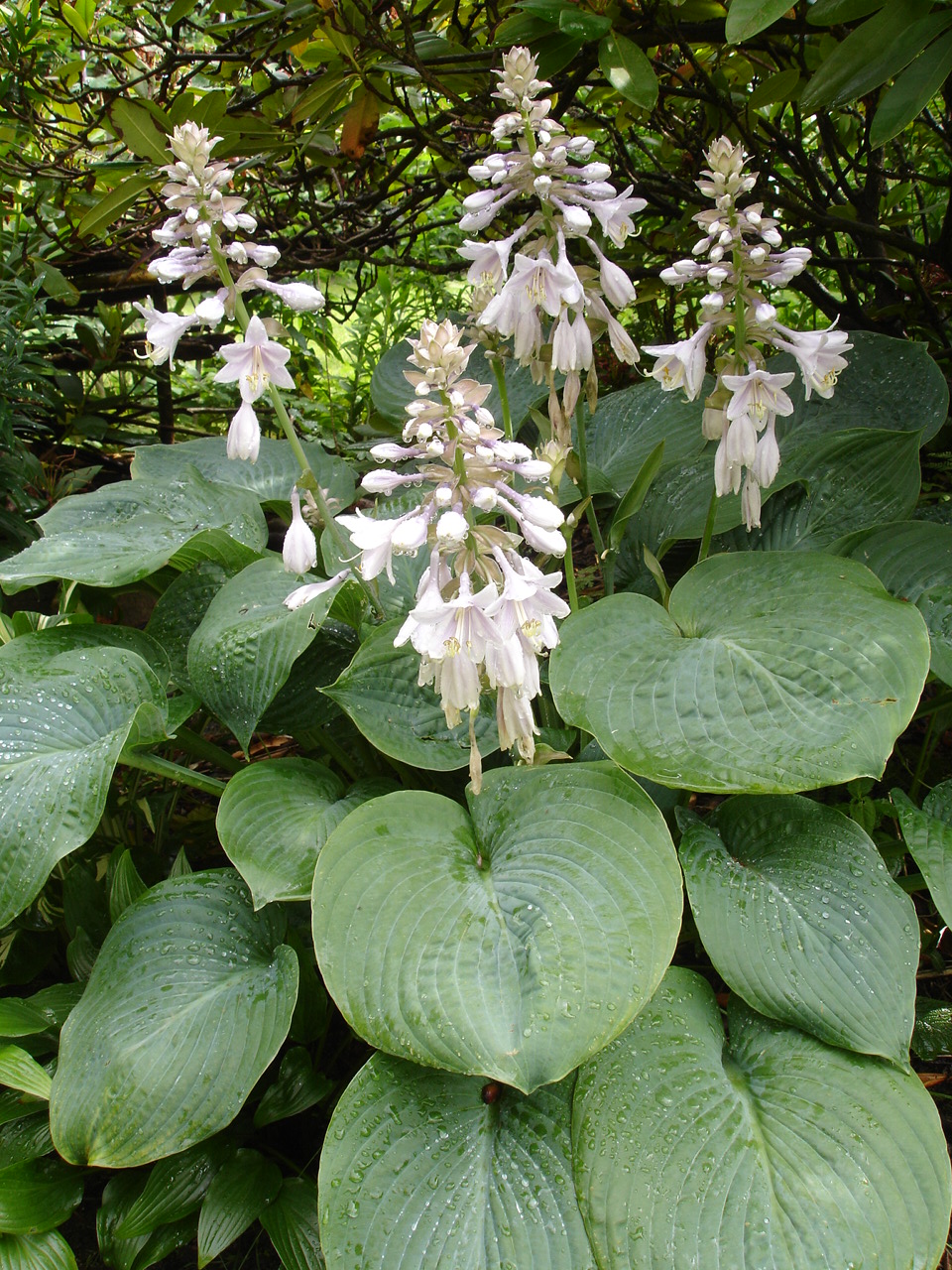
This plantain lily comes from the mountain forests of Japan and is one of the largest and finest hostas for the shade garden. It is grown for its huge, thick, heart-shaped leaves with deep veins and a puckered, almost quilted surface, covered in a blue-grey bloom. A mature clump reaches 90 cm tall and 1.2 m wide. In June–July pale lilac to white bells appear on stems just above or among the leaves. Gardeners value it because it lights up dark corners and because its thick leaves are less prone to slug damage than those of many other hostas. Well-known forms are the blue ‘Elegans’ and ‘Frances Williams’, with a broad yellow-green margin.
Caution: Toxic to dogs and cats: the leaves can cause vomiting and diarrhoea. Keep an eye on pets that like to chew plants.
Light
Partial shade or shade
tolerates little sun
Moisture
Normal to wet
must not dry out
Legal basis
Loam or clay
any pH
Hardiness
Fully hardy
down to -35 °C
Size
0.9 m
tall, 1.2 m wide
Flowering
June–July
| Pruning months | August and November |
|---|---|
| Height | 0.9 m |
| Native to Belgium | No, planted |
| Good for bees, butterflies and birds | Yes, for bees |
| Poisonous to people and pets | Yes, take care with children and pets |
| Flowering | June–July |
Identify
Siebold’s plantain lily: how do you recognise it?
- Habit
- Broad, dome-shaped clump up to 90 cm tall and 1.2 m wide; slow-growing and only full size after a few years.
- Leaves
- Very large, thick and heart-shaped, 30 cm long or more, with deep veins and a puckered surface; blue-grey bloom.
- Flowers
- Bell-shaped, pale lilac to white, in clusters on stems just above or among the leaves; June–July.
- Fruit
- Green capsules with flat, black seeds; seedlings do not always resemble the parent.
- Roots
- A dense mass of fleshy roots beneath a sturdy crown.
Flowering: June–July · Plants: March–May and September · Pruning: August and November
In your garden
Why grow it?
- An imposing foliage plant: one clump easily fills a shady corner.
- The blue-grey, puckered leaves look good from April until the first frost.
- The thick leaves are less prone to slugs than those of thin-leaved hostas.
- The lilac bells in June–July are visited by bumblebees.
- Very hardy and long-lived: a clump can stay in the same place for decades.
Siebold’s plantain lily: where does it grow best?
- Partial shade or shade; morning sun is fine, but fierce midday sun scorches the leaves and their blue wax.
- Humus-rich, moisture-retentive loam or clay, acid to chalky.
- Moist to damp: it dislikes drying out.
- Sheltered from strong wind and hail, which tear the big leaves.
- Allow at least 1–1.2 m per plant.
- Light
- Partial shade and shade
- Soil type
- Loam or clay
- Acidity
- Not fussy
- Moisture
- Normal or wet
- Size
- 0.9 m tall, 1.2 m wide
- Hardiness
- Hardy (to -35 °C)
Goes well with
- Ferns: Their fine fronds are a lovely contrast with the big blue hosta.
- Astilbe: Pink, red or white plumes in the same moist partial shade.
- Lenten rose: Flowers in winter, while the hosta is still underground.
- Japanese forest grass: A fine yellow or green grass clump at its feet.
- Smooth hydrangea: White flower heads above the blue-grey leaves.
Maintenance
Siebold’s plantain lily: when and how to plant it?
Plant in March–May and September.
- Plant in March–May or in September, when the soil is not too wet or frozen.
- Dig a generous hole and mix in a few spadefuls of compost or leaf mould.
- Set the crown 2–3 cm below the soil surface, no deeper.
- Keep at least 1 m from other plants.
- Firm in and water thoroughly.
- Spread a layer of leaf mould around the plant, but not against the crown.
Care
- Watering
- Keep the soil moist, especially in the first year and in dry summers. Water in the morning, at the base.
- Feeding
- In March–April, compost or an organic fertiliser around the clump.
- Mulching
- A layer of leaf mould in spring keeps the soil cool and moist.
- Slugs
- Protect the young shoots in April: pick off slugs in the evening and keep the ground around the clump free of debris.
- In a pot
- Grows well in a large pot of multi-purpose compost with some garden compost added; repot or refresh the compost every two to three years.
Tip: Protect the young shoots from slugs in April, even though the thick leaves are less vulnerable later: a single night of grazing can leave holes in the leaves all summer.
Siebold’s plantain lily: when to prune it?
Pruning months: August and November.
When: After flowering, in August, cut off the flower stems. Remove the leaves when they turn yellow and limp after the first frost, usually in November.
How:
- Cut spent flower stems off at the base, unless you want seed.
- In summer, cut damaged leaves off at the base.
- After the first frost, clear the yellow, limp leaves: slugs then find fewer hiding places.
- Leave the crown itself alone: that is where next year’s buds are.
Propagation
- Division
- In April, just as the shoot tips appear, or in late August–September. Cut the tough clump with a sharp spade or knife into pieces, each with a few buds and roots.
- Seed
- Possible, but seedlings grow slowly and do not always resemble the parent. Division is quicker and more reliable.
Siebold’s plantain lily: how does it get through the winter?
Hardy to −35 °C.
- Very hardy, to about −35 °C: no protection is needed in Belgium.
- It dies back in autumn and regrows in April–May; it needs the winter cold for its rest period.
- In a pot: stand the pot in a sheltered place and keep the compost on the dry side so the crown does not rot.
Diseases and pests
- Slugs: Holes in the young leaves in spring. The thick leaves are attacked less, but pick off slugs around the emerging shoots in the evening.
- Vine weevil: Half-moon notches in the leaf edges; the larvae eat the roots. Apply nematodes in spring or late summer.
- Leaf scorch: Brown, papery patches in strong sun or drought. Move it into more shade and water.
- Torn leaves: Caused by wind or hail. Cut off damaged leaves; a sheltered spot prevents it.
- Virus: Mottled or distorted leaves with discoloured streaks along the veins may point to a virus. Put the plant in the household waste and disinfect your knife.
Through the year
- March: Spread compost or leaf mould around the clump.
- April: Shoots emerge: pick off slugs. Plant or divide.
- May: The leaves unfurl. Planting is still possible. Water in dry spells.
- June: Flowering begins. Water in dry spells.
- July: Flowering. Bumblebees on the bells.
- August: Cut off spent flower stems. Water in dry spells.
- September: Plant or divide.
- October: The leaves turn yellow.
- November: Clear the yellow, limp leaves after the first frost.
Use
Edible and useful
Not edible. Hostas are poisonous to dogs, cats and horses: the leaves contain saponins, which cause vomiting, diarrhoea and lethargy when chewed. In Japan the young shoots of some hostas are cooked as a vegetable, but do not let children eat the leaves or flowers, and do not use your garden hostas in the kitchen. Dogs like to dig in the cool soil under the large leaves and young dogs chew the emerging shoots: clear up cut and dead leaves straight away, and do not give them to rabbits or guinea pigs. Call your vet if an animal has eaten a lot. If any is swallowed, call a poison centre (in Belgium 070 245 245) or your doctor at once.
Good for wildlife
- Bees
- Nectar and pollen for honeybees and wild bees.
You and this species
Did you know?
- The blue colour comes from a waxy coating on the leaves. In summer, in more sun or when handled, it wears off and the leaves turn greener.
- The species name honours Philipp Franz von Siebold, a German physician who worked for the Dutch in Japan and brought many Japanese plants to Europe.
- The genus Hosta is named after the Austrian physician and botanist Nicolaus Thomas Host.